Description
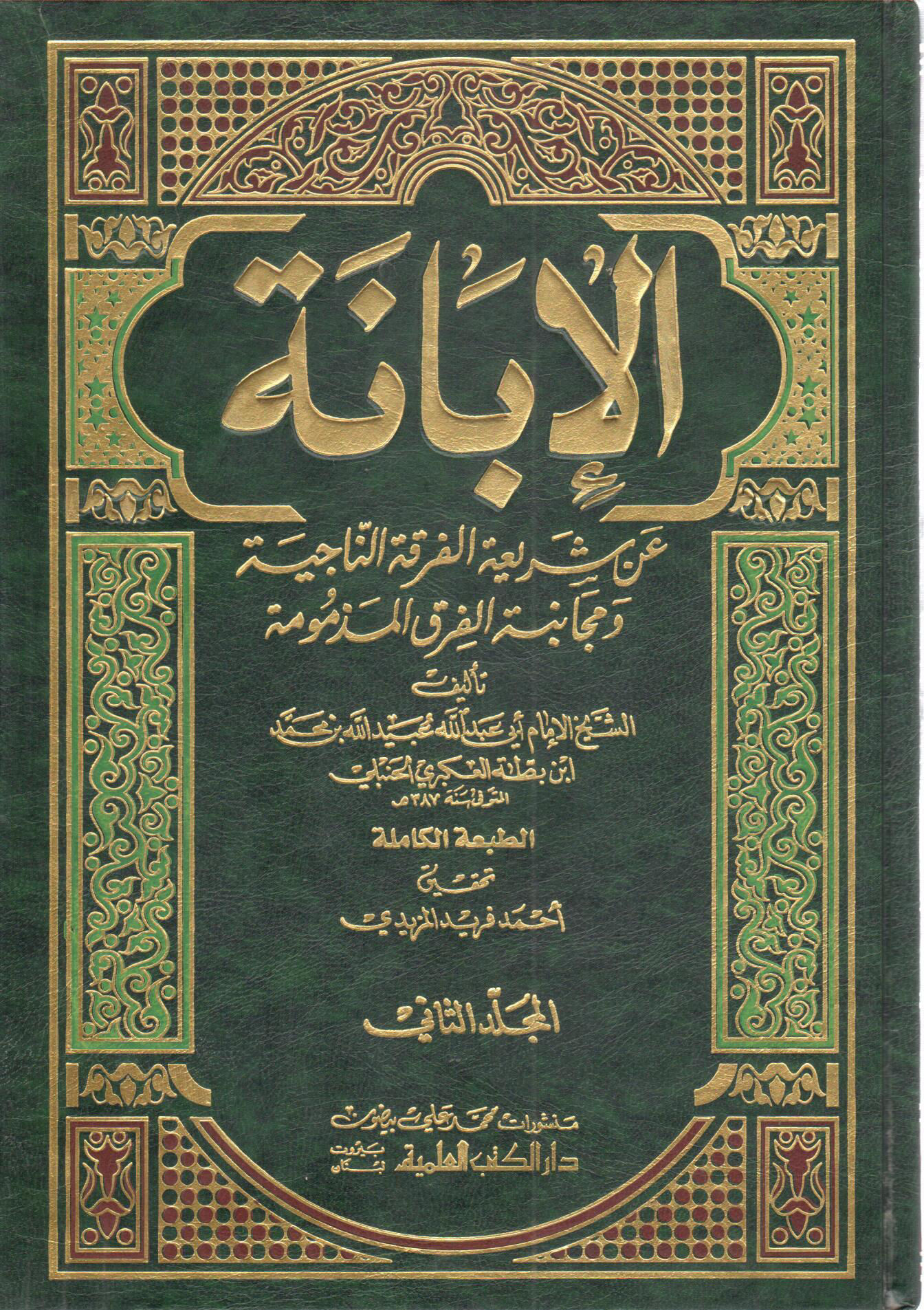
Book description:
-
Author's name: Abu Abdullah Ubaydallah Ubaydallah ibn Muhammad ibn Batta ibn al-Akbari al-Hanbali
-
Number of pages: 3990 pages
-
The subject of the book: The Shari'ah of the Survival Teams
The contents of the book:
Book I: Faith
Volume I
Introduction
A chapter mentioning the news and relics that prompted us to collect and compose this book, the Sheikh said: ”I ask Allah to help us to say the right thing and do the right thing, and I ask Him to protect us from missteps, and to make what He helps us to do connect us to Him, and make what we have learned a proof for us, and a blessing for us and for those who know us.
The chapter on obedience to the Messenger of Allah, may Allah bless him and grant him peace: Allah, the Almighty, sent Muhammad (peace be upon him) as a mercy to the world, a dominant figure among the prophets, and a warning between the hands of a severe torment with a book whose verses are well-written and whose proofs are detailed, so that no falsehood can come from between its two hands.
The chapter mentioning what the Sunnah says about obeying the Messenger of Allah (Sallallahu Alaihi Wasallam) and warning against sects who oppose the Sunnah of the Messenger of Allah (Sallallahu Alaihi Wasallam) with the Qur'an: ”Let the believers of reason and knowledge know that there are those who want to abolish the Shari'ah and teach the monuments of knowledge and Sunnah, and they deceive those who are less knowledgeable.
The chapter on what the Book of Revelation explicitly states about the obligation to remain in congregation and the prohibition against disunity: My brothers and sisters, may Allah guide us and you to goodness and unity, and protect us and you from dispersion and disagreement, know that Allah, the Almighty, has informed us of the differences of the past nations before us, and that they were scattered and disagreed with each other.
The chapter on what the Prophet (peace and blessings of Allah be upon him) commanded about keeping the congregation and warning against disunity
The chapter on the command to adhere to the Sunnah and the Jama'ah, and the virtue of those who adhere to it.
The chapter mentioning the dispersion of the nations in their religion and how this Ummah will be dispersed and the Prophet (peace be upon him) telling us about it: ”In the beginning of this book, I mentioned what Allah Almighty has narrated to us in His Book about the dispersion of nations and the dispersion of the People of the Book, and His warning to us against it.
The door of leaving the question of what is not useful, searching and digging for what is not harmful to be ignorant of, and warning against people who go deep into matters and deliberately introduce doubts to Muslims The Shaykh said: ”Know my brethren that I thought about the reason that took people out of Sunnah and Jama'ah, forced them into heresy and heinousness, and opened the door of
Volume II
I have informed you, my brother - may Allah protect me and you from temptation, and prevent us and you from all misfortunes - that what has made hearts sick, and caused them to doubt after they have been pious, is searching and inquiring, and asking too much about what is not safe, and the wise have had enough.
The chapter denouncing argumentation and disputes in religion, and warning against people who argue and talk
The chapter warning against listening to the words of people who want to undermine Islam and erase its laws, so they do so by slandering the Muslim jurists and faulting them for disagreement If someone says: "I have mentioned the Prophet's prohibition against disunity and his exhortation to his Ummah to do so: I have mentioned the Prophet's prohibition against division, his warning to his Ummah about it, and his exhortation for them to unite and adhere to the Sunnah, and I have said
The chapter where the Prophet (peace be upon him) informs his Ummah of the path of the nations before them, and warns them against it
The chapter on the Prophet (peace be upon him) informing his Ummah of the ongoing temptations, ordering them to stay in their homes, preferring to stay indoors, telling the wise to stay in their homes, fearing for their hearts from following their whims, and guarding their tongues and their religions.
The chapter in which the Prophet (peace be upon him) warns his Ummah about people who argue with the similarities of the Qur'an and what people should be wary of.
The prohibition against quibbling in the Qur'an
Praise be to Allah, the Lord of the Worlds, the Merciful, the Compassionate, the Merciful, the Compassionate, the Owner of the Day of Judgment, who is our Lord and through Him we ask Him to guide us to the Straight Path, which He has bestowed upon them with the guidance of the Qur'an, so they follow it.
The chapter on the day on which this verse was revealed
The chapter on knowing Islam and how it was built
The chapter on the knowledge of Islam and faith and Gabriel's question to the Prophet (peace and blessings of Allah be upon him)
A chapter on the virtues of faith, how many divisions it has, and the morals and qualities of believers
The chapter on the disbelief of those who forsake prayer and those who withhold zakat, and the permissibility of fighting and killing them if they do so
A chapter mentioning actions and words that lead to hypocrisy, and the signs of hypocrites
The chapter that mentions the sins for which one who commits them loses faith, but if he repents, he regains it
The chapter on sins that lead to disbelief that is not outside the faith
Bab: Faith is a fear and hope, and reasonable believers fear for themselves the loss of faith and fear hypocrisy for those who believe in it. This is what the Qur'an says, and the Sunnah says. Allah, the Almighty, said: These are those who pray to their Lord, seeking the way closer to Him, hoping for His mercy and fearing His punishment. And He said
The chapter explaining faith and its duties, and that it is a belief in the heart, a confession with the tongue, and action with the limbs and movements; a slave cannot be a believer without these three. The Sheikh said: Know, may Allah have mercy on you, that Allah, may His name be exalted, has imposed on the heart knowledge of Him, and belief in Him, His messengers, His books, and all that He has revealed.
Allah, the Almighty, has said: And He has preached to those who believe and do righteous deeds that they will have gardens from which rivers flow beneath them, and whenever they have a portion of fruit, they will say, "This is what we had before." The verse. And God Almighty said: Those who believe and do righteous deeds and establish
The Chapter on the Increase and Decrease of Faith, and the Evidence of the Virtuous and the Vulnerable Know, may Allah have mercy on you, that Allah, the Almighty, has favored faith on those whom He has predestined for mercy in His Book, and those whom He loves to make happy, and then made the believers in faith differentiated, and raised some of them above others in degrees, and then made them increase and strengthen them.
The door of the exclusion of faith The Shaykh said: May Allah have mercy on us and you, know that it is a characteristic of the believers and their qualities that they have faith, are always concerned about their faith, and are very cautious about their religions, ,
The chapter on asking another person, "Are you a believer?" and how to answer him, and the dislike of the scholars for this question and the heresy of the questioner
The chapter on the Marja'iyah, what has been narrated about them, and the scholars' denial of their bad doctrines
Book II: Destiny
Volume I
Bootstrap
Chapter One: Believing in Fate
Chapter Two The eternity of fate
Chapter Three The inclusion of divine destiny in all the actions of the servants and the necessity of its fulfillment
Chapter Four: The eternal knowledge of the people of Paradise and Hell and their appointment and judgment
Chapter Five: Recognizing Guidance and Misdirection
Chapter Six: God's seal and stamp on the hearts of His servants who go astray
Chapter Seven The Subordination of Human Will to Divine Will
Chapter Eight: The Faith of the Companions and Later Salafists in Destiny
Chapter Nine: Answering Qadiriyyah and explaining their judgment in this world and their reward in the hereafter
Chapter 10 The prohibition against researching fate
Introduction
The first chapter is the mention of what Allah Almighty told us in His Book that He sealed the hearts of those whom He willed of His servants so that they would not be guided to the truth, nor would they hear it or see it, and that He stamped on their hearts, Allah said, "Those who disbelieve, whether you warn them or not, they will not believe.
In the second chapter, Allah informs us in His Book that He leads astray whomever He wills and guides whomever He wills, and that no one is guided by messengers, books, signs, and proofs except those whom He has already foreseen that He will guide them.
The third chapter: Allah has told us that He sent messengers to people to call them to worship the Lord of the Worlds and then sent demons to the disbelievers to incite them to disbelieve the messengers, and whoever denies this is one of the perishing sects. The Sheikh said: It is obligatory for Muslims to believe and believe that
The fourth chapter is about what Allah Almighty has informed us that the will of creation is dependent on His will and that creation can only will what Allah Almighty wills. Allah Almighty said, "People were one nation, so Allah sent the prophets as heralds and warners, and Allah guides whomever He wills to a straight path. If Allah had willed it, they would not have fought
The fifth chapter on what is narrated that Allah created His creation as He willed for what He willed, whoever He willed created him for heaven and whoever He willed created him for hell, His knowledge preceded this, His judgment was executed, His pen was executed, and whoever denies it is among the perishing sects, and whoever denies it is among the perishing sects.
The sixth chapter on believing that Allah took Adam's offspring from their backs and made them into two groups, one for heaven and one for hell.
The seventh chapter is about believing that Allah, the Almighty, decreed the destinies before He created the heavens and the earth, and whoever disagrees with this is one of the perishing sects.
The eighth chapter is the belief that Allah created the pen and said: "Write," and He wrote what is to be, and whoever disagrees with it is one of the perishing sects, and whoever disagrees with it is one of the perishing sects.
Volume II
The chapter on believing that Allah wrote Adam's sin before He created him, and whoever rejects this is one of the perishing sects.
The chapter on believing that whoever is happy or unhappy is happy or unhappy in his mother's womb, and whoever rejects this is one of the perishing sects.
The chapter on believing that if Allah, the Almighty, decides that a sperm is created, it will be, even if its owner is alienated, and whoever rejects this is one of the perishing sects.
The chapter on believing that no one's faith is valid, and no one is a believer until he believes in the good and evil of fate, and that the one who disbelieves this, if he dies in it, will go to hell, and those who disbelieve this are among the perishing sects.
The chapter on believing that the devil is a creature that has power over human beings and runs through them like blood, except for those whom Allah protects from him, and whoever denies this is one of the perishing sects.
The chapter on believing that every child is born on the natural way and the offspring of polytheists
Chapter on those who disbelieve in fate
The chapter on what was narrated about this from the Companions, and their doctrine on fate, may Allah have mercy on them Abu Bakr al-Siddiq (may Allah be pleased with him).
Chapter on what was narrated from 'Umar ibn al-Khattab (may Allah be pleased with him)
A chapter narrated from the Commander of the Faithful, Ali ibn Abi Talib (may Allah be pleased with him)
Son of Omar
Ibn Abbas
Abdullah ibn Amr and Ibn Umar
A chapter about what was narrated about believing in fate and believing in it from a group of followers. Know, may Allah have mercy on you, that the Qadiriya deny Allah's judgment and fate, and deny His knowledge and will, and they have no book to believe in, no prophet to follow, and no scholar to follow, but they come up with what they have invented.
What was narrated from Mutrif ibn Abdullah ibn al-Shakhir
Chapter on Ibn Sirin
Saeed bin Jubair
Mujahid
Muhammad ibn Ka'ab al-Qurzi
Wahab ibn Minbah
Taus Al-Yamani
Makhoul
Ikrima, Ataa, Qadada, and a group of followers
Section II
Umar ibn Abdulaziz's doctrine on fate and his behavior toward the Qadiris
Letter of Abdulaziz ibn Abi Salama al-Majshoon
Section III
A chapter on what has been narrated from a group of Muslim jurists and their doctrine on fate
Ozai
Section I
A comprehensive chapter on destiny and what has been narrated about its inhabitants
Talk of the Phoenix
Section II
A mention of the misguided imams who initiated the discourse on fate, and the first one who created it and called for it
What he commanded people to avoid researching, debating, and arguing about destiny
Book III: Answering the Jahmiyyah
Volume I
The chapter on what the text of the Qur'an states that it is the word of God
The chapter on what the Sunnah says about the Prophet (peace be upon him) and his companions that the Qur'an is the word of God
The chapter on believing that the Qur'an is the uncreated word of God, contrary to the sect that stood in doubt and said: "We don't say that the Qur'an is created: Created, nor: uncreated
Know, may Allah have mercy on you, that a group of Jahmiyyah believed, through the cunning of their hearts, the malice of their opinions, and the ugliness of their passions, that the Qur'an was created, so they disguised this with a heresy they invented, to disguise their disbelief and to obscure their atheism for those who are less knowledgeable.
Door
Explaining the disbelief of a sect of Jahmiyyah who claimed that the Qur'an is not in the chests of men
Volume II
The chapter of the clear argument that the Qur'an is the word of God and not created from the sayings of the followers, the jurists of the Muslims, the substitutes and the righteous, may Allah have mercy on them all, and the disbelief of those who say that the Qur'an is created, and the statement of his apostasy and heresy (apostasy).
The chapter explaining their disbelief, misguidedness, and the permissibility of killing them
The chapter on the permissibility of killing them and prohibiting their inheritance to their family of Muslims
A chapter on what was narrated about Jahm and his misguided followers, and the ugly things they said.
The chapter explaining the disbelief of the Jahmiyyah, whose hearts were turned away by what they interpreted from the similarities of the Qur'an.
Chapter mentioning the debates of the examinees at the hands of the mighty kings who invited people to this delusion
Abdulaziz ibn Yahya al-Makki's debate with Bishr ibn Ghiyath al-Marisi in the presence of al-Ma'mun
The chapter on the ordeal of Abu Abdullah Ahmad ibn Muhammad ibn Hanbal, may Allah have mercy on him, and his argument with Ibn Abi Dawaad and his companions in the presence of al-Mu'tasim.
A chapter mentioning the ordeal of a sheikh from the people of Athanah in the presence of Al-Wathiq, and Al-Wathiq's reversal of his doctrine
I transferred it from the books of some of the sheikhs of our town, and wrote it from the original of his book, which is more complete than this one and more thorough in its arguments, so I repeated it for the place of increase
Chapter on Ibn al-Shaham's Debate with al-Wathiq
Chapter on Debating Another Man in the Presence of Al-Mu'tasim
Chapter on the Debate of Al-Abbas ibn Musa ibn Mishkweh al-Hamdani in the presence of al-Wathiq
Chapter on those who claim that faith is created
The chapter on believing that Allah spoke to Moses, and the disbelief of those who deny it. Know, may Allah have mercy on you, that whoever claims that he is on the path of Abraham and the religion of Muhammad, may Allah bless him and grant him peace, and that he is among the people of the law of Islam, and then denies that Allah spoke to Moses, has invalidated his claim to the religion of Islam and has lied in his statement.
Volume III
The chapter on believing that the believers see their Lord on the Day of Resurrection with the sight of their heads, and He speaks to them and they speak to Him, without a barrier between Him and them or an interpreter.
The narration of Jarir bin Abdullah al-Bijli from the Prophet (peace be upon him)
Abu Huraira's narration
Khederi
Abu Razin al-Aqili
Son of Omar
Uday bin Hatim
Buraida Al-Aslami
Abu Musa al-Ash'ari
Anas bin Malik
Hudhayfah ibn al-Yaman
Jaber ibn Abdullah
Aisha (may Allah be pleased with her)
Zaid bin Thabit
Ibn Abbas
A group of followers of Umar ibn Abdul Aziz: He wrote to some of the soldiers: After: ”I recommend you to fear Allah, to obey Him, to adhere to His command, and to pledge yourself to what Allah has charged you with from His religion and memorized from His Book, for it is by fearing Allah that the guardians of Allah are saved from His displeasure, by which they are entitled to His guardianship, and by which they
Abdulaziz ibn Abdullah al-Majshun's Treatise on Vision
Hadith of the Toba Tree, the description of Paradise and its market
The chapter on believing that Allah laughs said the Sheikh: Know, may Allah have mercy on you, that one of the characteristics of the believers among the people of truth is to believe the true verses, to receive them with acceptance, and to refrain from objecting to them by analogy, and to oppose the saying with opinions and whims, for faith is belief, and the believer is the one who believes, as Allah, the Almighty and Glorious, said
The chapter on believing that Allah, the Almighty, hears and sees, and explaining the disbelief of the Jahmiyyah in their denial of the Book and the Sunnah: Know, may Allah have mercy on you, that the sects of Jahmiyyah and Mu'tazila deny that Allah hears and sees, and they said that it is not possible for Him to hear and see except with hearing, sight, and instruments, and they claimed that whoever says that Allah hears
The chapter on believing that Allah Almighty is angry, pleased, loving and hating: He claims that Allah does not get angry, does not get satisfied, does not love or hate, but he wants to deny the attributes and deny them in order to deny the one who is characterized by them. And Allah
The Jahmiyyah said: Allah says: "Indeed, I marvel and they scoff." This is how Ibn Mas'ud read it, and it was said to Ibrahim: Ibrahim was told that Shariha read it: I marveled, he said: Ibn Mas'ud is more knowledgeable than Shurayh, and the exclamation has two faces: One of them is love
The chapter on the belief that Allah is on His throne, far from His creation, and His knowledge is all-encompassing, and the Muslims of the Companions and followers, and all the knowledgeable people of the believers, are unanimous that Allah is on His throne, above His heavens, far from His creation, and His knowledge is all-encompassing, without denying it, except those who deny it or deny it.
Know, may Allah have mercy on you, that the Jahmiyyah deny that Allah has a throne and say: "We do not say that Allah is on the throne because it is greater than the throne: Allah is on the throne because He is greater than the throne, and once we admit that He is on the throne, we have defined it, and many places other than the throne are devoid of Him.
The door of believing and believing that Allah descends every night to the lower heavens without going away or how The Shaykh, may Allah have mercy on him, said: Know, may Allah have mercy on you, that Allah has made it obligatory for His believing servants to obey His Messenger, may Allah bless him and grant him peace, to accept what he has said and reported, and to believe in everything that has been reported about him.
Narrated by Abu Huraira and Abu Said al-Khudri
Ibn Masud
Rifa'ah ibn Arrabah al-Juhani
Abu al-Darda
Ali ibn Abi Talib
Amr ibn Absa
Abu Bakr al-Siddiq
Aisha
Arafat Day
The Night of Ashura and others from the followers
The chapter on believing that Allah Almighty created Adam in His own image without any form, the Shaykh said: It is obligatory for Muslims to accept them, believe them, submit to them, and refrain from objecting to them, and it is obligatory for those who accept them and believe them not to strike
The door to believing that the hearts of the servants are between two fingers of the Almighty God without knowing how
The chapter on believing and believing in what was narrated that Allah places the heavens on a finger and the earth on a finger.
The chapter on believing in what was narrated that Allah, the Almighty, holds the earth in His hand and folds the heavens with His right hand.
The chapter on believing that Allah, the Almighty, takes charity with His right hand and raises it for the believer
The chapter on believing that God Almighty has two hands, and both of his hands are right hands
The chapter on believing that Allah created Adam with His own hand, the Garden of Eden with His own hand, and before the throne and the pen
The chapter on believing that Allah is Hearing and Seeing, in response to what the unbelieving Mu'tazilites deny, the Shaykh said: The Jahmiyyah deny that Allah has hearing and sight: The Sheikh said: The meaning of His saying: Hearing and seeing is that nothing is hidden from Him, as you say to the blind man: The Sheikh said: "The meaning of the saying: 'He hears and sees' is that nothing is hidden from Him, as when you say to a blind person
The chapter on believing that Allah does not sleep
A comprehensive chapter of the hadiths of the attributes narrated by the Imams and trusted sheikhs, believing in them is from the perfection of Sunnah and the perfection of religion, and no one denies them except a malicious Jahmiyyah.
Book IV: Virtues of the Companions
Volume I
Chapter on the Caliphate of Uthman ibn Affan, Commander of the Faithful (may Allah be pleased with him)
Chapter on the Caliphate of Amir al-Mu'minin, Ali ibn Abi Talib (may Allah be pleased with him)
The chapter on Ali ibn Abi Talib (may Allah be pleased with him) following the sunnahs of Abu Bakr, 'Umar and 'Uthman (may Allah be pleased with them) during the days of his caliphate and following each other.
Volume II
The chapter mentioning that Abu Bakr (may Allah be pleased with him) believed the Prophet (peace be upon him) and that Abu Bakr was the first to become a Muslim.
The chapter mentioning those who became Muslim at the hands of Abu Bakr from the former Companions, may Allah have mercy on them.
Abu Bakr (may Allah have mercy on him) rescued the women and slaves who were being tortured for the sake of Allah and bought them with his money and freed them for Allah, but he did not take their loyalty.
Bab the story of Abu Bakr with the Prophet (peace be upon him) in the cave
The chapter in which the Prophet (peace and blessings of Allah be upon him) said to Abu Bakr while they were in the cave, "What do you think of two people, Allah is their third?
Chapter {Allah sent down His peace upon him}
A chapter stating that Allah chastised the entire creation in His Prophet except for Abu Bakr (may Allah be pleased with him).
Chapter on the reason why Abu Bakr al-Siddiq was named Abu Bakr al-Siddiq
The chapter on Abu Bakr's patience with the Messenger of Allah (peace be upon him) in the matter of Allah and his migration with the Messenger of Allah (peace be upon him)
The chapter on Abu Bakr's migration with the Prophet (peace and blessings be upon him) and that he was the first to migrate with him and his companions.
The chapter about Abu Bakr consoling the Prophet (peace and blessings of Allah be upon him) with his wealth and spending it to please Allah and His Messenger (peace and blessings of Allah be upon him).
The chapter on the Prophet's specialty with Abu Bakr and his saying, "If I had a boyfriend, I would have taken Abu Bakr.
The chapter about Abu Bakr paying the Prophet's debts and fulfilling his promises after his death
A chapter that states that everyone is called on the Day of Judgment from one of the gates of Paradise by his deeds, and that Abu Bakr is called from all eight gates of Paradise.
The chapter on the Prophet's love for Abu Bakr and the fact that he was the most beloved person to him
The chapter on Allah's love for Abu Bakr and Abu Bakr's love for Allah in the Book of Allah
The chapter mentioning that Abu Bakr, may Allah have mercy on him, was ahead of all the Companions during the life of the Prophet (peace and blessings of Allah be upon him).
The chapter on Abu Bakr praying with the people during the life of the Messenger of Allah (peace and blessings of Allah be upon him) and the Prophet (peace and blessings of Allah be upon him) behind him
The chapter on the Prophet's order to close the doors of the mosque, except for Abu Bakr's door, may Allah be pleased with him
The Prophet (peace and blessings of Allah be upon him) said, "The sun never rose or set on anyone after the prophets and messengers who is better than Abu Bakr al-Siddiq (may Allah be pleased with him).
The chapter mentioning the faith with which Abu Bakr, may Allah have mercy on him, was singled out
The chapter on Umar ibn al-Khattab's preference for Abu Bakr (may Allah be pleased with him)
The chapter on Allah's favor to the Ummah of Muhammad (peace and blessings of Allah be upon him) through the succession of Abu Bakr and his rise in the apostasy
Also browse: