

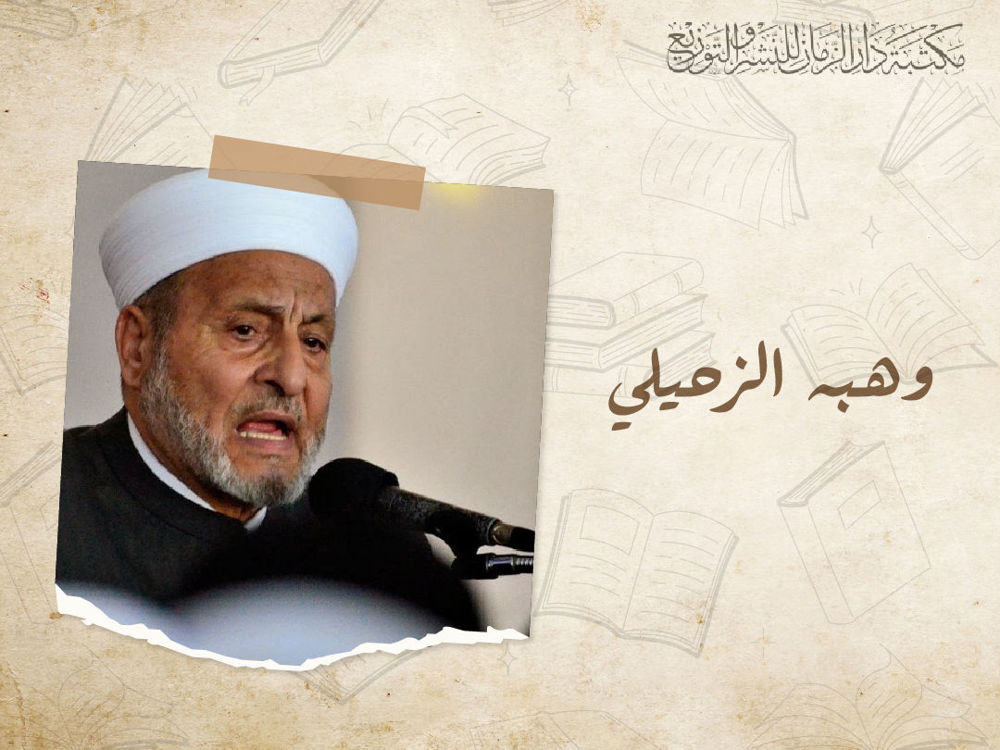
As an introduction, we would like to say that in the history of Islam, the contributions of its scholars stand out prominently, making important contributions in the fields of science and religion. Islamic scholars played a vital role in understanding and interpreting the Qur'an and the Hadith, and contributed significantly to the development of Islamic sciences such as jurisprudence, tafsir, and hadith. Thanks to their contributions, Islamic thought developed, scholarly schools flourished, and they contributed to building the foundations of justice and morality in Islamic societies. They are considered sources of inspiration for Muslims, providing a model of dedication to the search for truth and the development of knowledge. One scholar who has contributed greatly to Islam is Wahba al-Zuhaili. We will talk about him in this article, so stay tuned.
Who is Wahba al-Zuhaili?
Wahba al-Zuhaili was born in the town of Deir Atiyah near Damascus in 1932. His father was a memorizer of the Holy Quran and a determined man in his business, devoted to the Prophetic Sunnah, and lived a busy life between agriculture and commerce.
His married life
His married life was filled with five children, all of whom completed their university education, except for the last one, who dropped out in the middle of his studies.
His educational journey
Wahba Al-Zuhaili's scientific journey began with his primary studies in his hometown, then moved on to the secondary stage at the Sharia College in Damascus, where he topped the list by excelling and obtaining first place in all students of the Sharia High School in 1952. He also obtained the high school with its literary branch.
He continued his scientific journey at Al-Azhar's College of Shari'ah, where he obtained a high degree and excelled in it in 1956. He then obtained a teaching license from the College of Arabic Language at Al-Azhar, which made him possess a teaching certificate.
He continued his studies in law sciences and obtained a Bachelor of Laws degree from Ain Shams University with a good grade in 1957. He obtained a master's degree from the Institute of Sharia at the Faculty of Law at Cairo University in 1959, and obtained a doctorate in law (Islamic law) in 1963 with first honors with a recommendation to exchange the thesis with foreign universities.
He started his teaching career, as he was appointed as a teacher at Damascus University in 1963 and rose in rank until he became a professor in 1975. He exerted great effort in teaching, writing, and mentoring, giving public and private lectures, devoting his day to work for 16 hours.
Wahba Al-Zuhaili's Scientific Specialty
In the field of Jurisprudence and Fundamentals of Jurisprudence, he offers rigorous teaching at Damascus University, where he specializes in these two branches, in addition to teaching comparative jurisprudence. He lectures at the Faculty of Shari'ah and supervises the courses of Fiqh and Usul al-Fiqh, while lecturing in Shari'ah courses at the Faculty of Law.
He devotes his attention to graduate studies in these fields, keeping him busy with mentoring and scientific research. By framing the jurisprudence and theology courses, he seeks to accurately convey knowledge and deepen students' understanding of these sciences.
His teachers, professors and students
Dr. Wahba Al-Zuhaili's sheikhs are numerous, including sheikhs from Damascus and Egypt.
Among his sheikhs from Damascus
His sheikhs in Damascus hint at the diversity of his education and religious enlightenment. This diversity includes prestigious sheikhs such as Sheikh Mahmoud Yassin in hadith, Sheikh Mahmoud al-Rankousi in doctrine, and Sheikh Hassan al-Shati in fardh.
His influences extend to Shafi'i jurisprudence through Sheikh Hashim al-Khatib, and to the fundamentals of jurisprudence and hadith terminology through Sheikh Lotfi al-Fayoumi. The list also includes notable figures such as Sheikh Ahmed al-Samak in tajweed, and Sheikh Hamdi Joyjati in recitation sciences.
His legacy is not only religious, but also includes scholars in language, literature, and history, with notable figures such as Sheikh Hassan Habankah and Sheikh Sadiq Habankah al-Madani in the science of tafsir, and Sheikh Saleh al-Farfour in Arabic language sciences.
The interest in modern education and science is demonstrated by figures such as Dr. Nazim Mahmoud Nasimi and Maher Hamada in legislation, as well as the presence of scientists in chemistry, physics and English. In literature, Mr. Nassib Saad, may God have mercy on him, is mentioned as one of the prominent figures.
Thus, he has a diverse group of professors and scholars who have influenced different areas of science and education.
Among his Egyptian sheikhs
Imam Mahmoud Shaltout as the Sheikh of Al-Azhar, Imam Dr. Abdel Rahman Taj, Sheikh Issa Menoun, Dean of the Faculty of Sharia, Sheikh Jad al-Rab Ramadan in Shafi'i jurisprudence, and Mahmoud Abdel Dayem in Shafi'i jurisprudence, stand out as a unique reference for science and education.
Sheikh Mustafa Abdul Khaliq, his brother Sheikh Abdul Ghani Abdul Khaliq, Sheikh Othman al-Maraziqi, Sheikh Hassan Wahdan, Sheikh al-Zawahiri al-Shafi'i, and Mustafa Mujahid. In the jurisprudence of worship, Sheikh Muhammad Ali al-Zoabi appears.
At Ain Shams University, he refers to the sheikhs and professors who helped shape his academic path, such as Sheikh Issawi Ahmed Issawi, Zaki al-Din Shaaban, Abdel Moneim al-Badrawi, Osman Khalil, Suleiman al-Tamawi, Ali Rashid, Helmy Murad, Yahya al-Jamal, Ali Younis, Mohamed Ali Imam, Aktham al-Khouli, and others.
These scholars and professors constitute a rich and diverse educational composition that contributed to the overall development of his scientific and practical career.
Among his disciples
Dr. Muhammad al-Zuhaili, his brother, Dr. Muhammad Farouk Hamada, Dr. Muhammad Naim Yassin, Dr. Abdul Sattar Abu Ghada, Dr. Abdul Latif Farfour, Dr. Muhammad Abu Lail, Dr. Abdul Salam Abadi, Dr. Muhammad al-Sherbaji, Dr. Majid Abu Rakhiya, Dr. Badie al-Sayyid al-Lahham, Dr. Hamza Hamza, and other professors at the University's Faculty of Sharia and hundreds of religious education teachers at the Ministry of Education.
More than 40 generations have graduated under his guidance in Syria, and some in Libya, Sudan, and the Arab Emirates. Their influence touched many countries, with thousands of people receiving their education in the Levant and the Maghreb, and even in America, Malaysia, Afghanistan, and Indonesia. They had a major role in teaching jurisprudence, fundamentals, and tafsir, and their impact is reflected in their wide and varied map of students.
From Dr. Wahba Al-Zuhaili's books
“Al-Tafsir al-Manir fi al-”Aqeedah, al-Shari'ah wa al-Manajjah, authored by Dr. Wahba al-Zuhaili, and published by Dar al-Fikr in Damascus, Syria, and Dar al-Fikr al-Madar in Beirut, Lebanon The first edition was published in 1411 AH-1991 AD. The book consists of 32 parts, including 30 actual parts and two parts for indexes.
Tafsir al-Wasat al-Zuhaili
Author: Dr. Wahba bin Mustafa Al-Zuhaili
Publisher: Dar Al Fikr - Damascus
Edition: First Edition - 1422 AH
Number of parts: 3 (sequentially numbered)
Islamic Jurisprudence and its Evidence by Al-Zuhaili
The book: “Islamic Jurisprudence and its Evidence” (comprehensive of the Shari'ah evidence, doctrinal opinions, the most important jurisprudential theories, and the realization and synthesis of the Prophetic Hadiths)
Author: Prof. Dr. Wahba bin Mustafa Al-Zuhaili, Professor and Head of the Department of Islamic Jurisprudence and Fundamentals at Damascus University - Faculty of Shari'ah
Publisher: Dar Al Fikr - Syria - Damascus
Edition: Fourth Revised and Revised Proportionally Modified Edition (twelfth edition of the earlier illustrated editions)
Number of parts: 10
Prepared for inclusion: Abu Akram al-Halabi is a member of the Ahl al-Hadith Forum
The moderation and tolerance of Islam - Wahba Al-Zuhaili
The book: “Islam's Moderation and Tolerance”
Author: Dr. Wahba bin Mustafa Al-Zuhaili
Publisher: The book is published on the website of the Saudi Ministry of Endowments without data
Number of pages (paperback): 39
Dr. Wahba Al-Zuhaili dies
Dr. Wahba al-Zuhaili passed away on Saturday, August 8, 2015, corresponding to Shawwal 23, 1436 AH, in Damascus, Syria, at the age of 83. We have learned about Dr. Wahba Al-Zuhaili's life story and what he wrote and went through throughout his life.