

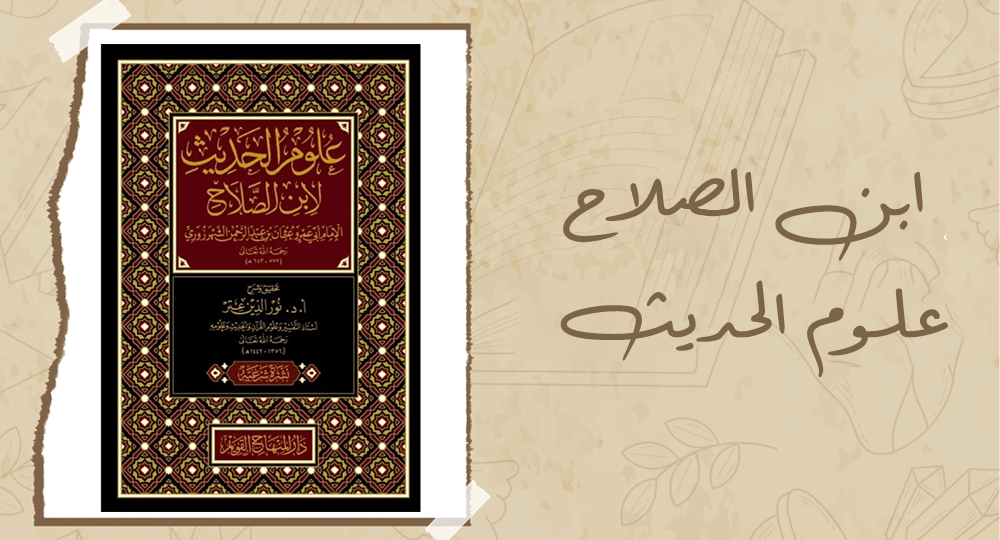
The science of hadith has never been just a novel that is transmitted, but rather a precise system of rules that govern the acceptance of news about the Prophet, and in Islamic history, names shine that have etched their mark in the march of legal sciences, but it is now rare to find a scientist who has combined the accuracy of the jurist, the depth of the scholar, and the intelligence of the methodology as in Ibn Al-Salah, who redefined the features of the science of hadith, and developed a comprehensive methodology for it that is still a reference until this day, and in the following lines we will dive into the life of this scientist, reveal his impact and analyze his leading scientific method that changed the course of the science of hadith in Ibn Al-Salah's introduction to the science of hadith.
Who is Ibn al-Salah, the scholar of hadith?
The man known as “Ibn al-Salah” was Uthman ibn Abd al-Rahman ibn Uthman al-Kurdi al-Shahrzuri, born around 577 AH and died in 643 AH in Damascus.
He is considered one of the most prominent scholars of hadith, and one of the scholars who combined narration and scholarship, and left behind an indelible scientific impact, especially through his famous book “Ibn al-Salah's Introduction to the Science of Hadith” (Muqaddima Ibn al-Salah al-'Ulum al-Hadith).
The book that became the cornerstone of the science of hadith terminology, also known as “Knowing the Types of the Science of Hadith.” Ibn al-Salah was a theorist and conductor of this science, bringing it together and setting methodological rules for it that were praised by senior scholars.
Ibn al-Salah's Introduction to the Science and Structure of Hadith
Ibn al-Salah's Introduction to the Science of Hadith is a qualitative shift in the course of this science, as Ibn al-Salah established the terminological reference for the science.
In the book, he laid the first building blocks for teaching it in a coherent methodology after it was scattered in the backs of works without a comprehensive arrangement or tight formulation.
The book originally originated as lessons given by Ibn al-Salah to students in Damascus at the Dar al-Hadith, and then he started collecting and organizing them.
I came up with this precious book, which includes more than 65 types of the science of hadith, starting from the correct and good hadiths to al-Mursal and al-Ma'al, the rulings of Ijazah and the ranks of Jarh and Ta'deeq, and one of the most prominent features of this great book:
- Teaching methodology: He used strong and clear language and precise terminology, taking into account both the student and the scientist, so his book is valid for teaching and formation, as well as for deduction and investigation.
- Scientific grounding: Ibn al-Salah did not limit himself to quoting his predecessors, but he edited the sayings, rationalized, discussed, revised, and relied on the narrations of the Imams and their principles of criticism.
- Scientific audacity: Ibn al-Salah did not hesitate to criticize some hereditary sayings or point out the differences of the Muhaddithis, and he clearly expressed his opinion while adhering to fairness and scientific politeness.
- Systematic encyclopedic: Ibn al-Salah collected in his book what was dispersed in the books of the advanced Muhaddithis, and coordinated them in a unique educational template.
Dar al-Zaman Library. A New Window on the Heritage of Hadith Sciences
Libraries have always been a mirror that reflects the development of human thought, and a carrier of the spirit of the times that characterized each scientific field, and there are many institutions that have worked to present unique thought to readers.
Among them is the Dar Al-Zaman Library, which strives to display the treasures of Islamic heritage with a modern flavor that suits the aspirations of students and researchers in today's era.
Among these scientific treasures is Ibn al-Salah's Introduction to the Science of Hadith, which is considered an important foundation for the study of the science of Hadith, and an indispensable reference in this field.
Not only that, but the library has also provided exceptional opportunities to access this introduction through various editions that feature all new annotations and investigations to enrich the deep understanding of this great work.
- provided Modern Library - Beirut A copy of Ibn al-Salah on the Science of HadithWith a modern academic approach that takes into account the accuracy of modern and historical texts, it is the perfect choice for academic researchers and university libraries.
- The library's second copy of Tomorrow's House for a book Ibn al-Salah on the Science of HadithThis makes it easier to understand the complexities of modern terminology and provides a qualitative addition for students of the Shari'ah sciences.
- A copy of Contemporary Thought House for a book Ibn al-Salah on the Science of Hadith It is characterized by high print quality and a distinctive methodological presentation that keeps pace with the development in the study of Hadith sciences, and offers readers a verified and approved version of the texts.
End of story. Ibn al-Salah's fame was not due to the abundance of authorship, but rather the fruit of a single composition built on tightness and perfection. He combined the methodology, vision, tools, and unified the terminological language that was dispersed, and that is why no student of science or researcher in the Sunnah does not find Ibn al-Salah's introduction to the science of hadith a key to open the doors of this noble art, and it still constitutes the backbone of that science to this day.
Read more: