

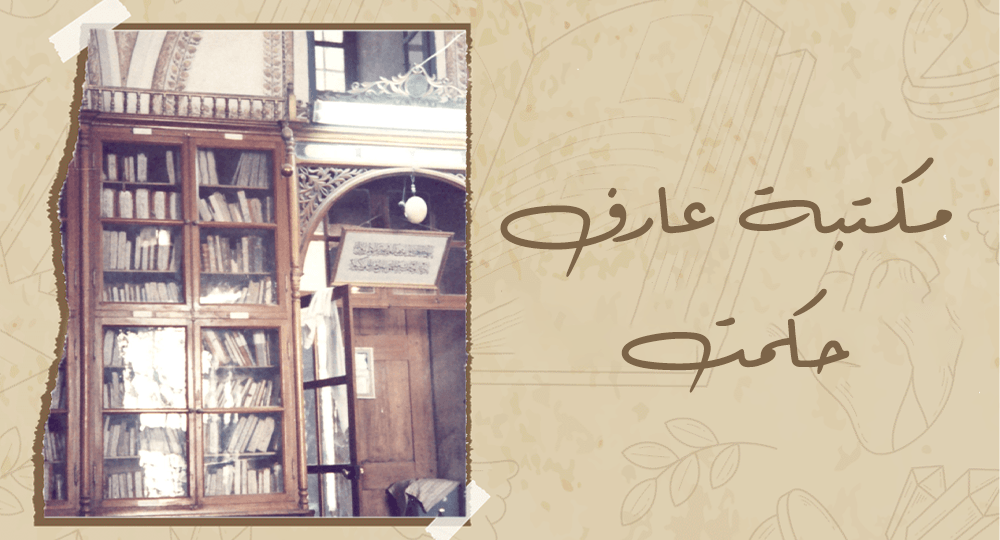
Has it ever occurred to you that behind the walls of Medina is a scientific treasure of equal value to the greatest libraries of the Islamic world? The Arif Hikmat Library is not just a place where ancient manuscripts are kept, but a living memory whose roots extend back to 1270 AH/1854 AD, when it was founded to be a beacon of science and a destination for researchers from far and wide. For almost two centuries, this library has been an invaluable source for lovers of heritage and knowledge, embracing precious works and rare manuscripts that can only be found here.
In the coming lines, we will take you on a journey through time to discover the uniqueness of Arif Hikmet's library, and learn about its most important holdings that preserved the Islamic scientific heritage from being lost.
What is the Arif Hikmet Library?
The Arif Hikmat Library is one of the oldest endowment libraries in the Arabian Peninsula. It was founded in 1270 AH/1854 AD in Medina by Ahmed Arif Hikmat, a prominent figure who held prestigious judicial and religious positions. He endowed it to serve science and spread it among students of knowledge, and over time, it became intellectual beacons that combine heritage and academic research.
Since its inception, the library has been an international center for the preservation of rare manuscripts and a refuge for researchers in the sciences of Sharia, history, literature, and Islamic thought. It has accumulated priceless treasures of knowledge, making it a major reference for anyone who seeks to study the authentic Islamic heritage and explore the roots of Arab culture.
The library was characterized by its meticulous organization and its distinctive method of classifying manuscripts and books, which made it a pioneering model in the management of scientific and charitable endowments in Medina and the basin of the Two Holy Mosques. It is no wonder that it remains today a symbol of endowed science and a witness to the value of knowledge in the march of the nation.
How did Arif Hikmet's bookstore come about?
The idea of establishing the Arif Hikmat Library began in the mid-13th century, when its founder had the idea of establishing a scientific center that would serve students and researchers in Medina. His vision was based on spreading knowledge throughout the Islamic world and facilitating access to precious books and manuscripts that were rare at the time. Hence, the idea of a scientific library was born to immortalize his name and remain a reference for every student of knowledge in the city.
Who is Ahmed Arif Hekmat?
Ahmad Arif Hikmat was a prominent scientific and religious figure in the Ottoman Empire, known for his vast knowledge and interest in knowledge. He held high positions in Jerusalem, Egypt, and Medina, then ascended to the position of Sheikh of Islam at the end of his life, one of the highest religious positions at the time. After his retirement, he devoted his time to worship, writing, and taking care of his library, which he wanted to be a beacon of knowledge and a haven for researchers.
How has the library evolved over time?
- The first stages of development began with the inclusion of a large collection of manuscripts belonging to the founder and his family, which represented the nucleus of the library and its scientific foundation.
- Later, it expanded by acquiring rare manuscripts from different Islamic regions, including books in Arabic, Turkish, and Persian, making it a diverse reference that connects the cultures of the Islamic world.
- Initially run by trustees such as Nur Effendi al-Turki and Abdul Qadir Hawari, it was then transferred to the Ministry of Endowments and later to the Saudi Ministry of Islamic Affairs, Dawa, and Guidance, which continued to preserve it.
- In 1371 AH/1951 AD, its original building was demolished as part of the expansion project of the Prophet's Mosque, and its collections were transferred to the King Abdulaziz Public Library, while maintaining the independence of its collections.
- The library went through difficult circumstances, witnessing the transfer and loss of parts of its contents during the wars, but most of its holdings were restored after the First World War thanks to official efforts to preserve this scientific legacy.
What are the contents of Arif Hikmet's library?
The library began with an estimated 20,000 manuscripts, but as time passed and statistics were updated, the actual number of manuscripts reached about 4,373, along with 7,045 rare prints.
In the latest detailed statistics, the library today includes 4389 original manuscripts, 632 linear collections containing 3838 scientific theses, in addition to 7875 printed materials ranging from rare books to modern editions.
These materials include rich topics in the sciences of tafsir, hadith, jurisprudence, history, literature, geography, and other diverse intellectual fields, making them a unique reference for the scientific movement through the ages.
What are the rarest manuscripts?
A group of manuscripts that are considered rare and exceptional in their historical and scientific value stand out, including:
- Al-Askari's “The Firsts” manuscript (395 AH/1004 AD), which deals with the earliest matters of language and history in a unique style.
- Imam al-Shafi'i's “The Mother” which is one of the basic principles of Shafi'i jurisprudence.
- A copy of the Quran Written in beautiful Andalusian script on gilded ostrich parchment, it is both an artistic and spiritual masterpiece.
- Manuscript Tafsir on Gazelle Parchment Dating back to 310 AH/922 AD, it is one of the earliest evidence of exegetical authorship in that early era.
- Sioti's manuscript “The Lectures” in the author's own handwriting, giving them invaluable textual and material value.
What languages are the manuscripts in?
The languages of the manuscripts in the Arif Hikmat Library include Arabic, Turkish, Persian, as well as some Western languages. This multilingualism reflects the extent of scientific and cultural interaction between the East and the West over the centuries, and embodies the breadth of knowledge exchange that Medina has embraced throughout its long history.
Why is Arif Hikmet's library important for researchers?
The library is one of the most important sources of scientific indexes that researchers use to document copies and study the evolution of texts. It allows them to compare the differences between copies and identify their ages and scribes, which constitutes an essential base for any academic research that relies on accurate scientific investigation. This support makes it a reliable reference for anyone who seeks to build studies based on the original text without distortion or incompleteness.
What do you offer for Islamic studies?
The library offers scholars of Islamic sciences original manuscripts that have never been published before, giving them a unique opportunity to investigate new texts that reveal unknown aspects of the Islamic heritage. It also helps trace the intellectual developments and scientific schools that emerged in the two Holy Mosques through direct sources, some of which date back to early Islamic history.
For example, many master's and doctoral theses have relied on the manuscripts of Arif Hikmat's library to investigate heritage books and study the history of Medina and its scientific life.
Why is it an academic reference?
- The diversity of its scientific fields: Collections cover the sciences of the Quran, jurisprudence, language and literature, history and geography, giving it a broad academic depth.
- Accurate thematic and spatial categorization: The manuscripts are organized according to a scientific methodology that facilitates quick access to the required material.
- Researchers rely on it globally: It has become a major hub for local and international researchers in everything related to Arab-Islamic heritage studies.
- Document the authenticity of the materials: Each manuscript is preserved according to standards that preserve its historical and scientific value, giving the documents high reliability in academic research.
What services are offered to researchers?
The library provides a range of services that facilitate the research and study experience. It allows direct access to manuscripts and provides a quiet study environment that promotes concentration. It also supports local and international researchers in accessing the required resources, and provides photocopies when needed to facilitate investigation and comparison without damaging valuable assets.
How has Arif Hikmet's library contributed to the preservation of Islamic heritage?
The Arif Hikmat Library played a crucial role in preserving the heritage of Makkah and Medina by tracing the biographies of local scholars and collecting them in special collections that allowed researchers to accurately trace the biographies of the scholars of the two holy cities. This effort contributed to drawing a clear map of the scientific movement in the two cities through the ages, and enabled those interested to compare the methods of scholars and their approaches to writing and teaching.
For example, the library includes collections dealing with the biographies of leading scholars who advanced the legal and linguistic sciences in Medina, making it an indispensable reference for understanding the intellectual and educational structure of that era.
How have you faced the challenges of loss and theft?
The library has not been spared from difficult challenges that nearly destroyed much of its manuscript heritage. During World War I, some of its contents were moved to Istanbul, while others were lost due to theft and neglect. As the decades passed, the number of manuscripts painfully decreased from about 20,000 to only about 5,000, reflecting the magnitude of the great loss of the Islamic heritage stored in this ancient library.
How are their collections protected today?
The Saudi authorities intervened to protect the remaining rare collections with a strategic initiative, as they were preserved in an independent wing of the King Abdulaziz Public Library under the supervision of the Ministry of Islamic Affairs. This supervision ensures continued access to the manuscripts and facilitates academic research, while maintaining the rigorous scientific classification that the library has been known for since its founding.
What are the best specialized sources on Arif Hikmet's manuscripts?
The manuscripts of Makkah and Madinah's most prominent figures in the library of Sheikh Arif Dar Al-Zaman Publishing and Distribution LibraryIt is one of the most prominent houses specialized in providing original sources that serve researchers and students in the fields of Islamic history. History and Geography:
The manuscripts of Makkah and Madinah scholars in the library of Sheikh Aref Hikmat
If you are interested in studying Islamic heritage and the rare manuscripts in Arif Hikmet's library, the book “The manuscripts of Makkah and Madinah scholars in the library of Sheikh Aref Hikmat” is one of the most important references that cannot be bypassed.
This publication contains a collection of rare original documents that document the biographies and works of the scholars of Makkah and Medina who served science and religion in the Two Holy Mosques. The book presents a rich analytical and documentary study, under the supervision of the editor, Abdul Hamid Muhammad Zahir.
What distinguishes this reference is that it not only lists information, but also provides an in-depth understanding of the scientific and religious structure in the two holy cities, and presents a comprehensive picture of the elite who contributed to enriching intellectual life over the centuries. It also provides researchers with a documented database that can be relied upon in the preparation of academic studies and specialized works on the civilization of the Two Holy Mosques and indexes of Islamic manuscripts.
Frequently Asked Questions about the Arif Hikmet Library
What are the oldest manuscripts in Arif Hikmet's library?
Among the oldest manuscripts is a rare copy of the Tafsir al-Qur'an written in beautiful Andalusian script on ghazal parchment dating back to 310 AH/922 AD, one of the earliest Qur'anic traditions in the city. The library also houses the manuscript of Al-Awael book by Al-Askari, which dates back to the fourth century AH, testifying to the historical depth of the collections it contains.
How can people access the contents of the library?
The library is now offering visitors and heritage researchers the opportunity to view its contents through a special pavilion at the King Abdulaziz Public Library in Madinah. The Ministry of Islamic Affairs also organizes access to manuscripts according to specific regulations that ensure the preservation of the library's holdings and provide a suitable environment for specialized scientific research.
What is the role of the library in protecting the scientific heritage of Madinah?
For two centuries, the library has contributed to preserving the scientific and historical heritage of Medina, preserving hundreds of rare manuscripts and documents documenting the city's landmarks and its scientific and religious life. Its role was not limited to preservation, but extended to transferring this heritage to scholars and new generations, so that it remains a beacon of knowledge that testifies to the city's history and scientific status.
The Arif Hikmat Library remains a living testimony to the depth of the scientific heritage in Medina, as it houses precious manuscripts documenting the stages of the scientific movement in the two Holy Mosques. The library represents a valuable reference for researchers and those interested in heritage catalogs and the realization of rare texts, and remains a vital center that serves both the local and international scientific communities.
Read more: