

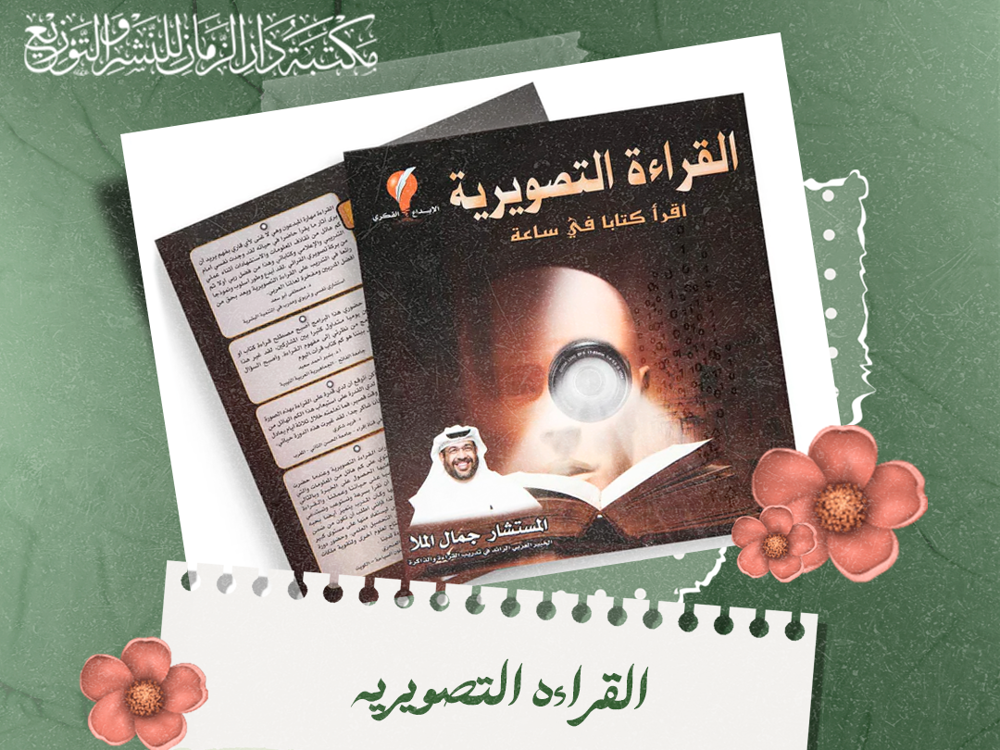
بThe holy revelation began with the verse “Iqraa”, reflecting God's emphasis on the importance of reading and learning. The Prophet Muhammad (peace be upon him) emphasized the importance of learning and science by saying, “Knowledge is by learning.” In this modern age of information explosion, graphic reading has become more important than ever. We live in a time that relies heavily on reading and learning to gain knowledge and understand the world around us. As we advance in technology and improve our lives in many aspects, we may have a challenge with time and focus when reading, in this blog we will talk in detail about visual reading.
Graphic reading
In fact, many of us get bored or distracted when reading a long text, and this makes us lose reading speed and comprehension. One study indicated that 90% people do not finish reading the first chapter of a book, due to factors such as busyness and boredom.
Understanding these issues and obstacles to speed reading can help improve them. By sharing knowledge and experience, we can offer solutions and strategies that help us increase reading speed and effectively understand and assimilate the content of the text. Imam al-Shafi'i is a role model in this context as he read quickly and efficiently.
Therefore, we must emphasize the importance of pictorial reading in this era and learn from different experiments and methods to increase reading speed and comprehension, thus making better use of reading and science in our lives.
What is Graphic Reading?
Graphic reading is an exceptional skill that allows an individual to read at a speed of up to 25,000 words per minute, with high comprehension of the content. You can understand what this means by being able to read a 250-page book or course in less than an hour with deep comprehension.
The beauty of this type of reading is that it's a skill that can be easily learned. In just three days on a course, people can significantly increase their reading speed. We've seen people read three books in that time when it used to take them months to read a single book.
I'll give you five easy steps to acquire this skill. These steps have been simplified, although they are usually explained in more detail during training courses that usually last several hours.
First step: Preparation
First of all, you should set a specific goal for your reading, whether it's to understand certain content or to find answers to certain questions. Then, before you start reading, prepare the book or material you intend to read. Relax or do breathing exercises to increase your concentration level, as being calm and attentive enhances comprehension. People who are stressed are often less able to remember what they have read.
Step Two: The Big Picture
In this step, reading is limited to an overview of the material. Read the front and back cover page of the book and focus on the printing date, the contents of the book, and the index. Also read the first paragraph and the last paragraph of each chapter if the book is divided into chapters. This step gives an overview of the book's content.
Step three: Energize the mind
In this step, you focus on the center of the book in such a way that you see two pages at once. This method enables individuals to quickly absorb information instead of reading each word individually. You are able to enter an optimal learning state where the information can enter the mind at high speed without having to read word by word. This is based on high mental abilities.
Step four: Targeting and focus
This step is based on identifying the section of the book that interests you and serves the goal you set in the first step. At this stage, read at high speed for topics that you find important or that catch your attention. You may create a mind map of just the material you want to focus on. The choice is up to you.
Step five
This step involves reading the book from cover to cover, with the possibility of adding more information to the mind map during or after reading. These five steps usually enable you to read and understand a 250-page book in less than an hour, which enhances understanding, comprehension, and recall of the reading material.
The skill we are talking about in our article is not new, it was an ancient practice. Imam Shafi'i and others used it, and it existed in civilizations such as China, India, and Persia. Over time, Paul Shelley developed it and gave it specific rules, making it easier to learn.
People trained in this technique can read up to 25,000 words per minute, and can read 2-3 books per day, which means reading approximately 700-1000 books per year, with a comprehension rate of 65-70%. Individuals who have not learned the technique can read at a speed of up to 160 words per minute, which means reading one book per month, with a comprehension rate of 45-55%, provided there are no distractions.
Key benefits of reading
-
Expand knowledge and increase understanding.
-
Deliver moments that are enjoyable and nourishing to the heart, mind, and soul.
-
Promoting virtue through the pursuit of knowledge and the elimination of personal ignorance.
-
Develop the ability to participate in discussions and enrich discussions and forums with valuable information.
-
Saving time, as reading contributes to appreciating time and making better use of it.
-
Reading is key to gaining knowledge and critical thinking.
-
Reading contributes to building enlightened societies and directing them towards the discovery of science and knowledge.
In conclusion, picture reading or speed reading is a valuable technique that enables individuals to maximize their time and increase their reading productivity. It is a tool that helps expand knowledge, develop mental skills, increase our ability to engage in conversations, and stimulate critical thinking. Individuals should strive to acquire and practice this skill, as it is a key to understanding the world more deeply and using time more effectively. Through figurative reading, individuals can achieve learning and enrich their lives with more understanding and inspiration.