

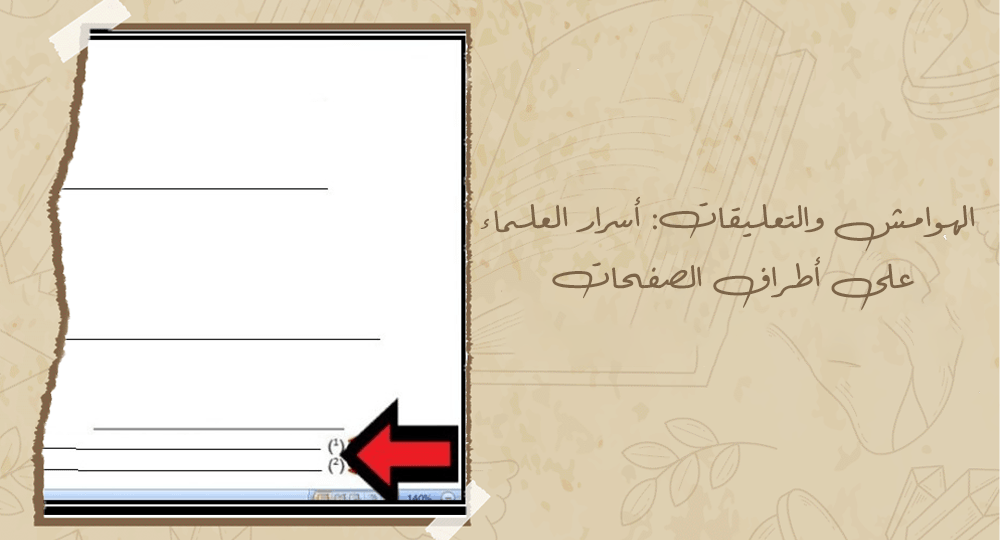
Have you ever thought about the secrets hidden in the margins of old books? Those little margins that the eye passes over quickly were actually spaces where scholars recorded their thoughts, criticisms, and profound comments. Margins and comments: Secrets of Scientists at the edges of the pages are not just fleeting additions, but an extension of the spirit of the text, a bridge between individual reading and collective scientific dialog through the ages.
Through these footnotes, the features of rigorous critical thought and the methods of systematic documentation adopted by scholars in treating and interpreting texts become clear. They reveal how scholars interacted with their authors, wrote down their corrections, or opened new research paths.
What are margins and annotations? Scientists' secrets at the edges of the pages?
Margins and comments: These are the little notes that we often find at the bottom or on the edges of pages, but they carry with them a wealth of knowledge. Through them, we can trace the thoughts of the authors and see how scholars have interacted with texts through the ages, whether by clarifying, criticizing or adding to them.
Definition of margins
Footnotes are documentary or explanatory notes that are usually inserted at the bottom of the pages of books and manuscripts, with the aim of supporting the original text with sources or explaining some vocabulary and information. Footnotes help the reader to understand subtle meanings without disturbing the sequence of ideas of the body of the text, thus serving as a bridge between the text and its sources.
Definition of comments
Comments are critical additions or supplementary information written by the author, editor, or even the reader about an idea or opinion in the text. They often appear in the margin or at the end of the pages and reflect a lively interaction with the text, whether by supporting or objecting to the idea or expanding the discussion with additional sources.
Types of footnotes and captions
- Linguistic margins: Explains obscure vocabulary or specialized terms to facilitate understanding.
- Explanatory margins: Provide a general explanation of the idea or passage to clarify the context.
- Commentary margins: Addresses additional opinions or comparisons between texts.
- Cash margins: Reflects an accurate assessment or correction of scientific or intellectual errors.
- Documentary margins: Mention the sources and references that the author relied on.
The types of comments fall under:
- Comments: It shows that the writer or reader is in tune with the opinion of the text.
- Review comments: Suggests reconsidering a proposition or idea.
- Reply comments: Provides an objection or counter-explanation to an opinion in the body of the text.
- Comments Adding sources: Expand the knowledge base by including references to complement the discussion.
Why are footnotes and commentaries important to scholars?
Footnotes and captions: Scientists' secrets at the edges of the pages are a hidden space that reveals much of the depth of research and sobriety of thinking. They are not mere sidebars, but rather precise tools that scholars rely on to clarify their methodology, elaborate their arguments, and express their scientific positions. Through them, the reader can trace the path of an idea, from its source to its analysis and criticism, and see the map of scientific thinking clearly before him.
How do you emphasize the scientific method?
Footnotes highlight the scientific method by revealing notes that explain the methods of verification and comparison between narratives or texts. When a researcher proves that two manuscripts have different words, or explains why he or she favors one of the sayings, he or she is applying the scientific method in criticizing, examining, and investigating texts.
For example, when a scholar places a note in the margin indicating the different versions on the meaning of a particular phrase, and then explains in the commentary why he has adopted one of the readings, this careful scholarly behavior embodies the spirit of systematic investigation based on verification and objectivity.
What is its role in documenting sources?
Footnotes and comments: Secrets of the Scholars on the edges of the pages play an essential role in documenting references and sources, as they are the first guarantor of scientific transparency. Through them, the reader can independently verify each piece of evidence or text in the body of the text. Footnotes also give other researchers the opportunity to trace the historical and intellectual context of the sources, which enhances confidence in the results and increases the credibility of the entire scientific work.
How do you reflect intellectual dialog?
Margins are also a space for open discussion between scholars and ideas. They allow them to agree, disagree, or add to what is presented in the text, creating a rich intellectual dialog that goes beyond the book itself. In a small line at the end, we may find a comment that re-reads a whole idea or opens a door to new questions. In this way, the margins become a vibrant record of intellectual movement, linking generations of scholars and fueling constructive debate in the knowledge arena.
How do scholars use footnotes in heritage research?
Scholars use footnotes and comments: Scholars' secrets on the edges of the pages are an essential tool in the realization of the heritage, as they are the space where accurate corrections and alerts to textual disturbances or different versions are monitored. Through the margins, the comments of successive scholars are documented, so the reader knows how each investigator or copyist dealt with the text and what additions or deletions were made to it.
For example, when an investigator is working on an old copy of a jurisprudence book, he or she makes notes in the margin, such as a different word in another copy or the correction of an obvious copying error. In this way, the margins become an open record that explains the text's journey between hands and enables researchers to trace its origins with confidence.
Review of manuscripts
When reviewing manuscripts, scholars rely on marginalia to distinguish what is original to the text from what was added later. The margins are a tool for comparing copies, and through them it is possible to see where scribes agreed and where they differed. Marginal comments often indicate alternative readings or annotations that clarify ambiguous phrases, helping to recover the meaning closest to what the original author intended.
Adjusting for shifts in mindset
The margins and captions: Scholars' Secrets at the edges of the pages also reflect the intellectual shifts of the scholars themselves. Someone may add a new comment that reflects a change of opinion or opens up an intellectual debate that was not previously on the table. The footnotes become a living record of how intellectual and social trends have changed over the centuries, revealing how scholars interacted with the texts of their predecessors, from criticism to development.
What are the best books about footnotes and captions?
is a library Dar Al-Zaman Publishing and Distribution Library One of the most prominent publishing houses that collect scientific artifacts and books specialized in heritage and critical thought. It combines reliable heritage references with modern academic publications, making it an ideal destination for researchers in the fields of manuscripts, sects and sects, and contemporary religious thought. In this context, a number of books dealing with the art of footnotes and commentaries stand out, including the following.
Notes on the Critique of Religious Thought
Sheikh Muhammad Hassan Al Yassin presents in Notes on the Critique of Religious Thought from a section Islamic Books A critical reading of Sadiq Jalal al-Azm's Critique of Religious Thought, in which he discusses his ideas in a scientific spirit based on a moderate Islamic background, combining religious understanding with comparative thought.
The author focuses on analyzing Western influences on religious thought and their overlap with theological concepts, and presents his observations in a scholarly style that addresses researchers in the field of cultural criticism and the study of religions and doctrines.
Manuscripts in the Book of Flags
As for the book Manuscripts in the Book of Flags from a section Languages Published by Dar al-Zaman - Damascus, this book is an excellent reference for lovers of biography and writing history. Throughout the pages of the book, the author shows photos of rare manuscript copies of the Book of Al-Alam, with a detailed explanation of the tools and techniques used to preserve the manuscript heritage.
The work is intended for researchers interested in manuscripts and historical documentation, and is characterized by clear printing and a large size that makes it easy to navigate.
How have margins evolved in Islamic thought?
Footnotes in Islamic Studies
Since the early centuries, footnotes and footnotes have emerged in Islamic thought as an extension of the text rather than a later addition. They were used by scholars to clarify meanings, respond to objections, and restrict generalities or specialize texts. Footnotes were a form of dialog with foundational texts in jurisprudence, exegesis, logic, and philosophy, in which scholars found space for critical expression without compromising the essence of the original text.
Dialogue and Criticism Forms
Footnotes and captions: Secrets of the Scholars at the edges of the pages were not just static annotations, but over time they became an arena for debate and questioning. The pages of footnotes hosted heated intellectual debates that addressed issues of religion and reason, and pondered the location of Western influence in Arab-Islamic thought. This is evident in the works of Mohammed Arkoun and Sadeq al-Azm, both of whom used the margins as a platform to criticize and reread the heritage in a polemical manner. These margins and commentaries were a space where the text and the critic met, where the inherited text and contemporary thought coexisted in an ongoing dialog.
The role of footnotes in historical documentation
Beyond footnotes and captions: Secrets of the Scholars on the edges of the pages go beyond their intellectual value to their role in documenting scientific and social history. Ancient manuscripts with their annotations are a living record of the movement of scholars, the change of doctrines, and the evolution of language and methodology. They reveal the temporal depth of philosophical and jurisprudential debate, and allow one to trace how concepts developed within the Islamic environment. Without these margins, much of the communication between generations of scholars would have been lost and the heritage would have remained incomplete in its subtleties.
How do I write footnotes and captions professionally?
To write footnotes and captions professionally, it is necessary to follow organized steps that make the work neat and easy to understand for the reader.
- Start with a careful selection of reliable sources that support the text and enrich the content with significant references.
- Prepare a reference list for each margin to ensure transparency and accurately document information.
- Write annotations clearly without ambiguity or awkward abbreviations.
- Use scientific language that maintains the academic character and expresses a deep understanding of the material.
- Fine-tune the numbering to maintain the logical sequence between the margins for easy reference.
Numbering systems
Numbering systems for margins and comments: Scholars' secrets for footnotes vary across academic disciplines, but the most important thing is to be consistent. You can adopt the international numbering system with sequential numbers, or the Arabic system that uses letters or glyphs. It is important to distinguish between footnotes, which appear at the bottom of the page, and endnotes, which are collected at the end of the chapter or paper, taking advantage of modern editing tools that make it easy to format and manage them automatically.
Common mistakes to avoid
So that margins don't lose their value, beware of some common pitfalls:
- Neglecting to cite citation sourcesan error that undermines academic credibility.
- Lack of control over number sequencing This confuses the reader and weakens the overall organization of the research.
- Excessive lengthy comments It doesn't serve the main text and distracts from the main idea.
- Failure to clarify important terms in the margin, causing the reader to lose the context of the intended meaning.
Professionalism in writing footnotes does not mean overusing them, but rather choosing them well and drafting them accurately to be a real scientific addition to the edges of the pages.
FAQs about footnotes and captions: Scientists' secrets at the edges of the pages
What are the ways to number the margins?
To number margins and comments: Secrets of Scientists for accurate page margins, first check your pagination settings within your Word document. From the menu bar, choose “Insert” and then “Page Number” to review the current numbering. If you notice any anomalies, check for unnecessary section breaks, which may be the cause of the numbering discontinuity. You can re-insert or edit page numbers through the header and footer tools so that the margins are neat and consistent across all pages.
How to write footnotes on pages?
To add a footnote while typing, place the cursor at the position where you want the footnote symbol to be inserted into the text. Then, from the toolbar, select “Footnote” and the number will automatically appear in the text, and a special place to write the footnote text will open at the bottom of the page. This way you keep the information in the body of the text connected to the footnote at the bottom of the page.
How do I make a footnote for each page?
If you want each page to have its own footnote, place the cursor at the desired place in the text, then from the References menu choose Insert Footnote. Word will automatically add an automatic number to the new footnote on that page, with a space underneath to write the desired information. This method helps to keep notes separate, so that footnote numbering does not extend between different pages.
Margins and comments: The secrets of the scholars on the edges of the pages are not just sidebars, but a living record that reflects the scholars' honesty and accuracy in documenting knowledge. Through them, thought traveled, scientific dialogue was renewed, and a rich heritage of reflection and debate was preserved, making these margins a mirror of the evolution of scientific research in the Arab and Islamic heritage.
Read more: