

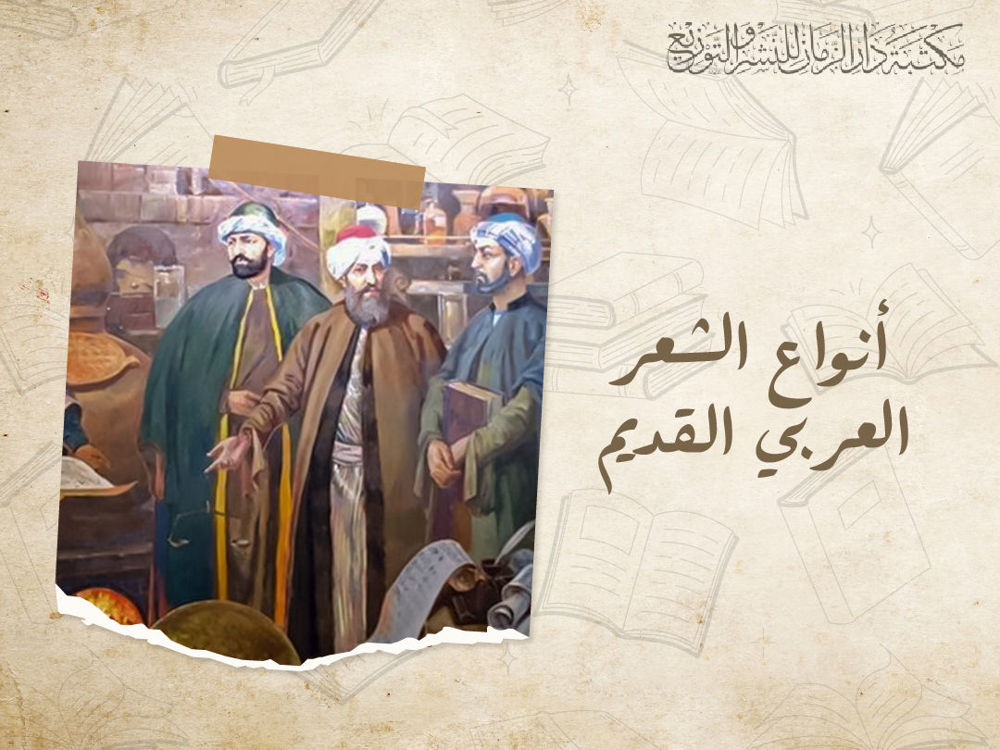
Ancient Arabic poetry is one of the ancient literary arts in Arab culture, and its history extends significantly from ancient times to the present day, reflecting the reality surrounding man and expressing his various feelings and sensations in a creative and attractive way, making it one of the basic literary arts in Arabic literature.
Types of ancient Arabic poetry and its role in Arabic literature
Poetry is a form of linguistic art, as it relies on the use of aesthetics in the formulation of ideas and feelings and their creative embodiment in attractive words and rhymes. It involves describing things in an aesthetic way for the purpose of communicating certain meanings and messages to the recipient in a smooth and attractive way.
The ancient period in the history of Arabic literature is considered the beginning of Arabic poetry, and it was characterized by its continuous development to reach the modern period, and here the different types of ancient Arabic poetry differentiated according to place and time and the emergence of literary schools that differ in the style of poetry they present.
Types of Ancient Arabic Poetry
Studying the genres and themes of ancient Arabic poetry is essential to understanding the depth of Arabic literature and its development through the ages. The forms and genres of Arabic poetry vary, and some genres are known for their thematic unity and organic unity. Each type of Arabic poetry reflects the culture and traditions of the society to which it belongs and its history full of different events and developments:
-
Prehistoric poetry
Jahiliyya poetry represents a period of Arabic literature that extends from the fifth century AD until the Islamic mission, a pre-Islamic period characterized by liberal thought and artistic expression. The source of the name Jahili poetry dates back to the dawn of Jahiliyyah, and during this period, various themes appeared in Jahiliyah poetry, and the most important types of Arabic poetry that appeared in Jahiliyah poetry are love and loyalty, morals and behaviors, genealogy, and nature, which are common forms of poetry.
Jahiliyya poetry occupies an important place in the culture of Arabic literature, as it reflects multiple aspects of the social and cultural reality of a particular period. It is also a rich source of details related to Arab history and civilization, as it can be used to identify the developments and changes that occurred in the customs, traditions, and social conditions of the people. The period of Jahiliyyah poetry is considered a history and heritage that can be identified, as it left strong imprints in Arabic literature and still enjoys popularity and widespread popularity by the public.
-
Nabataean poetry
Nabati poetry is a popular poetry based on the dialects circulating among people and is characterized by talking about daily life and various incidents that may occur in the family or community, and Nabati poetry also includes complaints and enthusiasm against corruption and injustice, and Nabati poetry is considered an expression of a particular society.
Although the types of Arabic Nabati poetry differ from Jahili poetry in the dialect used and its themes, it is similar to it in its expressive style and its use of rhetorical and pictorial methods. Nabati poetry is considered equally important as Jahili poetry, as it represents a true expression of the culture and traditions of the society to which it belongs and its themes reflect common aspects of their daily lives.
-
Modern Arabic Poetry
Modern Arabic poetry describes the time period after the Jahiliyya era to the present and is characterized by its diverse and different themes according to the different time periods in which it was written. Modern Arabic poetry uses the classical Arabic language and is concerned with everyday life, political, social, religious, philosophical, feminist, and other topics of interest to society.
Modern Arabic poetry can be categorized into several categories according to the styles and schools in which it was written:
-
Free hair.
-
National and revolutionary poetry.
-
Sad and bitter poetry.
-
Tantric poetry.
-
Modern free verse.
-
Modern Romantic poetry.
Modern Arabic poetry is an evolution of many types of Arabic poetry, as it is concerned with poetic and expressive style, the use of new terminology, jokes and verbal quips.
How to choose the best Arabic poetry books?
This question is on many people's minds, because choosing the right books is a good start to learning and enjoying the art of poetry. So, here are some important tips to help you make the best choice:
-
Choose a book by your favorite poet: If you love Arabic poetry, your favorite poet has a special place in your heart, and if you love Arabic poetry, you may have a poet who occupies a special place in the list of the best poets. If you love Arabic poetry, you may have a favorite poet who holds a special place in your heart.
-
Choose a book with a theme that means something to you: You can choose a book that has a theme that has a certain meaning to the reader, and therefore the benefit will be greater. Some poems may be self-promotion or inspire wisdom, so choose a book that allows you to do that.
-
Choose a book with a group of poets: One of the most important tips that can be given to the Arabic reader is to choose from different books that include a group of poets, as it gives the reader the opportunity to explore new works and read poems that may be unknown to them, and this opens wider horizons for them to learn Arabic poetry.
-
Choose a quality book: You should choose a book that has good and harmonious texts. It is important that the book has a high literary production and contains simple and easy-to-understand poetry. The book should also be of visual quality, with clear and vertical lines.
-
Choose a book with notes and comments: Books with notes and comments from the critic, or a footnote, allow the reader to understand the book better. In these books, the critic's important messages are addressed directly to the reader with analysis, advice, and suggestions, which helps the reader to utilize the book in developing his or her poetic abilities.
Make sure you choose the right types of Arabic poetry for you and the way you read Arabic poetry.
In conclusion, those interested in learning about the types of ancient and modern Arabic poetry and familiarizing themselves with the various examples and models of the poets of the Jahiliyya era and contemporary poets in the present; and using the various styles of Arabic poetry, you can do so through the books provided by the Dar al-Zaman.