

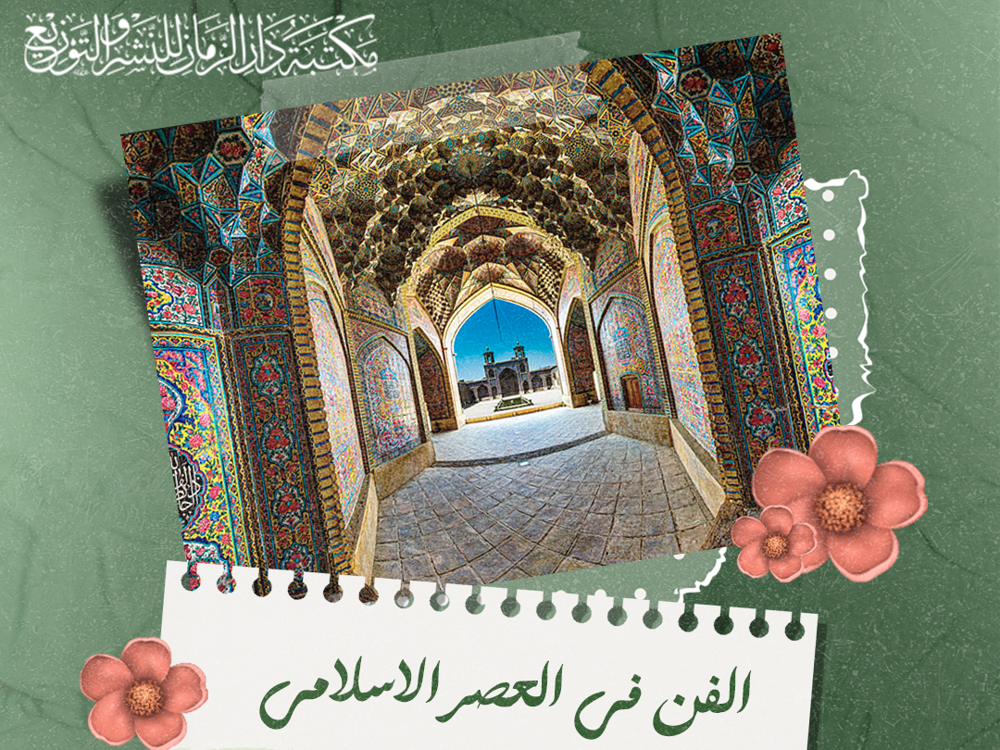
Throughout the ages and civilizations, humans have lived under the influence of art and culture. The Islamic era was no exception to this rule and was a hub of creativity and artistic brilliance. The Islamic era is a unique and distinctive period in terms of the development and prosperity of art. Through this article, we will enter the world of art in the Islamic era and discover the richness of this time period in terms of creativity and artistic mastery. We will see how Islamic values and culture influenced artistic representation and how the Arab and Islamic courtyard added its own spirit to the world of art. In this exciting journey, we will explore the various artistic currents and techniques that adorned Islamic art, from magnificent architecture to abstract art and unique Islamic decoration. We will discover how religious stories and doctrines were materialized through art, and how artists represented the uniqueness and beauty of the human being through their paintings and sculpture.
Art in the Islamic Era
Art in the Islamic era is the embodiment of the creativity, diversity and rich cultural heritage of this civilization. We will enjoy discovering the world of art in Islamic times and its great contribution to the enrichment of human heritage in all its colors and forms.
The Origins of Islamic Art
Islamic art originated in the Islamic era beginning in the first century of the Hegira, and gradually developed until it reached its peak in the 14th century AD. This art carries with it the influence of the environments and cultures that have coexisted with it throughout the ages. Because it has survived and evolved over a long historical period spanning more than 14 centuries, it is difficult to provide a precise definition that can be applied to it in general. Islamic art encompasses all artistic manifestations that emerged after the Prophet's migration in 622 AD and continued until the 19th century in areas stretching from Spain to India. This definition reflects the Islamic roots of this art and its wide influence across different regions.
Stages in the Development of Islamic Art
Artwork in the Islamic context has evolved with the passage of time and has been influenced by the social and cultural events that have taken place in Islamic societies. Let's take a quick look at the evolution of this art through the ages:
Islamic Art in the Age of the Rashidun Caliphs
In the beginning, Islamic art had no official name, and its emergence during the reign of the Rashidun caliphs was simple and natural. The efforts of the Rashidun caliphs were focused on Islamic conquests and spreading the new religion. As Islamic conquests expanded, Islamic art began to emerge more clearly. This growth saw the construction of mosques and urbanization in the country.
Islamic Art in the Umayyad Period
During the Umayyad period, Islamic art underwent a remarkable evolution as new and exciting concepts were assimilated. One of the most prominent examples of this development is the Dome of the Rock Mosque in Jerusalem, Palestine, one of the most important monuments in the history of Islamic art.
Islamic Art in the Abbasid Period
As time passed and the center of the caliphate moved to Iraq, Islamic art witnessed the influence of Persian artistic styles. The design and construction of cities and capitals began to take on a more distinctive appearance. Cities were characterized by their new circular and distinctively shaped buildings, and mosques began to be built prominently in the center of these cities. Furniture and decorations began to take on ornate shapes and beautiful ornaments.
Islamic Art in the Ayyubid and Mamluk Periods
In this period, the use of Islamic art saw an increase in luxury and wealth among the people. They began to build magnificent palaces and decorate them with luxurious furniture. Not only that, but they also built mausoleums, schools, and mosques and decorated these buildings with artifacts. This era was characterized by the development of multi-dimensional geometric shapes, including triangles, quadrilaterals, pentagons, and other multiples. Calipers were mainly used in art making, and Islamic art was characterized by its masterful use of botanical design and the creative use of Arabic calligraphy.
Islamic Art in the Ninth to Fifteenth Centuries
Islamic art in this period made a significant contribution to the construction of universities and educational institutions that taught a variety of sciences, including philosophy. This contribution was not only in the field of education and science, but also in the construction of magnificent mosques and mosques. The influence of Islamic art was also evident in regions such as Syria and Egypt, where there was a great interest in architecture and aesthetic design.
Islamic art of this period was characterized by exceptional architecture, and would have been inspired by Romanesque and Gothic techniques. Examples of these creations include: The Great Mosque in Cordoba, the Alhambra, Madinat al-Zahra, and others. In addition, Islamic art was characterized by the creation of ornate and patterned jewelry and luxurious silk fabrics.
Islamic art in the fifteenth to nineteenth centuries
In the Ottoman period, Islamic art shone brightly and showed its own characteristics. The Taj Mahal in India is one of the most prominent masterpieces of the period. Islamic art was also famous for the manufacture of precious stones in various forms, ivory carving, and many other techniques and handicrafts that were characteristic of the period.
General aspects of Islamic art
Islamic art is characterized by its diversity and richness, and has had a profound impact on many artistic and cultural fields in the world.
Islamic art encompasses a wide range of techniques and creative fields. Among these important areas are:
-
The art of calligraphy and calligraphic decoration: It involves writing texts and slogans in beautiful and ornate calligraphic patterns. Arabic calligraphy has a major role in artistic decoration and ornamentation.
-
The art of textiles and carpets: The skill of Islamic artisans is evident in the weaving of fabrics and carpets, and the intricate ornamentation that adorns them.
-
Sculpture, woodcarving, and the use of ceramics, crystal, and glass: These arts represent different techniques for materializing ideas and expressing beauty through various means.
-
Islamic architecture: Characterized by high-rise buildings, temples, and mosques that incorporate geometric motifs, decorative columns, and artistic domes.
-
Mosaic and decoration: Materials such as porcelain, crystal and glass are used to produce amazing ceramic and glass artifacts to decorate buildings, mosques and temples.
-
Geometric and structural motifs: There are many architectural styles and forms that characterize Islamic architecture, including the intricate ornamentation and materials with which buildings are adorned.
In conclusion, the art of the Islamic era, with its elegance and deep diversity, shows a great influence on the world. It is embodied in architecture, design, crafts, and the visual arts. From the earliest times to the present day, art in the Islamic era shows a rich heritage and astonishing beauty. It reminds us of the importance of art as a means of expressing identity and culture, and has a great role in enriching cultural interaction and mutual understanding among peoples, an undeniable fact.