

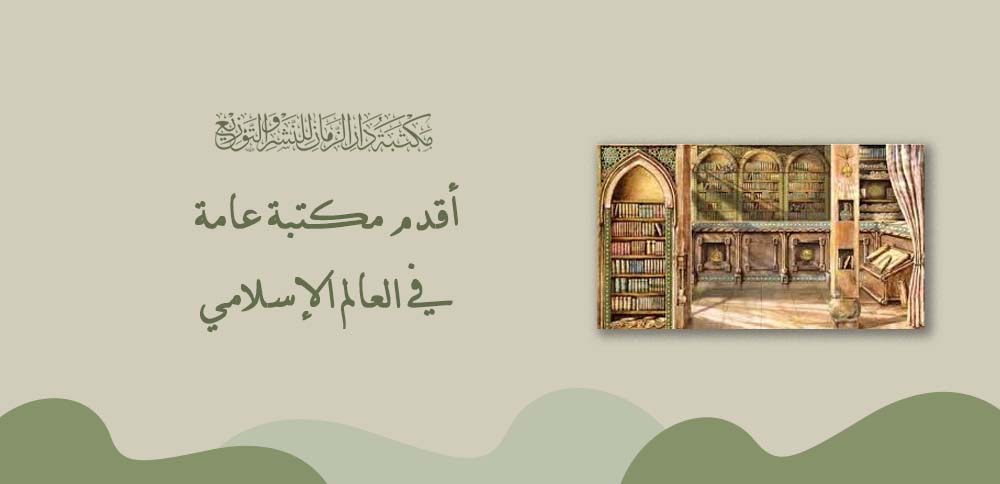
The oldest public library in the Islamic world has long been the focus of interest for historians and knowledge lovers. It was not just a place to keep books, but a living symbol of the prosperity of Islamic civilization and its keenness to spread and exchange knowledge. This library was an example of the humanitarian vision that brought together different cultures and contributed to the transfer of science from the world's languages to Arabic, making it an exceptional intellectual beacon in the history of humanity.
In this article, we take you on a journey to learn about the House of Wisdom Library in Baghdad, a cultural landmark that embodied the spirit of research and experimentation in the Islamic Golden Age.
What is the oldest public library in the Islamic world?
The Dar al-Hikma or House of Wisdom in Baghdad is the oldest public library in the Islamic world. It was founded during the reign of the Abbasid Caliph Harun al-Rashid in the eighth century AD, and flourished greatly during the reign of his son al-Ma'mun, who made it a global scientific center. This great library was a meeting point for scientists and thinkers from different religions and ethnicities, and a place to exchange knowledge and translate science from Greek, Persian, and Indian into Arabic.
Where was the first public library founded?
The first public library was founded in Baghdad, the capital of the Abbasid Caliphate, as a center of wisdom and science. Dar al-Hikma was not just a place to keep books, but became a research institution that combined reading, study, translation, and authorship. The Bani al-Abbas caliphs allowed scholars to freely enter the library and benefit from its rich content in medicine, philosophy, astronomy, mathematics, and literature.
Why is the House of Wisdom so named?
Dar al-Hikma was so named because it was associated with high knowledge and an enlightened mind, as its goal was to collect the sciences of the nations and enrich Islamic culture with them. Wisdom in the Abbasid concept meant combining reason and transmission, i.e. combining religious and rational sciences. This is why the name became a symbol of the intellectual diligence and scientific openness that characterized that stage in the history of Islamic civilization.
What is the difference between the House of Wisdom and mosque libraries?
Differs House of Wisdom about Mosque libraries old in the nature of its goals and modus operandi.
- Mosque libraries, such as the library of the Grand Mosque, were focused on preserving books of Islamic sciences, tafsir, hadith, and jurisprudence.
- The House of Wisdom was a comprehensive scientific institution that encompassed various human and natural sciences and received researchers from all disciplines without religious or ethnic discrimination.
The House of Wisdom was open to scholars as a public and academic library, while mosque libraries were specifically religious and educational in nature.
The Qarawiyyin Library in Fez is one of the oldest continuous libraries in the world, but it was founded several decades after Dar al-Hikma, making the latter a pioneer in the history of public libraries in the Islamic world.
How did the earliest public libraries contribute to the transmission of knowledge?
The oldest public library in the Islamic world played a pivotal role in collecting rare manuscripts from various ancient civilizations such as Greek, Persian and Indian. These efforts were aimed at preserving human scientific heritage and documenting it in one place for easy reference by scholars. The library also included original Arabic and Islamic texts, creating an unprecedented diversity of knowledge and paving the way for cross-cultural cross-fertilization.
How have you supported the translation movement?
In the corridors of this library, a vast translation movement was active, as translators and intellectuals were encouraged to transform the sciences from their original languages into Arabic. The caliphs encouraged this activity by rewarding translators and authors, making the Arabic language a receptacle for the sciences of medicine, astronomy, philosophy, mathematics and others. This initiative turned the library into an intellectual beacon that attracted scholars from different countries.
What's the point of scientific debates?
The oldest public library in the Islamic world witnessed lively scientific councils and intellectual debates that brought together leading scholars and researchers in various disciplines. In these sessions, theories were discussed and ideas were exchanged, leading to the development of existing concepts and the production of new works. These interactions made science a living process based on dialogue and constructive criticism rather than mere memorization, and fields such as medicine, astronomy, philosophy, and mathematics flourished, making this library a timeless symbol of Islamic knowledge and a source of inspiration for subsequent libraries across the Islamic world.
How has it affected generations?
The effects of this intellectual renaissance extended beyond the walls of the library thanks to the network of copying and distribution that transported books and knowledge to schools, mosques, and educational centers in the regions of the Islamic State. Over time, these efforts became a solid base for the spread of knowledge that inspired later civilizations and helped spark the intellectual renaissance in Europe and subsequent centuries, and the library remains a timeless symbol of human connection through knowledge.
What are the characteristics of the oldest Islamic public library?
The oldest public library in the Islamic world was characterized by a precise management system for scientific resources, as it was managed in a way that ensured that books and manuscripts were organized and categorized into different branches of science. The curators of the library adopted advanced methods to facilitate access to references, so that researchers and students could easily find the knowledge they needed. This system was an early model of knowledge management in Islamic civilization.
What is the cultural specificity of the library?
This library was a civilized interface that embodied the spirit of scientific tolerance and cultural openness in Abbasid society. It brought together scholars from different cultures and religions and reflected the diversity of thought that characterized that era. It was not just a place to keep books, but a space for meeting minds and exchanging knowledge between scholars, translators, and researchers.
What disciplines are included?
The oldest Islamic public library contained a wide variety of sciences, making it a unique and comprehensive reference in its time. It combined the sciences of religion, the universe, and humanity, and reflected the comprehensive interest of Muslim scholars in all fields of knowledge.
- Medical and chemical sciences for the study of man and nature.
- Astronomy and math to understand the universe and its laws.
- Philosophy and Sharia to contemplate human values and meanings.
- Language and literature to preserve heritage and develop Arabic expression.
These disciplines were available to scholars and students alike, making the library a center of scientific radiation open to all.
How has it benefited the community?
The oldest public library in the Islamic world contributed to the creation of a public culture based on dialog, cooperation, and equal opportunities in the pursuit of knowledge. It became part of daily intellectual life and directly influenced the education system and scientific research. It created a knowledge environment that helped the growth of schools and scientific councils, and knowledge became more widespread and circulated among different levels of society, making this library a pioneering example in spreading scientific awareness and building an intellectual renaissance that extended its effects through the ages.
How has the influence of Islamic libraries lasted until today?
The relationship between ancient Islamic libraries and modern libraries shows a continuum of intellectual and epistemological development. Contemporary institutions such as Dar al-Zaman It follows in the footsteps of ancient libraries such as the House of Wisdom, following its encyclopedic model that combines research, translation, and preservation of scholarly works. This extension reflects an ongoing philosophy based on making knowledge available to all, and developing ways to access it in line with the needs of the times.
How do modern organizations continue to disseminate knowledge?
Today's publishing houses and cultural centers are working to capitalize on the huge legacy left by the first Islamic libraries. They are realizing the ancient heritage and republishing books and manuscripts in modern formats to ensure their continued circulation among readers and researchers.
What are the aspects of cognitive integration?
The complementarity between ancient heritage and modern institutions is evident in the combination of preserving cultural identity and developing accessibility tools. Knowledge is no longer confined to shelves and manuscripts, but has become available through electronic platforms and online libraries, allowing a wider interaction between the reader and the scientific heritage.
Thanks to this integration, researchers and readers today benefit from a solid body of knowledge, based on joint efforts between preserving the heritage, meticulous documentation, and republishing it in modern formats that ensure its survival and development.
What are the recommended books on the history of Islamic libraries?
Dar Al-Zaman Bookstore offers a unique collection of books that combine authentic heritage with modern studies, making it a rich destination for those looking for the history of the oldest public library in the Islamic world and everything related to the legacy of Islamic knowledge. Among its distinctive publications, here are some of the books from the Languages which reflects the depth of this interest in the history and intellectual identity of Islamic civilization.
Imams and muezzins of the Grand Mosque during the Saudi era
The book Imams and muezzins of the Grand Mosque during the Saudi era The book documents the history of the imamate and adhan in the Grand Mosque, reviewing the careers of the imams and muezzins of the Grand Mosque during the Saudi era.
The book explains the administrative and religious development of this system through different stages of time, and presents rare archival photos documenting this spiritual journey in the holiest place on earth. The texts are clear and the paperback has a simple design, with meticulous documentation that makes it a valuable reference for those interested in the history of the Makkah Mosque and the Islamic religious heritage.
Uthman bin Affan (may Allah be pleased with him)
Book Uthman bin Affan (may Allah be pleased with him) This book sheds light on the life of Caliph Uthman ibn Affan, the third of the Rashidun caliphs, and one of the greatest figures in the history of Islam. The author discusses his major achievements, such as collecting the Qur'an and expanding the Islamic state, in an educational style suitable for students of science and those interested in the biography of the Prophet.
It is characterized by a stylish cover and high print quality, making it suitable for anyone who wants to learn about the biography of the honorable companions in a universal language.
FAQs about the oldest public library in the Islamic world
What are the oldest libraries in the Islamic world?
The House of Wisdom in Baghdad, the Library of the Grand Mosque and the Qarawiyyin Library are among the oldest libraries in the Islamic world, all of which played an important role in preserving the religious and scientific heritage of the nation. These libraries collected jurisprudential, scientific and literary manuscripts and were a destination for scholars and researchers throughout the centuries.
What was the first Arabic library?
The Royal Library of Alexandria was the first public library in Arab history, a global center of ancient knowledge that housed thousands of manuscripts from different civilizations. This library contributed to the development of the scientific and intellectual movement in the ancient world and brought together scholars from multiple cultures.
In which city was the first Islamic library built?
The first Islamic library, the House of Wisdom, or what was known as the Khazanat al-Hikma, was established in Baghdad during the reign of Caliph Harun al-Rashid. This library was a center for translation and scientific research and collected books from Persian, Greek, and Indian languages, making it a beacon of knowledge in Islamic civilization.
The oldest public library in the Islamic world, represented by the House of Wisdom, was more than just a center for books and manuscripts, but a turning point in the history of human knowledge. It laid the foundations of the scientific and cultural renaissance, and contributed to building a solid bridge between authentic heritage and the spirit of modernity, so that its impact on the dissemination and circulation of knowledge across generations continues to this day.
Read more: