

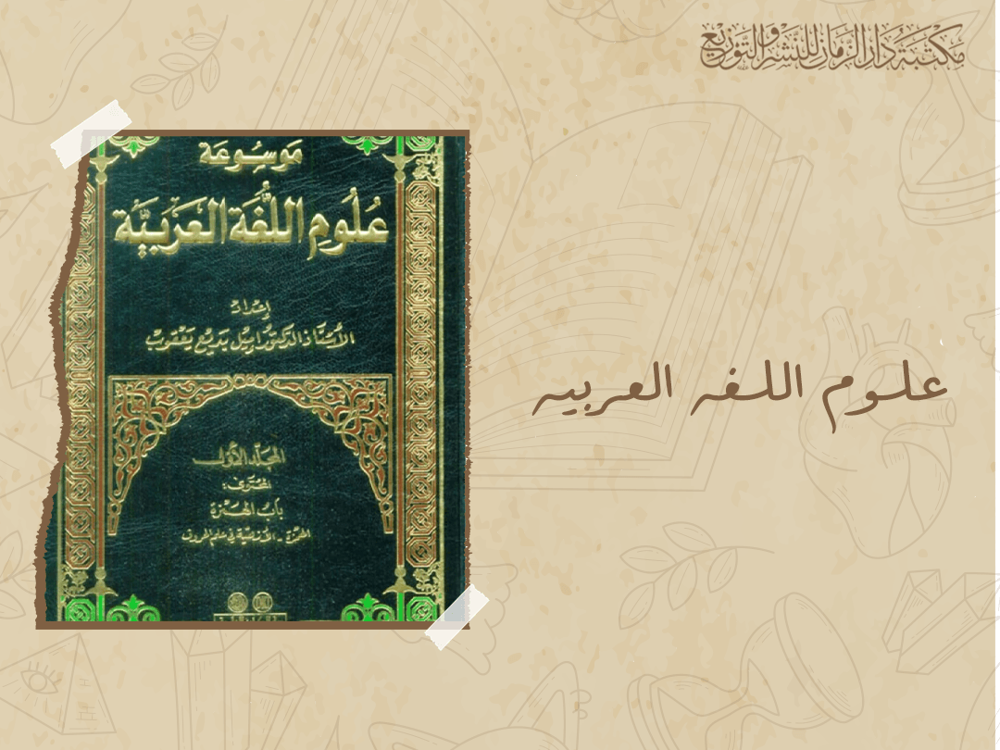
The Arabic language is one of the oldest and most influential Semitic languages in human history. Its roots stretch back thousands of years, and it is one of the richest languages in terms of vocabulary and meaning. In order to understand this linguistic treasure, we must explore the Arabic language sciences that contributed to its development and spread.
Arabic Language Sciences
Grammar
Grammar is one of the most important sciences of the Arabic language, and is concerned with the study of syntax and rules of expression. The goal of this science is to clarify how to properly structure sentences to ensure clarity of meaning. Among the most prominent grammarians: Sibuyeh, who is considered one of the first to set the rules of grammar in his book “The Book”.
The importance of grammar:
1. Corrects grammatical errors: Helps avoid mistakes that may lead to changes in meaning.
2. Facilitates understanding and interpretation: It makes it easier for the reader to understand complex texts.
3. Language protection: It contributes to preserving the Arabic language sciences from distortion and extinction.
Drainage science
Morphology is the study of the structure of a word and the analysis of its components such as roots and weights. This science is concerned with how words are derived from their roots and how they change their forms to perform different meanings.
The importance of morphology:
1. Vocabulary enrichment: Helps generate new words from linguistic roots.
2. Understanding texts: It is easier to understand the meanings of words in different contexts.
3. Language development: Enables language development by introducing new terminology.
Rhetoric
Rhetoric is the study of the arts of expression and linguistic techniques that make speech more effective and beautiful. Rhetoric is divided into three main branches: Semantics, Bayan, and Badiya.
The importance of rhetoric:
1. The beauty of the language: It improves language style and makes texts more appealing.
2. Speech effect: Enhances a speaker's ability to influence and persuade.
3. Interpretation of texts: Helps in a deeper understanding of literary and religious texts.
Presentation science
The science of presentation is concerned with the study of the weights and rhymes of Arabic poetry. This science is attributed to al-Khalil ibn Ahmad al-Farahidi, who established the first rules. Understanding the science of performance is essential for anyone who wants to write or study poetry.
The importance of performance science:
1. Organization of poetry: Helps poets write poems that are balanced and coherent.
2. Understanding poetry: It makes it easier for the reader to understand poetic weights and purposes.
3. Preservation of heritage: Contributes to the preservation of the Arabic poetic heritage.
Derivatization
Etymology is the study of how words are generated from triple or quadruple roots. It explains the relationship between different words and reveals their common origins.
The importance of etymology:
1. Understanding meanings: It helps in understanding the meanings of different words and how they relate to each other.
2. Expansion of vocabulary: Enables the generation of new words that meet the needs of the times.
3. Language development: Contributes to language development through innovation in the use of linguistic roots.
Semantics
Semantics is the study of the meanings of words and how they evolve over time. It aims to understand how words can have multiple meanings depending on the context.
The importance of semantics:
1. Interpretation of texts: Helps in understanding the different meanings of words in different contexts.
2. Language development: Contributes to language development by introducing new meanings to words.
3. Accuracy and clarity: It helps in choosing the most appropriate words to express different concepts.
The history of Arabic language sciences is full of scholars who contributed significantly to the development of its various sciences. These scholars left indelible imprints in the fields of grammar, morphology, rhetoric, rhetoric, presentation, derivation and semantics. Here are the most prominent scholars in each of these sciences:
Grammar
1. Sibweh (Abu Bishr Amr ibn Othman ibn Qanbar)
- Sibuya is considered one of the most prominent grammarians in Arabic history. His book “The Book” is one of the oldest and most important references in grammar.
2. Al-Kasa'i (Ali ibn Hamza ibn Abdullah)
- He was one of the most famous grammar scholars in Kufa and had a major role in the development of this science.
3. Al-Akhfash Al-Awsat (Saeed bin Masada)
- He is considered one of Sibweh's disciples and has important contributions to grammar.
Drainage science
1. Al-Khalil ibn Ahmad al-Farahidi
- In addition to his contributions to presentation, Al-Khalil is considered one of the founders of morphology and has several books that study word structure.
2. Al-Mabrid (Muhammad ibn Yazid)
- His book Al-Muqtadhir is one of the most important references in morphology.
3. Ibn Jinni (Abu al-Fath Uthman ibn Jinni)
- He is the author of several books on morphology and grammar, most notably Al-Khasisat.
Rhetoric
1. Abdul Qaher al-Jarjani
- He is considered one of the greatest scholars of rhetoric and has two famous books: “Dalilat al-Ijaz” and ”Asrar al-Balagha”.
2. Ibn al-Athir (Dia al-Din Ibn al-Athir)
- He is the author of the book “The Proverb in the Literature of the Writer and Poet,” which is considered one of the most important references in the science of rhetoric.
3. Zamakhshari (Mahmoud ibn Umar)
- His book Al-Kashaf is considered one of the rhetorical masterpieces in the interpretation of the Holy Qur'an.
Presentation science
1. Al-Khalil ibn Ahmad al-Farahidi
- He is the founder of the science of performances and is the author of the book “Offers,” which is considered the main reference in this science.
2. Middle Akhfesh
- He made significant contributions to the science of presentation and grammar.
Derivatization
1. Ibn Genie
- He is considered one of the most prominent scholars in this field and is the author of the book Al-Khasisat, in which he deals extensively with the science of derivation.
2. Al-Khalil ibn Ahmad al-Farahidi
- He made significant contributions to this science, in addition to his contributions to the sciences of grammar, presentation, and morphology.
Semantics
1. Abdul Qaher al-Jarjani
- His contributions to rhetoric intersect with semantics, as his books address how meanings affect expression.
2. Ibn Manzoor
- He is the author of the book “The Language of the Arabs,” which is considered one of the greatest references in semantics and understanding the meanings of words.
These scholars were not just researchers, they were innovators and innovators in the language sciences. Their contributions are still studied and used to this day, demonstrating the depth and importance of their work. By studying the work of these scholars, we can better understand the science of the Arabic language and explore its aesthetics and complexities.