

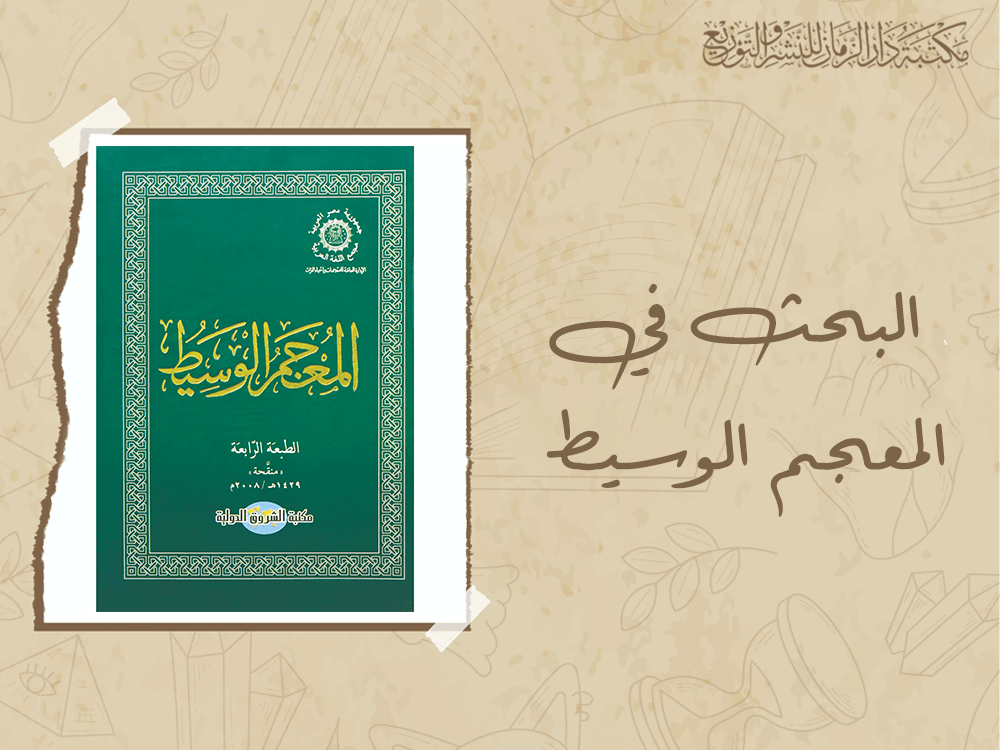
Researching the intermediate dictionary is an essential step in understanding the meanings of words and clarifying their different connotations, as it helps researchers and students reach the exact meaning of a word quickly and easily. Research in the intermediate dictionary is characterized by a clear methodology based on the arrangement of words according to their linguistic roots, making it an effective tool in the study of the Arabic language. Many learners face difficulty in searching the intermediate dictionary due to the need to know the linguistic root of the word before searching for it, but following the correct rules makes it easier. Researching in the intermediate dictionary is not limited to knowing only the meanings, but includes derivations and conjugations that help in understanding the correct usage of words. Therefore, mastering research in the intermediate dictionary enhances the ability to use the Arabic language accurately and clearly.
Searching the Intermediate Dictionary
Intermediate Lexicon Definition
1. Definition and Objectives of the Lexicon
A dictionary is a book that includes the vocabulary of a language and explains its meanings, and is an essential tool for understanding words and clarifying their different meanings. The dictionary aims to:
Clarify the meanings of words according to their different contexts.
Explanation of linguistic derivations and conjugations.
Documenting modern terminology and introducing it into linguistic usage.
Helping researchers and students study language and understand its vocabulary.
2. Intermediate Lexicon Definition
The Waseet Dictionary is one of the most famous modern dictionaries in the Arabic language, prepared by the Arabic Language Academy in Cairo to be a linguistic reference that combines originality and sophistication. The first edition was published in 1960, followed by other revised and amended editions.
The Waseet Dictionary is characterized by ease of style and clarity of arrangement, as it was prepared to be a suitable dictionary for students and researchers, compared to older dictionaries that adopted complex methods of vocabulary arrangement.
3. Organization that prepared it
The Waseet Dictionary was prepared by the Arabic Language Academy in Cairo, a scientific institution concerned with developing the Arabic language and enriching it with modern terminology. A group of scientists and linguists specialized in the field of language and dictionaries worked on the preparation of the dictionary, and their goal was to provide a dictionary that combines scientific accuracy and ease of use.
4. Intermediate Lexicon Content
The dictionary includes a detailed explanation of the words of the Arabic language, indicating their different meanings according to the contexts in which they appear. It also contains:
Precise linguistic definitions of vocabulary.
Explain word derivations and conjugations.
The inclusion of modern scientific terms that were not present in the old dictionaries.
Cite examples and explanatory sentences that help to understand the different meanings of the word.
Identify the metaphorical meanings of some words whose meaning has evolved over time.
5. The difference between an intermediate lexicon and older lexicons
The Waseet Dictionary differs from older dictionaries such as the Arabic tongue and the Oceanic Dictionary in terms of style and approach, as it is characterized by:
Ease of search: Words are arranged according to their roots, with clear explanations.
Adding modern terms that were not present in the old dictionaries.
A simplified and clear style suitable for students and researchers, compared to older dictionaries that relied on complex language and an extended style of explanation.
Research Methodology in the Intermediate Lexicon
Word order in the intermediate lexicon
The Waseet Dictionary is based on root alphabetical order, meaning that words are arranged according to their linguistic root rather than their direct order of pronunciation. This means that when searching for a particular word, you need to know its triple or quadruple root.
Example:
The word “library” is searched under "books" because it is derived from it.
The word “forgiveness” is searched under "forgive" because it comes from this root.
Steps to search the intermediate dictionary
To find the meaning of a word in the Intermediate Dictionary, the following approach is used:
1. Determine the linguistic root of the word:
If the word is derived (e.g. “beneficiary”), it should be returned to its triple root (“fad” → “fad”).
Superfluous words such as “do”, “react”, and “do” are searched under the original root.
2. Find the root in the first letter section:
Lexicon pages open starting with the first letter of the root.
Consider the order of the second and third letters to determine the exact location.
3. Read the different meanings of a word:
The word has several meanings depending on its context.
A word can have both real and metaphorical meanings.
4. Examples of searching in the intermediate dictionary
The word “diligence” → Root (JHD) → Search under “effort”.
The word “school” → Root (DRS) → Search under “lesson”.
The word “investment” → Root (wmr) → Search under “fruit”.
5. Clarifying meanings and polysemy
The Intermediate Dictionary relies on mentioning the different meanings of a single word, as some words have multiple meanings depending on the context, such as:
Eye: Used in the sense of the organ of sight, a fountain of water, or a spy.
Sword: It can be a name for a type of weapon, or a metaphor for strength and power.
6. Derivations and conjugations
The dictionary provides an explanation of how the word is conjugated in various forms, such as past and present tense, infinitive, subject and object, which helps researchers understand the morphological rules of the word.
7. Use examples and illustrative sentences
The dictionary adds illustrative sentences and examples to help the researcher understand the meaning of a word, especially when there are multiple meanings.
8. Documentation of modern terminology
Unlike older dictionaries, the Intermediate Dictionary includes modern scientific and technical terms, such as:
Computer
Genetic engineering
Electronics
Features of the Intermediate Lexicon
1. Ease of explanation and clarity: The Waseet Dictionary is characterized by using a simplified style that makes it easy to understand the meaning of words, even for students and beginners in the Arabic language.
2. Adding new terms: The dictionary contains new scientific and technical terms that match the modern developments in science and arts.
3. Accuracy and variety of meanings: The Intermediate Dictionary offers multiple meanings of words and presents them in different contexts, which helps in understanding the correct meaning in each case.
4. Clarify derivations and conjugations: The dictionary helps clarify how words are derived and conjugated, promoting a full understanding of the word.
How to search the Intermediate Dictionary
1. Determine the linguistic root: The researcher must know the root of the word before searching for it in the dictionary, and then search under the initial letters of the root.
2. Search by alphabetical order: The word is searched in the dictionary in the alphabetical order of the root, making it easy to find the meaning quickly
3. Choosing the right meaning for the context: After finding the word, you should choose the most appropriate meaning based on the context in which it is used.
Comparing the Intermediate Lexicon to other lexicons
1. Difference with Arabic tongue: Compared to older dictionaries such as Tasan al-Arab, Waseet is simpler and quicker to get to the meaning, with a greater focus on modern words.
2. Difference with the Oceanic Dictionary: The Intermediate Dictionary offers a simpler explanation and includes more modern terms than the Oceanic Dictionary which can be more complex at times.
The importance of the intermediate lexicon in linguistic studies
1. Teaching the Arabic language: The Waseet Dictionary is an essential tool in teaching the Arabic language to students at all stages, as it makes it easier for them to understand the meanings of words accurately.
2. A reference for researchers and translators: The dictionary is an important reference for researchers and translators who rely on it to understand and clarify the different meanings of words.
3. Preserving and developing Classical Arabic: The dictionary contributes to the preservation and development of the classical Arabic language in line with the changes in the modern era.
Researching the Intermediate Dictionary remains an important tool for understanding the Arabic language accurately, as it helps to clarify the different meanings of words according to a clear scientific methodology. By researching the Intermediate Dictionary, students and researchers can gain in-depth knowledge about the origins and derivations of words, which contributes to improving their language skills. Researching in the intermediate dictionary not only determines meanings, but also provides explanations and examples that contribute to the correct understanding of vocabulary. Therefore, paying attention to the skill of researching the intermediate dictionary is essential for anyone who seeks to master Arabic and improve their language level. Thanks to its accuracy and ease of use, research in the Intermediate Lexicon has become an essential part of modern linguistic and literary studies.