

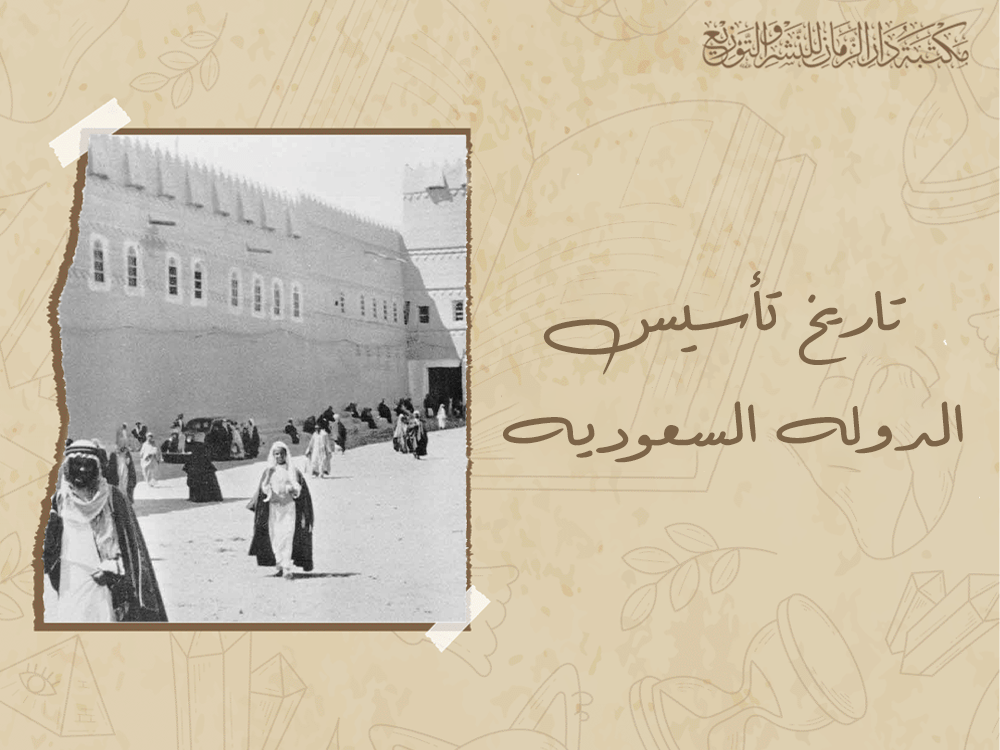
The history of the founding of the Saudi state is one of the important milestones in the history of the Arabian Peninsula, where the region witnessed major transformations that led to the emergence of a strong political entity. Since the 18th century, the history of the Saudi state began when Imam Muhammad bin Saud allied with Sheikh Muhammad bin Abdul Wahhab, establishing a strong state in Najd. As the years passed, the history of the establishment of the Saudi state went through multiple stages, starting with the first Saudi state, then the second, and finally the unification of the kingdom by King Abdulaziz. Studying the history of the founding of the Saudi state highlights the efforts made to achieve unity and stability. Today, the history of Saudi Arabia's founding remains a solid foundation for the Kingdom's growth and leadership in the region and the world.
Formation of the First Saudi State (1744-1818)
The founding of the first Saudi state dates back to 1744, when Imam Muhammad bin Saud, the ruler of Diriyah, allied himself with Sheikh Muhammad bin Abdul Wahhab, a religious scholar who sought to reform Islamic doctrine according to the monotheistic approach. This religious and political alliance was the cornerstone of the first Saudi state, with Imam Muhammad bin Saud providing political and military protection, while Sheikh Muhammad bin Abdul Wahhab provided the religious and intellectual foundation of the state.
The first Saudi state began to expand gradually, with many areas coming under its influence, such as Najd, Al-Ahsa, Hejaz, and Asir. A strong administration and an organized army contributed to this expansion, making the First Saudi State a prominent regional power in the Arabian Peninsula.
But this rapid growth worried the Ottoman Empire, which controlled large parts of the region through its local rulers in Egypt, the Levant, and Iraq. As a result, Muhammad Ali Pasha, the Ottoman governor of Egypt, sent a military expedition led by his son Ibrahim Pasha to eliminate the first Saudi state. After fierce battles, the Ottoman expedition managed to destroy Diriyah in 1818, where Imam Abdullah bin Saud was captured and taken to Istanbul, where he was executed, thus officially ending the First Saudi State.
The Second Saudi State (1824-1891)
After the fall of the First Saudi State, its influence did not completely disappear, and loyalty to its ideology and political approach continued among the tribes and influential figures in Najd. A few years later, Imam Turki bin Abdullah was able to regain control of parts of Nejd and re-established the Second Saudi State in 1824, making Riyadh its capital instead of Diriyah, which had been destroyed by the Ottomans.
The second Saudi state was characterized by inheriting the political and religious foundations of the first state, but it faced major internal challenges, most notably family disputes between the sons and grandsons of Imam Turki bin Abdullah over the rule, which led to the weakening of the state. Despite attempts by some rulers, such as Imam Faisal bin Turki, to stabilize the state, tribal conflicts and external interference, especially from the Ottoman-backed Al-Rashid Emirate in Hail, led to the fall of the Second Saudi State in 1891.
With the fall of the second Saudi state, Abdulrahman bin Faisal Al Saud, its last ruler, was forced to leave Riyadh and take refuge in Kuwait with his family, including his young son Abdulaziz bin Abdulrahman Al Saud, who would later begin the journey of regaining power and establishing the third Saudi state.
Establishment of the Third Saudi State (1902-1932)
After the fall of the second Saudi state in 1891, Imam Abdul Rahman bin Faisal Al Saud moved with his family to Kuwait, where his son Abdul Aziz bin Abdul Rahman Al Saud lived in exile, but he did not give up his dream of regaining power and re-establishing the Saudi state. King Abdulaziz had a clear vision and a strong will, and he began to develop a plan to regain Riyadh, which was under the control of Al Rashid, the rulers of the Emirate of Hail supported by the Ottoman Empire.
In 1902, after careful preparation and an elaborate military plan, King Abdulaziz led a small group of about 60 men and managed to enter the Masmak Palace in Riyadh and kill Ajlan bin Rashid, the appointed ruler of Al Rashid, thus regaining control of the city. This event was a turning point in the history of the founding of the Saudi state, as it formed the basis for the beginning of the process of unifying the country under the banner of the House of Saud.
After regaining Riyadh, King Abdul Aziz began to unify the Arabian Peninsula under his rule, using diplomacy and warfare. Over the next three decades, he managed to control large areas, from the Najd to Al-Ahsa in 1913, then fought battles with Sharif Hussein, the ruler of the Hejaz, and managed to annex Mecca in 1924, then Medina and Jeddah in 1925, ending the rule of the Ashrafs in the Hejaz.
King Abdulaziz's efforts continued until he was able to announce on September 23, 1932, the unification of all regions under the name “Saudi Arabia”, which was the official date of the establishment of the modern Saudi state.
The importance of Saudi Arabia's founding
The founding of Saudi Arabia is one of the most important events in the history of the Arabian Peninsula, as it contributed to achieving political stability and unity after centuries of tribal conflicts and fragmentation. The unification of the kingdom had a major impact on several aspects:
1. Political and security stability
Before the founding of the Saudi state, the Arabian Peninsula was plagued by tribal conflicts and the lack of a strong centralized authority. But after unification, King Abdulaziz succeeded in imposing law and order, ending the chaos and creating a safe environment for citizens.
2. Economic development
With the unification of the Kingdom, work began on developing infrastructure and introducing modern systems of governance and administration. The discovery of oil in 1938 was a major turning point, as it became one of the Kingdom's most important economic resources and contributed to accelerating overall development.
3. Religious and Global Role
The Kingdom of Saudi Arabia has great religious significance as the home of the Two Holy Mosques, making it a religious center for Muslims around the world. It has also strengthened its political status, becoming an influential country regionally and globally.
4. Social and cultural impact
Monotheism contributed to building the Saudi national identity, as King Abdulaziz worked to strengthen the spirit of belonging among citizens, linking them to their history and civilizational heritage. Stability also improved the quality of life, through the development of education, health, and transportation.
The history of the founding of the Saudi state remains a testament to the strong will and wise leadership that led to the emergence of one of the most important countries in the region, as the Kingdom continues today to achieve development and progress, based on strong foundations laid by King Abdulaziz more than a century ago.
The history of Saudi Arabia's founding is a testament to the struggles and unification that the Kingdom has gone through over the centuries. The history of Saudi Arabia's founding contributed to the formation of a unified and stable political entity in the Arabian Peninsula. As the Kingdom flourishes today, the history of Saudi Arabia's founding remains a source of pride and inspiration for future generations. Studying the history of the founding of the Saudi state reflects the efforts of the leaders to establish a strong and prosperous state. The history of the founding of the Saudi state will remain a symbol of unity and renaissance in the Arab and Islamic world.