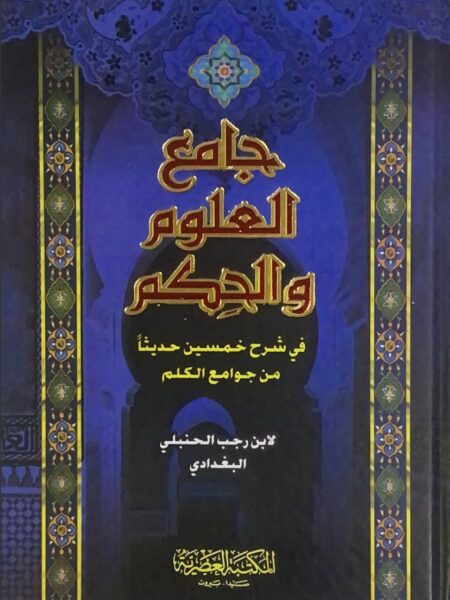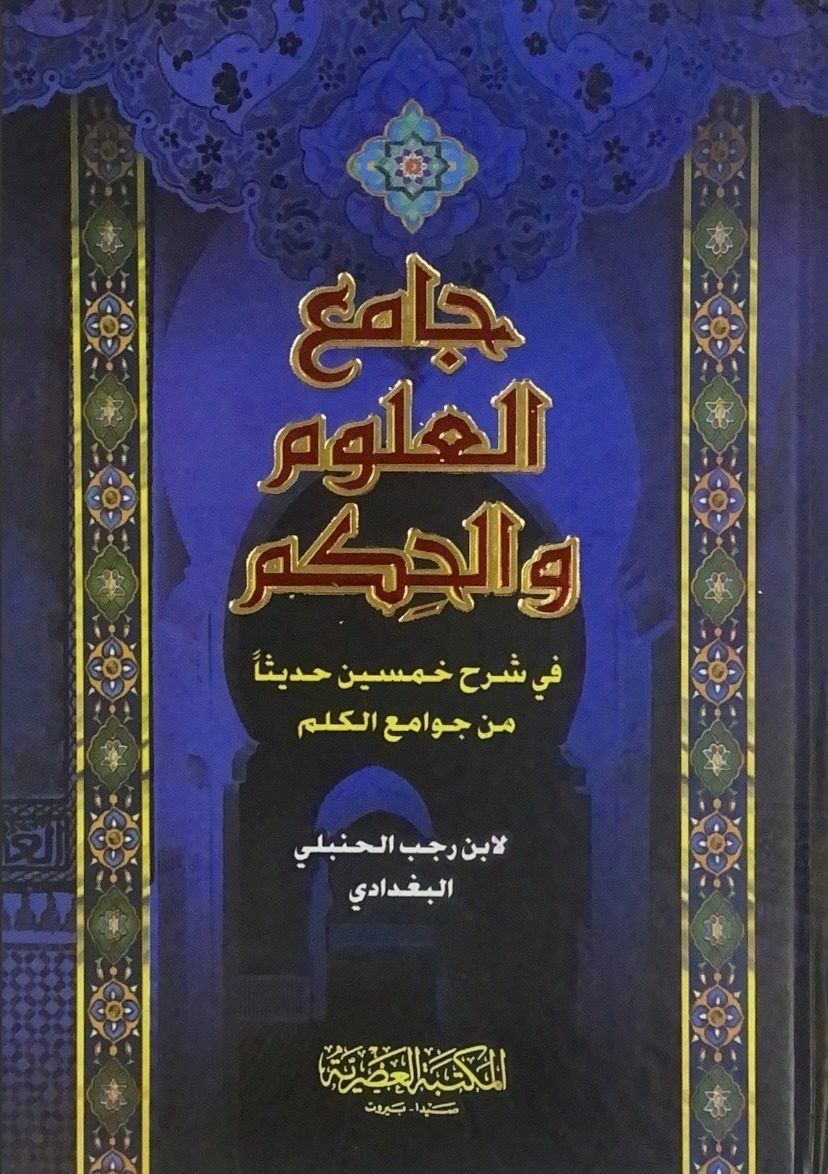
Description
The author of the book, Ibn Rajab al-Hanbali, said: “Allah, the Almighty, sent Muhammad (peace and blessings of Allah be upon him) with the plurality of words and specialized him with the best of wisdoms, as it is reported in the two Sahihahs from Abu Huraira about the Prophet (peace and blessings of Allah be upon him): “I was sent with the plurality of words” (1). Al-Zuhri said (2): “As far as we have heard, Allah combines for him the many things that were written in the books before him in one or two commands, and so on.
Book description:
-
The author of the book: Imam Zayn al-Din Abu al-Faraj Abu al-Faraj Abd al-Rahman bin Shihab al-Din “known as Ibn Rajab al-Hanbali”
-
He set its text and directed its hadiths: Muhammad bin Riyadh al-Ahmad
-
Number of pages in the book: 956 pages
-
The subject of the book: Explanation of Fifty Hadiths from the Gawam al-Kalam
The contents of the book:
From the hadiths explained in the book:
-
On the authority of “Umar, may Allah be pleased with him, he said: I heard the Messenger of Allah - may Allah bless him and grant him peace - say: ”Actions are based on intentions, and everyone has what he intends, so whoever's migration is to Allah and His Messenger, his migration is to Allah and His Messenger, and whoever's migration is to a world to gain or a woman to marry, his migration is to what he migrated to." Narrated by Bukhari and Muslim (1).
-
On the authority of Abu Ya'ala Shaddad bin Aws, the Messenger of Allah - may Allah bless him and grant him peace - said: “Allah has written charity on everything, so if you kill, kill well, and if you slaughter, slaughter well, and let one of you sharpen his blade and make his slaughter comfortable.” Narrated by Muslim (1).
-
It was narrated by Ibn Majah, Al-Darqatni and others on the authority of the Prophet (peace be upon him). Malik narrated it in Al-Mutawa from Amr bin Yahya from his father about the Prophet (peace be upon him). He omitted Abu Sa'id, but there are a number of ways in which they are mutually reinforcing (1).
-
On the authority of Ibn “Abbaas, may Allah be pleased with them both, the Messenger of Allah - may Allah bless him and grant him peace - narrated from his Lord, blessed and exalted be He: ”Allah, the Almighty, wrote down the good deeds and the bad deeds, and then explained them, so whoever thinks of a good deed, but does not do it, Allah will write it down for him as a perfect good deed, and if he thinks of it and does it, Allah will write it down for him as ten good deeds to seven good deeds. and if he thinks of a bad deed and does not do it, Allah writes it down as a perfect good deed, and if he thinks of it and does it, Allah writes it down as a single bad deed." Narrated by Bukhari and Muslim (1).
-
Narrated Anas ibn Malik (may Allah be pleased with him): I heard the Messenger of Allah (peace be upon him) say: “Allah Almighty said: O son of Adam, if you call upon Me and hope in Me, I will forgive you whatever you have done and I do not care, O son of Adam, if your sins reached the height of the heavens, then you forgive Me, I will forgive you, O son of Adam, if you came to Me with the dust of the earth for sins and then met Me with nothing in common with Me, I would bring you the dust of the earth for forgiveness.”(1) Narrated by al-Tirmidhi and said: A good hadith.
-
Narrated Al-Muqaddam bin Ma'ad Yaqrib: I heard the Messenger of Allah - may Allah bless him and grant him peace - say: “No human being has ever filled a vessel with an evil thing in his belly. The son of Adam should eat enough food to sustain his body, and if he must, one-third for his food, one-third for his drink, and one-third for himself.” Narrated by Imam Ahmad, al-Tirmidhi, al-Nisa'i and Ibn Majah, and al-Tirmidhi said: "This is a good hadeeth" (1).
-
On the authority of “Umar ibn al-Khattab (may Allah be pleased with him), the Prophet (peace and blessings of Allah be upon him) said: ”If you would put your trust in Allah, He would provide for you as He provides for the birds; they go out as sheep and return as ducks.“ Narrated by Imam Ahmad, al-Tirmidhi, al-Nisa'i, Ibn Majah, Ibn Habban in his ”Sahih" and al-Hakim, and al-Tirmidhi said: "It is good and true" (1).
-
On the authority of Abdullah bin Basr, he said: A man came to the Prophet (peace be upon him) and said: “O Messenger of Allah, the laws of Islam have become too much for us, so what door can we hold on to?” He said: "Keep your tongue moist from the remembrance of Allah." Imam Ahmad narrated it in this manner (1).
-
On the authority of Abu Burda, from his father Abu Musa al-Ash'ari, the Prophet (peace be upon him) sent him to Yemen, and he asked him about some drinks that were made there, and he said, “What are they?” Abu Barda said: “What are they?” He said: "Honey wine," he said: He said, "All intoxicants are forbidden." Al-Bukhari narrated it (1).
-
Abu Huraira, may Allah be pleased with him, said: The Messenger of Allah - may Allah bless him and grant him peace - said: “Every day that the sun rises is a charity: You help a man with his chariot, you carry him on it or lift his luggage for him, a good word is a charity, a good word is a charity, every step you walk to prayer is a charity, and every step you take to remove a debris from the road is a charity.” Narrated by Al-Bukhari and Muslim (1).