Description
Book description:
-
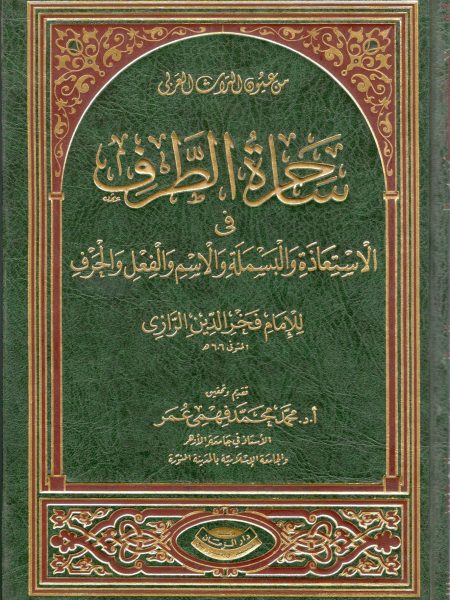
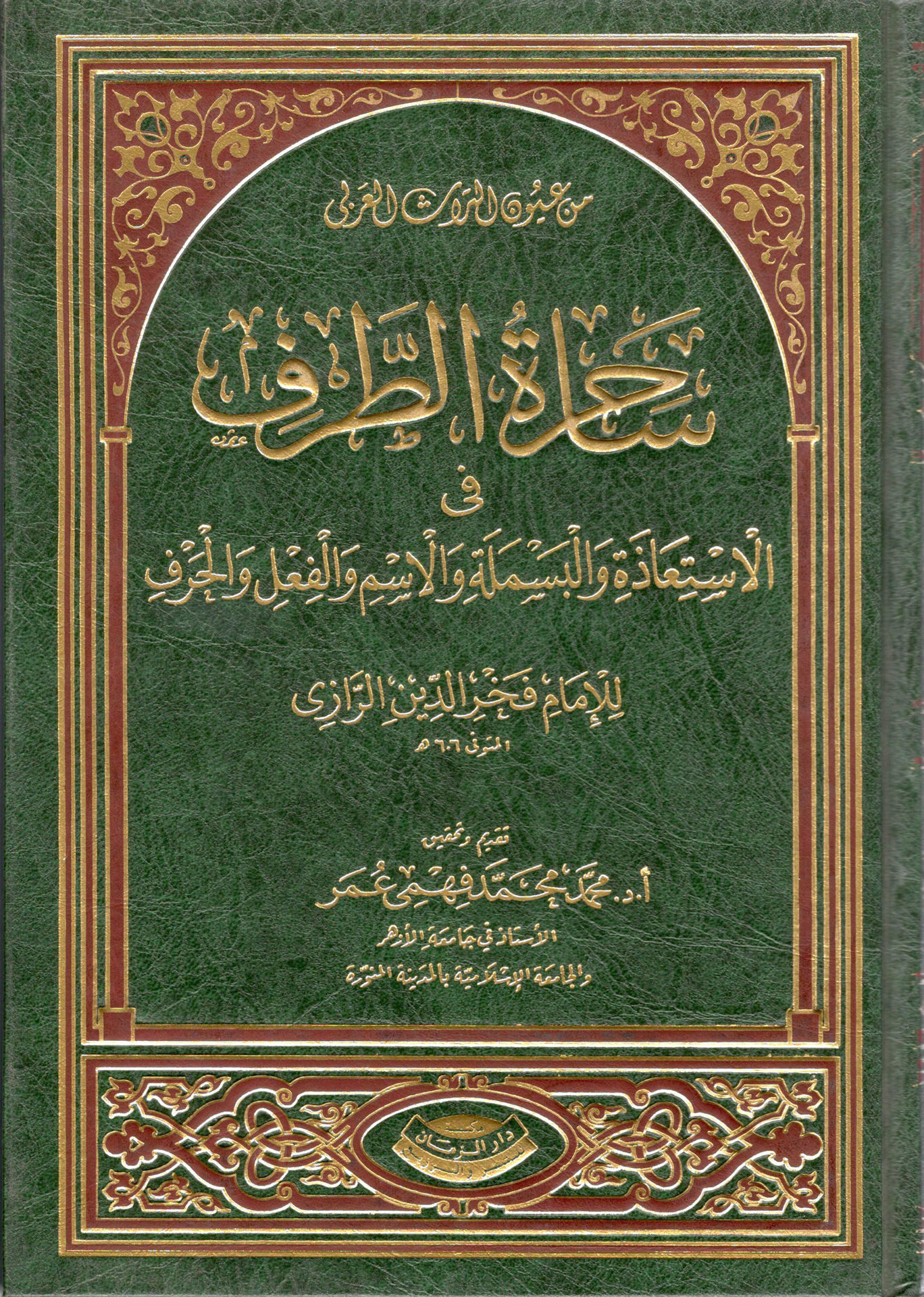
Author: Fakhr al-Din al-Razi
-
Correction and comment: A. Dr. Mohamed Mohamed Fahmi Omar
-
Number of pages: 131 pages
-
The theme of the book: Invocation, Bismillah, Noun, Verb and Verb
About the author:
He is Abu Abdullah Muhammad ibn Umar ibn al-Hasan ibn al-Hussein ibn Ali al-Razi, al-Tabarastani, born Qurashi, al-Timi al-Bakri, al-Shafi'i al-Ash'ari, known as Fakhr al-Din al-Razi, son of Khatib al-Rai, Sultan of the Talkers, and Sheikh of the reasonable and the movable: Physics, Mathematics, Medicine, and Astronomy.
He was born in Al-Rai, Qurashi, originally from Tabaristan, traveled to Khorezm, Beyond the River and Khorasan, and people came to his books to study them, and he was fluent in Persian.
He was famous for his responses to the philosophers and Mu'tazilites, and when he rode, three hundred students of jurists walked around him, and he was nicknamed Sheikh al-Islam in Hira, and he had many useful works in every art, the most important of which are: The Great Tafsir, which he called “The Keys of the Unseen,” in which he collected what is not found in other tafsirs.
He was born in 544 AH corresponding to 1149 AD in the city of Al-Rai, and it is said that he was born in 543 AH. He grew up in a house of knowledge, as his father, Imam Dia al-Din Omar bin Al-Hassan, was a fundamentalist jurist and Sufi speaker, and he was the orator of Al-Rai and its scholar, and had many writings in fundamentalism, preaching, and others, the most important of which is Al-Maram in the science of speech.
Al-Razi believed that learning all sciences is a legal obligation. Therefore, he loved all sciences and approached them without distinction, except for the difference between the virtuous and the inferior, and all sciences, in his view, do not go beyond being an obligation or that which is necessary to achieve a worldly interest or that which must be learned to know its harms and dangers and call for avoiding them.
Scientific books and other works:
-
The Great Tafsir or Keys of the Unseen.
-
Tafsir al-Saghir, Asrar al-Tanzil and Anwar al-Taweel.
-
The Foundation of Sanctification (The Basis of Sanctification in the Science of Kalam), a volume he wrote for Sultan al-Adil Abu Bakr ibn Ayyub, who sent him a thousand dinars.
-
The High Demands of Divine Knowledge, in three volumes, which he did not finish, and it is one of his last works.
-
The summation of the thoughts of advanced and late scholars, sages, and speakers.
-
Beliefs of Muslims and polytheists.
-
Al-Mahsoul in the Fundamentals of Jurisprudence.
-
Oriental Investigations in Divinity and Natural Science.
-
Lama'i al-Binat, explaining the names of God and the attributes.
-
Milestones in the fundamentals of religion.
-
Al-Arbaeen on the fundamentals of religion.
-
The Fifty Questions in the Fundamentals of Religion.
-
Al-Bayan wa al-Burhan in responding to the people of Zaygh and Toghyan.
-
Al-Mabahith Al-Amadiya in the hostile demands.
-
Guiding the beholder to the subtleties of secrets.
-
The end of brevity in the knowledge of miracles.
-
The End of Minds in the Knowledge of Origins, two volumes.
-
Manaqib al-Shafi'i.
-
The weighting of Shafi'i doctrine and its news.
-
The soul and spirit and explaining their powers in ethics.
-
Enlightenment in the Commentary on the Signals.
-
Labab al-Isharat wa al-Tanbayat (Commentary on Ibn Sina's Al-Isharat wa al-Tanbayat).
-
Commentary on Ibn Sina's Oyoun al-Hikmah.
-
Virtues of the Companions.
-
Judgment and fate.
-
Slander the world.
-
Breath of the source.
-
Monqa Riyadh.
-
The Obstruction of the Philosophers, in Persian.
-
Gyatherian beauties.
-
Baha'i proofs, in Persian.
-
Al-Risalat al-Kamaliyah fi al-Haqiqat al-Divine, in Persian by Kamal al-Din Muhammad ibn Mikael, Arabized by Taj al-Din al-Armawi.
-
The message of the individual essence.
-
Commentary on Al-Zamakhshari's Al-Mufassal in Grammar, unfinished.
-
Commentary on Nahj al-Balagha, unfinished.
-
Commentary on Diwan al-Mutanabbi.
-
Honorary Presbyterianism.
-
Mullahs and bees.
-
invalidate the analogy.
-
Creation and rebirth.
-
Siraj al-Qalb.
-
The Great Compilation, unfinished, also known as the Great Book of Medicine.
-
Anatomy from Head to Throat, unfinished.
-
Significant Verses, in Logic.
-
Abstract, in Philosophy.
-
Ethics.
-
Physiognomy.
-
Drinks.
-
Care.
-
Butter.
-
A book on geometry.
-
Book on Pulse, vol.
-
A book in sand.
-
Issues in medicine.
-
A message in the soul.
-
A Treatise on Prophecy.
-
A treatise on pointing out some of the secrets contained in some of the suras of the Qur'an.
-
The story of magic and magicians in the Quran.
-
The creation of the Qur'an between the Mu'tazilites and Ahl al-Sunnah.
-
The Revealer of the Origins of Evidence and the Classes of Causes.
-
Wonders of the Koran.
-
Nodal debates.
-
Healing the Eye and the Disagreement or Healing the Eye from the Disagreement.
-
The pillar of sight and the adornment of thought.
-
Muhammadan message.
-
The message.
-
The message is true.
-
Existence investigations.
-
Controversy detective.
-
Border Patrol.
-
Celestial tests.
-
Therapeutic tests.
-
tagged in the secret.
-
The Al-Alaya Method of Disagreement, four volumes.
-
Explanation of Euclid's encounters.
-
Commentary on Abu al-'Ala's Fall of the Zend.
-
Commentary on al-Wajiz by al-Ghazali, unfinished, of which he obtained worship and marriage in three volumes.
-
Commentary on the Colleges of Law, unfinished, written for the sage Thiqa al-Din Abd al-Rahman bin Abd al-Karim al-Sarkhsi.
-
The Gardens of Light in the Truths of Secrets: It contains the topics of sixty sciences, which he wrote for Sultan Ala al-Din Taksh al-Khwarizmi.
-
Durrat al-Tanzil and Ghurrat al-Tawil (On the Similar Verses).
-
Infallibility of the prophets.
-
The message of occurrence.
-
Sentences in speech
-
Tahdhib al-Dalil and Ein al-Maqsa.
-
Oriental Investigations in Divine Science.
-
Milestones, the last of his minor works.
Arbaeen Nuclear Commentary
Zarouk's commentary with Tanoukhy's commentary on the body of the letter