Description
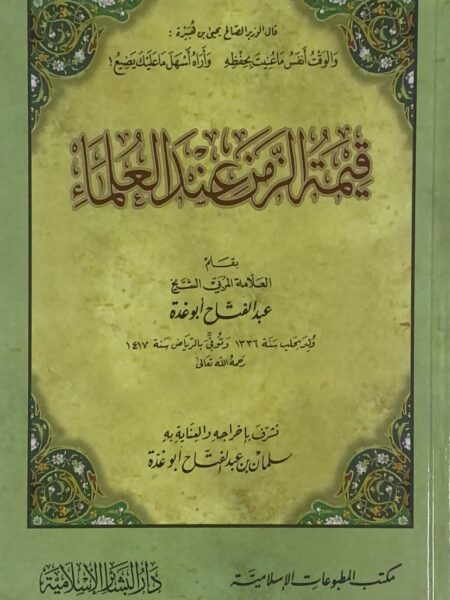
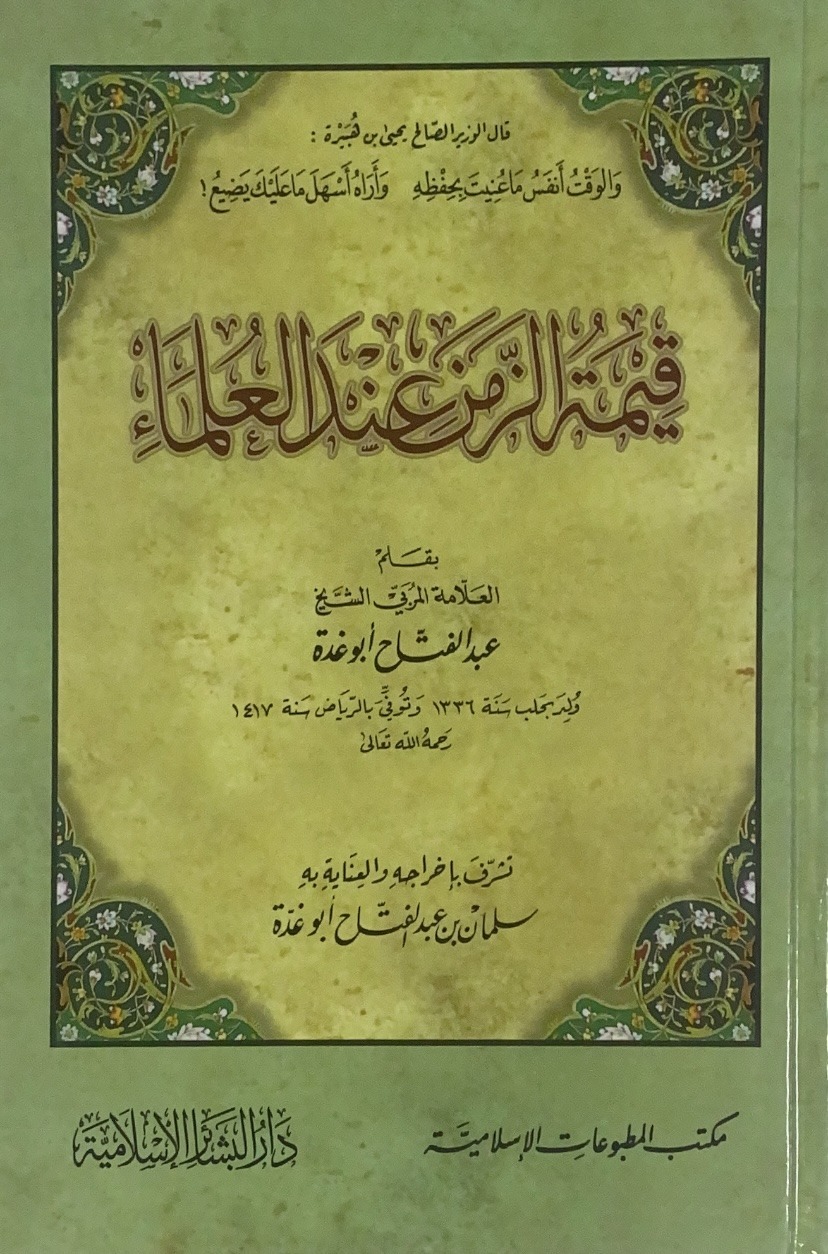
Book description:
- Author's name: Abdel Fattah Abu Ghada
- Number of pages: 403 pages
- The subject of the book: The book illustrates the value of time for scientists
The contents of the book:
The book contains many topics, including the following:
- Ashegan Moheb, by Muhammad Zahid Abu Ghadda
- Introduction by the caretaker
- The importance of attributing science to its author or transmitter
- Introduction to the eighth edition by the author, may Allah have mercy on him
- This book inspires people to write in its genre
- Texts on attributing knowledge to the one who said it or transmitted it
- The Islamic Fiqh Academy's decision that authorship and invention are the private rights of their owners
- This book is the result of nearly twenty years of reading and review
- The author's commitment in all his books is to attribute each word to the person who said it and name the source, although some people benefit from it and attribute the source he quoted from without mentioning it.
- An introduction to the fourth edition by the author, may Allah have mercy on him, in which he emphasizes the guidance of the Qur'an and Sunnah to take care of time and organize it in our education, life, and work
- Examples of Shari'ah mandates that are repeated in the Muslim's work, which are activated by the Holy Shari'ah with their times, to establish time management in the Muslim's life
- Muhammad ibn al-Nadr's grief over the day that passes in vain
- The heaviest hour for Al-Khalil ibn Ahmad Al-Farahidi is the hour when he eats
- Judge Abu Yusuf discusses jurisprudential issues at the time of his death
- Imam Shafi'i describes his appetite for science and his attachment to it
- Warning on the status of a hadith: Seek knowledge from the cradle to the grave
- Judge Abu Yusuf's son dies, so he arranges for his son to be buried so he can attend class
- Imam Muhammad ibn al-Hasan gets his clothes dirty and doesn't take the time to remove them because he is busy with science
- Imam Muhammad ibn al-Hasan sleeps very little at night
- Imam Shafi'i's division of the night into three parts
- Imam Abu Ubayd al-Qasim ibn Salam divides the night into three parts
- Hafiz al-Husayri's triangulation of the night
- Imam Abu Zayd al-Ansari teaches in his deathbed
- The jurist Issam al-Balkhi bought a pen for a dinar to write down what he heard immediately
- Muhaddith Muhammad ibn Salam al-Bikindi in Nadi: A movie with a dinar when his pen broke
- Muhaddith Ubayd ibn Yaish was taught by his sister for thirty years to write hadith: I hope the hadith is on me now, I'm afraid I won't meet you
- Yahya ibn Maeen's Imamate in Hadith and his spending (one million) dirhams to collect Hadith
- Ibn Mu'min wrote a thousand thousand hadiths and wrote one hadith fifty times Every hadith that Ibn Mu'min does not know is not a hadith.
- Ibn Mu'min said: "If you write, you scratch, and if you speak, you inspect," and its interpretation
- Interpreting the meaning of hadith among modernists
- The many books that Ibn Mu'min used to own and then left behind
- Imam Ibn al-Jawzi: The book of the scientist and his immortal son
- Imam Abu Bakr ibn al-Khayyat, a grammarian, is studying on the road and falls into a cliff Abu Jaafar al-Mahri is reading at his meal
- Al-Hafiz Abu al-Qasim al-Baghaghawi dies and al-Hadith is read to him
- The martyred ruler does not speak to his visitors when they visit him because he is busy writing
- Imam Abu Ishaq al-Bakri always taught science with a tail until just before his death
- Al-Hafiz Ibn al-Furat writes a hundred tafsirs and a hundred histories
- His handwriting is a testament to the authenticity of the transmission
- The many works of Hafiz al-Muhaddith Ibn Shaheen for keeping time
- Ibn Shahin spent seven hundred dirhams on ink for writing
- Monzer al-Marwani's grammatical nickname: Al-Mudhakira, because he was very attached to studying grammar
- The jurist Ibn al-Makkawi does not leave the reading on the day of the slave
- Muhaddith Ibn al-Baghdadi only sleeps when he is tired
- Faqih Ibn Mahmash al-Zayyadi ruled on the guarantee of the gendarmerie
- Definition of Dirk
- Ibn al-Salah's commentary on Ibn Muhammad's fatwa on extraction
- Al-Hafiz Abu Naim al-Isfahani reading hadiths to him in the Darah Road
- The astronomer Al-Biruni learns a math problem in his deathbed
- Al-Biruni was fluent in five languages and died at the age of 120
- Jurist Salim al-Razi is either copying, studying, reading, or reciting
- Al-Khatib al-Baghdadi is walking down the road while reading a book
- Imam al-Haramain Ibn al-Juwayni eats and sleeps out of necessity rather than habit
- At 50 years old, Imam al-Haramain is a grammarian's apprentice
Sheikh Ya'qub Al-Najir reads his book while walking Imam Ibn Aqeel and Ibn Al-Jawzi The end of the forests in keeping time Ibn Aqeel is one of the most virtuous of the world and one of the most intelligent of the people of Adam says: It is not permissible for me to waste an hour of my life - Ibn Aqeel chooses to eat wet cakes over bread to save time The diversity of Imam Ibn Aqeel's sciences and the variety of his writings
- Ibn Aqeel's Kitab al-Funun, one of his books, is eight hundred volumes.
- His words: The best way to pass the time and get closer to Allah is to seek knowledge
- Ibn Aqeel's words upon his death: Let me be ready to meet God
- Ibn al-Jawzi's writings exceeded 500 authors by saving time by knowing the honor of time and filling it with the best of the best.
- Most people waste time on things that don't work
- Ibn al-Jawzi took refuge from the company of idle people
- Doing things that don't preclude conversation when meeting visitors
- Two Wise Rules of Timekeeping
- Two houses in stealing time from the unemployed
- Verses for ornaments for visitors
- A joke by Ibn Nabhan on getting rid of drumming guests
- The honor of time is only known to the fortunate
- Imam al-Razi's son dies and he is not distracted by regret and thought from continuing to compose
- Imam al-Razi is a humble seeker of knowledge and a great imam
- Imam Ibn Sakinah kept his time, organized it and filled it with good deeds
- Ibn Sukaynah said to his students: "Don't exceed the question 'Salaamu alaikum'
- The Andalusian writer Ibn Said finds comfort in learning
- Imam Ibn Taymiyyah, the grandfather, reads the book to him when he enters the closet
- Al-Hafiz Al-Mandhari wrote 90 volumes and 700 parts by hand
- A benefit of dating one's writing
- Al-Hafiz al-Mandhari engages in science while eating
- Al-Hafiz Al-Mandhari doesn't leave the school for funerals or mourning
- Al-Hafiz Al-Mandhari's precious son dies, so he mourns him only at the door of the school
- Historian Ibn al-Adim al-Halabi writes down science as a traveler
- Imam Ibn Malik used to pray, recite, compose, or read
- Al-Qarimi's whitewashing of al-Nasafi's Manar al-Anwar commentary while on a pilgrimage
- Imam Ibn Malik memorized eight verses before his death, taught to him by his son
- Imam Nawawi did not put his side on the ground for about two years
- Imam al-Nawawi reads twelve lessons every day with notes and commentary
- Imam Nawawi only eats one meal a day and night
- Imam Nawawi's austerity and fear of God in his food, clothing, and livelihood
- Imam Nawawi only sleeps for a moment if he falls asleep
- Imam Nawawi read al-Wasit four hundred times
Also browse:
- A special collection of books Culture
- 555 commandments to become a successful coach and speaker