Description
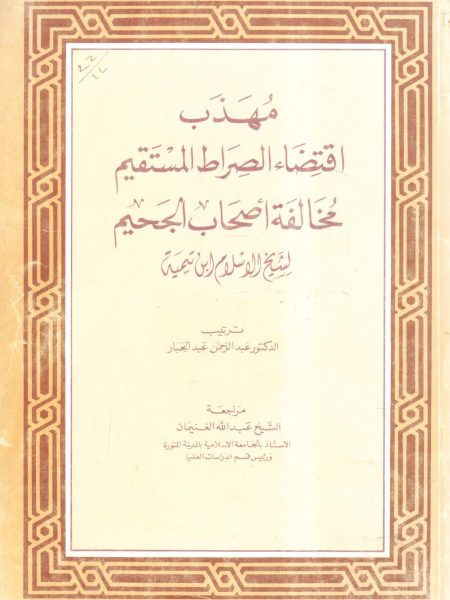
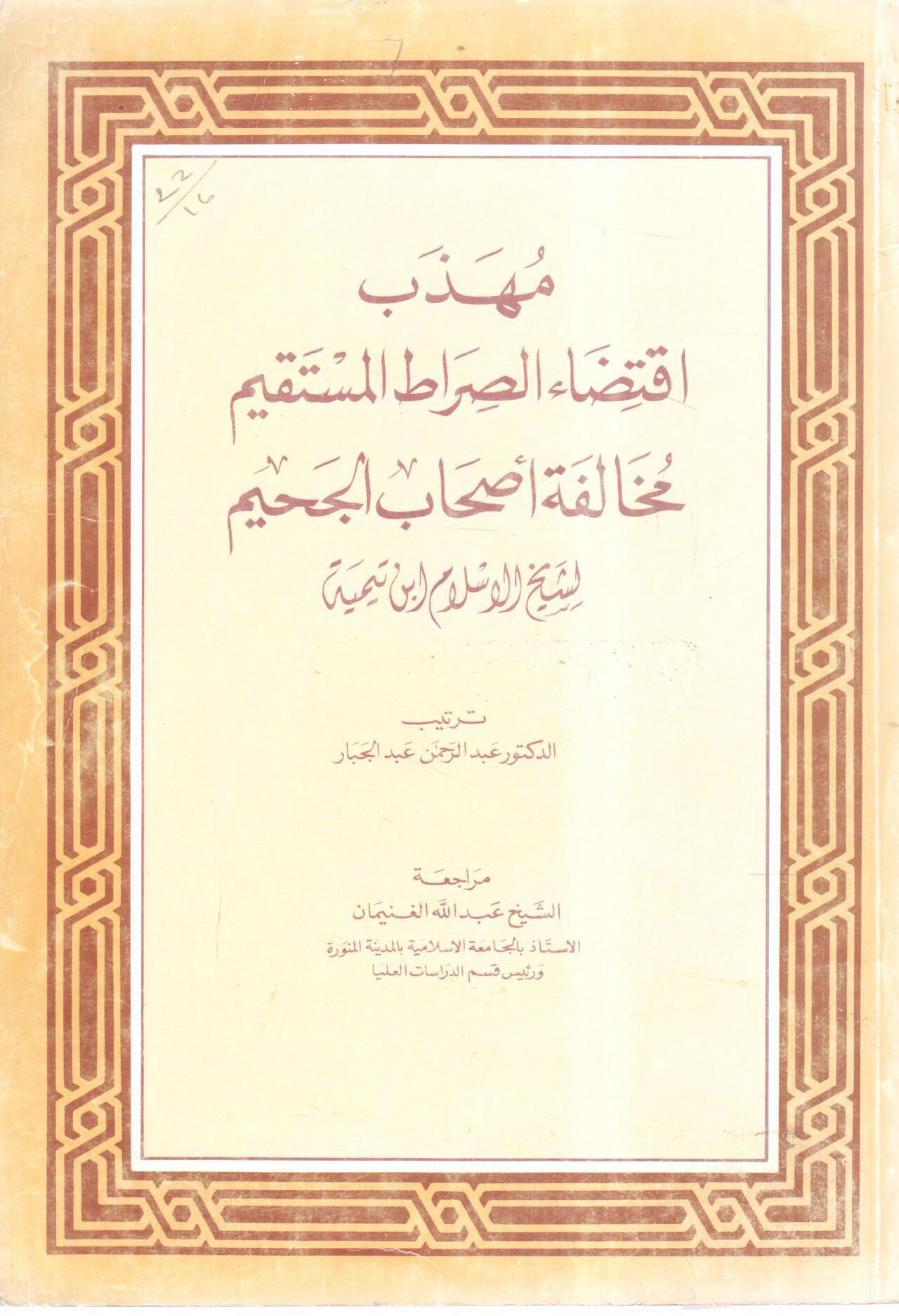
Book description:
- Author's name: Ahmed Ibn Taymiyyah
- Number of pages: 540 pages
- The subject of the book: The Righteousness of the Straight Path and the Unrighteousness of the Companions of Hell
The contents of the book:
The book contains many topics, including the following:
-
- Introduction
- First section
- A brief translation of the author
- Description of the manuscripts
- Name and date of authorship of the edited book Approach to realizing the book and commenting on it
- An analytical study of some of the book's themes: The main theme of the book
- First topic: The author's alert on two important assets
- Second topic: Characterizing Some Types of Heresies
- Third topic: The impact of imitation on the nation
- Fourth topic: Basic Rules of Simulation
- Theme 5: Groups of people we are forbidden to imitate
- Sixth topic: The prohibition against all traits of infidels
- Topic VII: When it is permissible to imitate non-Muslims
- Topic VIII: Festivals and heterodox celebrations
- Topic IX: In jargon
- Tenth topic: On the concept of heresy
- Topic Eleven: Heresies of graves, shrines, and shrines
- Section II: The book is edited with commentary
- The Sermon of Need (from the edited book)
- Reason for writing the book
- The state of people before Islam
- The impact of Muhammad's prophethood and guidance
- Jews and Christians
- Explain that this is not a statement about the entire Ummah, and that a sect of them will remain in the truth until the end of time.
- Mentioning some of the things of the People of the Book and the Arabs that plague some Muslims
- The straight path: Inner things, outer things, and between them there is an occasion
- The command to contradict those who are wronged and misguided in outward guidance for a number of reasons:
- Sharing the same phenomenon leads to similarities in morals and actions.
- Violation of the outward appearance requires separation and leaving the causes of anger
- Participation in the phenomenon means mixing and not distinguishing between those who are blessed and those who are disfavored
- In mentioning the evidence from the Book, Sunnah, and consensus on the command to oppose the infidels in general, and on their festivals in particular
- Explaining the benefit of disobeying the unbelievers, and the harm and disadvantage of following them The Book of Allah - its general and general significance, and the Sunnah explaining and clarifying it Inference from the Qur'an on the prohibition against following the unbelievers
- Verses (16) to (19) and the reasoning behind them
- Aina al-Ra'd ( 36 - 37 ) and the reasoning behind them
- Al-Baqarah verse ( 120 ) and the reasoning behind it
- Al-Baqarah verses (145-150) and the reasoning behind them
- Al-Imran verse ( 105 ) and the reasoning behind it
- The verses of repentance (67-73), their interpretation, reasoning, and comparison
- Between the characteristics of the hypocrites and the characteristics of the believers mentioned in these verses Enjoying creation, and the wading into it that other nations have fallen into - explaining its meaning and that this nation will fall into it.
- Enjoying creation refers to following lusts, and wading refers to following suspicions
- Vilification of those who do it until the Day of Judgment
- What the Qur'an says about this, the Sunnah also says about it.
- Hadith: And you will take what the nations before you took?
- And what some of the companions of the Prophet Muhammad said about it
- The difference that the Prophet told Allah about is either in religion, in the world, or in both
- What the hadiths of disagreement indicate is what Allah has forbidden in the Qur'an
- Hadith: I asked my Lord three times and He gave me two
- Hadith: Allah leveled the earth for me, and I saw its east and west sides.
- The Prophet's Fear of Misguided Imams
- Telling him that a portion of my Ummah will join the polytheists
- Thirty liars claiming to be prophets will rise up in them.
- and that there is still a sect of them who are on the right and victorious
- Dispersion and disagreement are bound to occur in the Ummah
- Hadiths forbidding disagreement
- Most of the disagreement between the Ummah is where each of the disputants is correct in what he proves
- is wrong to deny what his opponent is
- Difference in the Book is the cause of the destruction of previous nations
- The difference that God mentions in the Qur'an is twofold
- One of them: Things that vilify both sides of the conflict
- This unfortunate disagreement is sometimes caused by bad intentions
- Most of the disagreements that lead to passion and bloodshed are from the first section of the Prophet about asking too many questions
- The difference may be in the download and letters, and it may be in the interpretation
- The origin of the human race's doom is disputing fate
- The Origin of the Magi, Sabians, and Qadiris
- Hadith al-Anwat
- The Qur'an and the Sunnah, just as they indicate that this nation is similar to the Jews, Christians, Persians and Romans, they also indicate that this is forbidden and that there is still a sect of this nation that is on the right
- Return to the Qur'an's prohibition against imitating infidels - Al-Baqarah verse
- What some of the predecessors had to say about the interpretation of the verse
- Then he mentioned other verses about the dispersion of the People of the Book and warned against it
- Whoever follows another in some of his affairs is like him in that matter
- Lifting the burdens and shackles that plagued the People of the Book from this nation
- The Prophet warned his Ummah about monasticism and celibacy
- The prohibition against taking Jews and Christians as guardians
- The participation of infidels in the outward appearance is a pretext for loyalty and affection for them, and there is no
- Interest as in contrasting and boycotting
- The Salaf understood that disbelief is like a disease of the heart, and the Salaf understood that disobedience to the unbelievers is something intended by the Shari'ah.
- The command to change gray hair is an offense to the Jews The command to grow beards and mustaches is an offense to the polytheists and the Magi
- Disobeying the Magi is intentional
- The prohibition against shaving the scruff in contravention of the Magi
- The prohibition against leaving the prayer with slippers, contrary to the Jews
- The prohibition against delaying Maghrib until the stars are intertwined.
- The prohibition against continuing fasting as the Christians do
- The command to have sex with menstruating women and to meet with them at home is contrary to the Jews
- The Prophet forbade praying at sunrise and sunset in order to prevent the infidels from worshipping the sun because they prostrate to it at that time.
- The Sabians' veneration of the planets, and in recent times there are Muslims who do so The prohibition against praying to that which is worshipped without God
- The Shari'ah forbids resemblance to the infidels in places - such as the Qibla and what they pray to - and in times
- It is forbidden to rely on the hand in prayer because it is the session of those who are tormented. It is forbidden for a man to put his hand in his loins in prayer because the Jews do it, and because they dislike standing behind a seated imam, as do Persians and Romans.
- Blood of some of the qualities of jahiliyyah
- Disgraceful nervousness
- Adding something to the jahiliyya requires it to be condemned
- Types of reprehensible qualities of jahiliyyah
- Proselytizers, preachers, and fanatics, and the details of what to say about them
- Corruption is in religion and corruption is in the world
- Types of Religious Corruption
- Meaning of Sunnah Jahiliyyah - what it means
- The inclusion of works in the name of faith is real, not metaphorical
- No Jahiliyyah after the Prophet's Resurrection
- The restrictive jahiliyya may exist in some Muslim homes and people
- The prohibition against entering and praying in places of torment
- The prohibition against praying in a cemetery, the land of Babylon, and other places of torment
- Whoever resembles a people is one of them
- The concept and requirement of mimicry
- Some of the Salaf disliked things from the dress of non-Muslims
- The prohibition against imitating Jews and Christians in the peace sign
- The difference between Muslims and polytheists wearing turbans over shirts
- The prohibition against women resembling men and men resembling women
- Fasting on Ashura, and one day before or one day after, in opposition to the Jews
- The times of fasting, breaking the fast, etc. are established by sighting, contrary to the People of the Book The prohibition against advancing Ramadan by one or two days, contrary to the People of the Book
- Examples of Shafi'i statements Examples of Hanbali statements
- Separate
- The command to oppose demons The command to oppose those who have not completed their religion, such as the Arabs
- Separate
- There is a difference between imitating infidels and devils, and between Arabs and Ajamis. The term Arabs refers to the desert Arabs are better than Ajamis, and Muhammad is the best of creation, both in person and in lineage The prohibition against hating Arabs
- People are divided into righteous and unrighteous, believers and disbelievers.
- The Qur'an and Sunnah praise some Arabs - some of the sons of Persia
- Living in villages is closer to the perfection of religion and tenderness of heart than living in the desert
- Other Bedouin have the rule of the Arab
- Quraysh is the best of the Arabs, and Bani Hashim is the best of the Quraysh
- Populism doesn't recognize Arabs, and that's kind of hypocritical
- The descendants of Ishmael from Ibrahim are better than the descendants of Isaac, and this preference requires love for Bani Hashim, then for Quraysh, then for Arabs.
Also browse:
- A special collection of books Religious books
- MUSLIM CHRISTIAN DIALOGUE is different