Description
Book description:
-
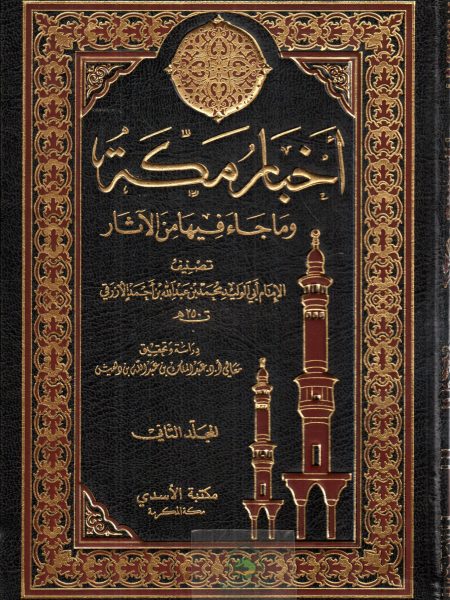
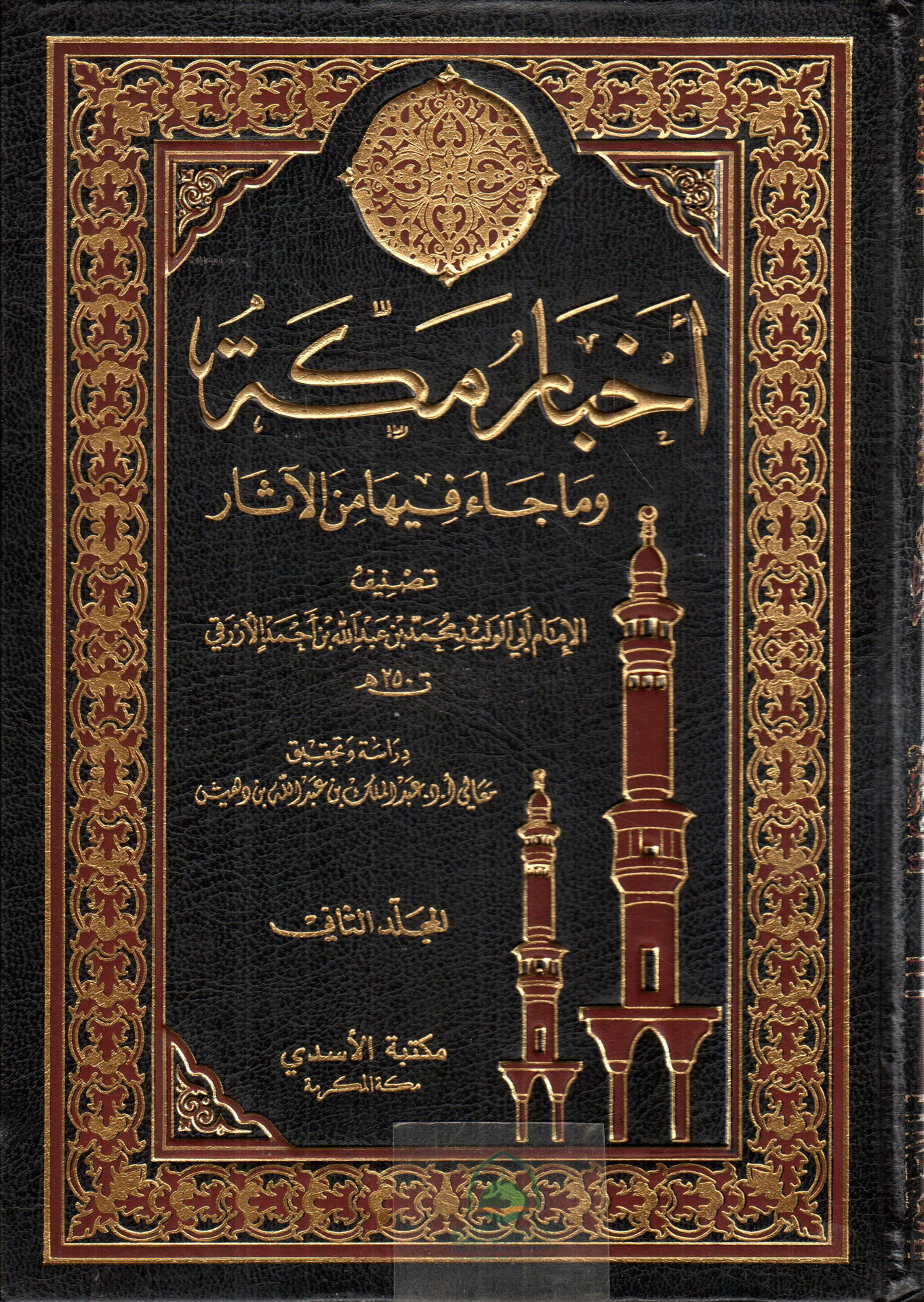
Author: Abu al-Walid Muhammad ibn Abdullah ibn Ahmad ibn Muhammad ibn al-Walid ibn Uqba ibn al-Azraqi
-
Number of pages: 1189 pages
-
Number of volumes: 2 volumes
-
The theme of the book: News of Mecca
The contents of the book:
-
The mention of what the Kaaba was on above the water before God created the heavens and the earth, and what was reported about it
-
The angels built the Kaaba before the creation of Adam and the beginning of the circumambulation
-
Mentioning the visit of the angels to the Sacred House, honored by Allah
-
The mention of Adam's descent to earth, building the Kaaba, Hajjah, and circumambulating the house
-
What is related about Adam's pilgrimage and his prayers for his descendants
-
Year of circumambulation
-
Adam's loneliness in the land when he landed, and the virtues of the Holy House and the Sanctuary
-
What is mentioned in the Mamour House
-
What was said about the raising of the built house at the time of the drowning, and what was said about it
-
The mention of Adam's children building the Sacred House after the death of Adam (peace be upon him)
-
What is reported about the circumambulation of Noah's ship at the time of the sinking of the Holy Mosque
-
The matter of the Kaaba between Noah and Abraham, peace be upon them
-
What is mentioned about Ibrahim (peace be upon him) choosing the location of the Sacred House from the earth
-
The chapter on Abraham's housing his son Ishmael and his mother Hajar in the beginning of his command at the Sacred House and how it was
-
The mention of Jarhum landing with Ishmael's mother in the Haram
-
What is mentioned about Ibrahim building the Kaaba
-
The pilgrimage of Abraham, peace be upon him, his announcement of the pilgrimage, the pilgrimage of the prophets after him, his tawaf, and the tawaf of the prophets after him
-
The Almighty says: The first house that was built for people, and what was said about it
-
What came in the matter of Ibrahim, God's Khalil, security and sustenance for the people of Makkah, and the books in which the sanctuary was found to be glorified
-
Mention of the guardianship of the sons of Ismail bin Ibrahim, peace be upon them, of the Ka'ba after him, and the order of Jarhum
-
The mention of Khuza'a's guardianship of the Ka'ba after Jarhum and the command of Mecca
-
Chapter about Qusay ibn Kalab's guardianship of the Sacred House and the command of Makkah after Khuza'a and what was mentioned about it
-
The spread of Ishmael's children, their worship of stones, and the change of Hanifiyyah, the religion of Abraham, peace be upon him
-
Chapter on who first set up idols in the Ka'ba and the use of azlams
-
Chapter on who first set up idols and who broke them
-
Chapter on the idols that were on Safa and Marwah, who erected them, and what was reported about them
-
What came in Manat and who first installed it
-
A chapter on what was said about al-Lat and al-Uzza and what was said about their appearance and how it was
-
What is said in The Watts of Anwat
-
The breaking of idols
-
Ba'ab's march to Mecca
-
The beginning of the elephant story
-
Mention of the elephant when the Abyssinians drove it
-
The mention of the Quraysh building the Kaaba in Jahiliyyah
-
Chapter on the opening of the Kaaba, when they opened it and when they entered it, and the first to take off their shoes and slippers when entering it
-
The pilgrimage of the people of Jahiliyyah and the feminization of the months and seasons
-
The Jahiliyyah honoring the pilgrim
-
Feeding the People of Jahiliyyah the Hajj pilgrims
-
What was reported about the fire of the Ka'ba and what happened to it when Abu Qubais threw a catapult at it
-
The chapter on Ibn al-Zubayr's construction of the Ka'bah and what he added to it from the arms that were in the stone of the Ka'bah and what the pilgrims took away from it
-
What was said about the Kaaba's quarry and where it was quarried from
-
The Kaaba's horns, the ram's horns, and who hung those horns
-
A copy of the tablet in the hollow of the Kaaba that was with the bed, in the name of Allah, Imam Al-Ma'mun, the Commander of the Faithful, honored by Allah, ordered Fadl bin Sahl to send this bed from Khorasan to the Holy House of Allah, in the year two hundred, which is the bed of Asbahbad Kabul Shah.
-
The copy of the two books that were written in the belly of the Ka'ba, to which he testified, and the copy of the condition that Muhammad Ibn Amir al-Mu'minin wrote in the belly of the Ka'ba, in the name of Allah, the Merciful, the Compassionate, this is a book for Abdullah Harun, the Commander of the Faithful, written for him by Muhammad Ibn Harun, the Commander of the Faithful, in the health of his body and mind and the permission
-
The copy of the condition written by Abdullah ibn Harun, Commander of the Faithful, in the belly of the Ka'ba, in the name of Allah, the Merciful, the Compassionate, this is a book written for Abdullah ibn Harun, Commander of the Faithful, in the soundness of his mind, the permissibility of his command, and the sincerity of his intention, in what he wrote in his book and the knowledge of what is in it
-
Imam al-Ma'mun, the Commander of the Faithful, was ordered to carry this crown from Khorasan and hang it in the place where the two conditions were hung in the Sacred House of Allah in thanks to Allah Almighty for the victory over those who betrayed him and to honor the Kaaba if those who disrespected it disrespected it.
-
Mention of the mountain that was in the Ka'bah in Jahiliyyah and the money of the Ka'bah that was dedicated to it, and what was reported about it
-
The mention of who dressed the Kaaba in Jahiliyyah
-
Mentioning the covering of the Ka'ba in Islam, its aroma, its servants, and the first person who did so
-
What came about the stripping of the Kaaba and the first person who stripped it
-
The Prophet (peace and blessings of Allah be upon him) gave the key to 'Uthman ibn Talha
-
Praying in the Ka'ba and where the Prophet (peace be upon him) prayed from
-
What is reported about Bilal ascending the Kaaba and giving his call to prayer on the day of conquest
-
The chapter on the Abyssinian who destroys the Kaaba and the chapter on those who want to harm the Kaaba, etc.
-
What to say when looking at the Kaaba
-
The names of the Kaaba and why it is called the Kaaba, and because no house should be built overlooking it
-
What is said in Allah's saying: "We made the house a place of refuge for people and security.
-
What is stated in Allah's saying, "Allah made the Ka'ba, the Sacred House, a place for people to reside.
-
What is related about Abraham and Ishmael cleansing the house for the worshippers, the standing, the kneeling, and the prostrate.
-
What came about the first to wake up around the Kaaba and in the Sacred Mosque in Makkah and on the night of the crescent of Muharram
-
Abu al-Walid said: "The Ka'ba was built by Ibrahim, the Khalil al-Rahman, so its length in the sky was nine cubits and its width in the earth was thirty cubits: Abraham, the Khalil al-Rahman, built the Ka'ba, the Sacred House, making its length in the sky nine cubits, its length in the earth thirty cubits, and its width in the earth twenty-two cubits, and it was unroofed during the time of
-
The length of the house from the outside is twenty-seven cubits, the length of the face of the Ka'ba from the black corner to the Shami corner is twenty-five cubits, the length of its side from the Yemeni corner to the western corner is twenty-five cubits, and the length of its right side from the black corner to the Yemeni corner is twenty cubits, and the length of its right side from the black corner to the Yemeni corner is twenty cubits.
-
The length of the Ka'ba from the inside of the Ka'ba, Abu al-Walid said: The length of the Ka'ba in the sky from its interior to the lower roof from what follows the door of the Ka'ba is eighteen and a half cubits, and the length of the Ka'ba in the sky to the upper roof is twenty cubits, and there are four pillars in the roof of the Ka'ba from the upper roof to the lower roof
-
The length of the walls between the pillars and the length of the walls between the black corner and the right corner to the first cylinder is four and a half cubits, the length of the first cylinder to the second cylinder is four and a half cubits, and the length of the second cylinder to the third cylinder is four and a half cubits
-
Abu al-Waleed said: The roof of the Ka'ba has four pillars, one of which is towards the western corner, the second towards the Yemeni corner, the third towards the black corner, and the fourth towards the middle cylinder, which is the one that follows the walls between the black corner and the Yemeni corner.
-
Abu al-Walid said: In the wall opposite the door of the Ka'ba, which is the door of the Ka'ba, there is a black stump, striped with white, with a capacity of twelve fingers by the same, rounded, with a gold collar around it, three fingers wide, and it is facing those who enter from the door of the Ka'ba, and its height from the belly of the Ka'ba is six and a half cubits:
-
It is square with the two walls of the Ka'ba in the corner of the Shami corner of the Ka'ba, inside the Ka'ba from its wall where its door is, three and a half cubits, and the length of the other wall next to the stone is three and a half cubits, and the length of the door of the step in the Ka'ba is three and a half cubits.
-
The lower marble is in the belly of the Ka'ba, and the belly of the Ka'ba is decorated with white, red, and green marble and gold and silver-clad panels, which are two buttons, a lower button in which there are thirty-eight panels each two cubits and eight fingers long, of which the white panels are twenty-one in the walls
-
Abu al-Waleed said: In the second top garment, there are forty-two panels, each panel is four cubits and four fingers long, the white panels are twenty of them, five of them are in the wall between the right corner and the black corner, one of them is in Al-Multazam, and one of them is in the wall in which
-
Description of the nails in the belly of the Ka'ba: Abu al-Walid said: There are sixteen nails in the boards, three of which are in the boards after the Mutazam, and three in the boards between the Yemeni corner and the black corner, which is the one after the Yemeni corner, and three of which are in the belly of the Ka'ba.
-
Abu al-Walid said: The floor of the Ka'ba is furnished with white, red and green marble. The number of marbles is thirty-six, of which four are green between the pillars and between the walls of the Ka'ba, the width of each marble is a cubit and four fingers, and their width is from the width of the chairs of the pillars and from the wall where the door is a door.
-
Abu al-Walid said: This was until the last months of the year forty and two hundred and forty, and Muhammad al-Muntasir Allah, the crown prince of the Muslims at that time, was in charge of Mecca, the Hejaz and other places, and the governor of Mecca wrote to him that I entered the Kaaba and saw that the marble on the floor was broken into small pieces.
-
The length of the door of the Kaaba in the sky is six cubits and ten fingers, and the width between its two walls is three cubits and eighteen fingers, and the walls, the upper threshold of the door, and the drywall of the door are clothed with engraved gold plates, and in the wall of the two door jambs are fourteen rings of iron camouflaged with silver in each
-
The arm of the Kaaba from the outside of the Kaaba in the sky from the tiles laid around it is twenty-nine cubits and sixteen fingers, and its length from the Shadrwan is twenty-seven cubits, and the number of Shadrwan stones around the Kaaba is sixty-eight in three faces of that from the western corner boundary to the western corner boundary.
-
Stone mention
-
Sitting in the stone and what was said about it
-
What was said about supplication and prayer at the cube of the Kaaba
-
Abu al-Walid said: The Hajar is round, between the Shami corner and the western corner, and its floor is furnished with marble, and it is leveled by the Shadrwan that is under the Kaaba's sash, and its width from the walls of the Kaaba from under the Mizab to the walls of the Hajar is seventeen cubits and eight fingers, and the length of what is between the two doors of the Hajar
-
The virtues of the Black Corner
-
Chapter about kissing the black corner and prostrating on it
-
Chapter on the Preference of Receiving the Black and Yemeni Corners
-
The crowds at the Black and Yemeni corners
-
Sealing with receiving and receiving in each chord
-
Receive the two western corners following the stone
-
Leaving the receipt of corners
-
Women Receiving the Corner
-
Kissing the right-hand corner and placing the cheek on it
-
Receiving the Yemeni Corner and its virtues
-
Chapter on what to say when receiving the black corner
-
Chapter on what is said between the Black and Yemeni corners
-
What is said when receiving the corner and from which side it is received
-
What is said about lifting the black corner
-
What is said about kissing the hands when receiving the corner
-
The first of the Imams to receive the black corner before and after the prayer
-
Mentioning the silver on the black stone
-
The length of the silver around the black stone is one cubit and four fingers, the length of the space between the stone and the ground is two and two-thirds cubits, the length of the space between the corner and the maqam is twenty-eight cubits, and around the black stone is a hollow silver collar, which follows the walls, and the entry of the silver around the black stone and the entry of the stone
-
What came about in the Mutazim and Qiyam at the back of the Ka'ba
-
What was said about praying in the face of the Ka'ba
-
Chapter on the virtues of circumambulating the Kaaba
-
What is said about the mercy that descends on the people who perform tawaf and the virtue of looking at the house
-
What was mentioned about standing at the door of the mosque in front of the house praying
-
Chapter on Walking in Tawaf
-
The chapter on chanting poetry, pairing in Tawaf, counting, talking in Tawaf, and reading the Qur'an
-
What is said about standing up in tawaf
-
What is said about the niqab for women in tawaf
-
Those who vow to circumambulate on all fours and those who dislike pairing and circumambulating on foot
-
What came about in the tawaf of the serpent
-
Chapter on whoever said: The Ka'ba is the qiblah for the people of the mosque, the mosque is the qiblah for the people of the sanctuary, and the sanctuary is the qiblah for the people of the earth.
-
What has been mentioned about praying at all times in Makkah and tawaf
-
What is said about circumambulation in the rain and its preference
-
What is said about the virtues of tawaf at sunrise and sunset
-
What was said about fasting and staying in Makkah during the month of Ramadan and the virtues of doing so
-
What is said about al-Hattim and where is it located?
-
What to swear on between the corner and the seat
-
What is said about the shrine and its virtues
-
What is said about the monument at the shrine and Ibrahim's standing on it
-
Chapter on the location of the shrine and how 'Umar (may Allah be pleased with him) restored it to its position
-
What came about the gold on the shrine and who put it on it
-
Abu al-Waleed said: The height of the shrine is one cubit, and the shrine is square with a capacity of fourteen fingers by fourteen fingers at the top and fourteen fingers at the bottom, and at both ends from the top and bottom is a gold collar, and between the two collars from the stone of the shrine is prominent without gold on it, its length on all sides of it is nine fingers.
-
Chapter on how Jibril brought Zamzam to the mother of Ishmael, peace be upon them
-
What came about when Abdulmuttalib ibn Hashim dug Zamzam
-
The virtue of Zamzam and what was reported about it
-
The mention of the Prophet, peace be upon him, drinking water from Zamzam
-
What was reported about al-Abbas ibn Abdulmuttalib prohibiting Zamzam for those who wash in it, etc.
-
The Prophet, may Allah bless him and grant him permission for the people from his household to stay in Makkah for the nights of Muna
-
What was mentioned about the water before the Day of Judgment, except for Zamzam
-
What the Zamzam Basin was like during the time of Ibn Abbas and his council
-
Abu al-Walid said: "Zamzam was sixty cubits from the top to the bottom, and its bottom had three springs: Zamzam was sixty cubits from its top to its bottom, and there were three springs at its bottom, one at the black corner, one at the corner of Abu Qubais and Safa, and one at the corner of Marwah, and then it was very low in water until the year twenty-three and four
-
Mentioning the boundaries of the Sacred Mosque and the virtues of praying in it
-
The first to turn the rows around the Kaaba
-
Location of the graves of the virgins of Ishmael's daughters in the Grand Mosque
-
Praying in the Grand Mosque with people passing between the hands of the worshipper
-
Chanting the stray in the mosque
-
What was said about sleeping in the Grand Mosque
-
Ablution in the Grand Mosque and what has been said about it
-
A mention of what the Grand Mosque and its walls used to be and who expanded and built it until it became what it is now
-
The work of 'Umar ibn al-Khattab and 'Uthman (may Allah be pleased with them)
-
Mention of the building of Abdullah ibn al-Zubayr (may Allah be pleased with him)
-
The work of Alwaleed bin Abdulmalik
-
The work of Amir al-Mu'minin Abu Ja'far
-
The First Increase of Mahdi Amir al-Mu'minin
-
Mentioning the Mahdi's further increase in the valley section of the Grand Mosque
-
Abu al-Walid said: The arm of the Sacred Mosque is one hundred thousand cubits and twenty thousand cubits, and the arm of the mosque in length, from the door of Bani Jamah to the door of Bani Hashim, which has the green flag opposite the house of al-Abbas bin Abdulmuttalib, is four hundred cubits, and four cubits with its wall passing in the belly of the mosque.
-
The number of foundations of the Sacred Mosque is one hundred and three cylinders from its eastern side, one hundred and three cylinders from its western side, one hundred and five cylinders, one hundred and thirty-five cylinders from its Shami side, and one hundred and forty-one cylinders from its Yemeni side: cylinders
-
Description of the pillars The pillars whose chairs are gilded are three hundred and twenty-one, of which in the shadows after Dar al-Nadwa, one hundred and thirty-three, of which in the shadows after Bab Bani Jameh, fifty-four, of which in the shadows after al-Wadi, forty-two, and of which in the shadows after al-Wadi, forty-two.
-
Abu al-Walid said: There are four hundred and ninety-eight energies on the walls, one hundred and forty-two of which are in the shadows next to the Symposium House, one hundred and forty-two of which are in the shadows next to the Wadi, one hundred and forty-five, and nine of which are in the shadows next to the Endeavor.
-
Abu al-Walid said: There are twenty-three doors in the Sacred Mosque, with forty-three enclosures, of which the eastern side has five doors and eleven enclosures, including the first door, which is the big door that is said to be:
-
The length of the walls of the Sacred Mosque, Abu al-Walid said: The length of the wall that follows the Masa'a, which is the eastern one, is eighteen cubits in the sky, the length of the wall that follows the valley, which is the Yemeni section in the sky, is twenty-two cubits, and the length of the wall that follows Bani Jamah, which is the western one, is twenty-two and a half cubits.
-
Abu al-Walid said: The number of the balconies on the walls of the mosque on the outside of the mosque is two hundred and seventy-two and a half balconies, seventy-three of them in the wall that follows the Masa'a, one hundred and nineteen of them in the wall that follows the valley, and one hundred and nineteen of them in the wall
-
The number of balconies in the belly of the mosque and what is enacted in the courtyard, and in the part of the mosque in which there is an endeavor, thirty-one bricks with one hundred plastered balconies above them, and in the part of the mosque that follows the door of Bani Shaybah the Small and the Symposium House, forty-six bricks with one hundred and seventy-four balconies above them, and in the Yemeni part, five bricks.
-
The Grand Mosque has two roofs, one above the other, the upper of which is roofed with the Yemeni Drum, and the lower with good sajj and selj, and between the two roofs there is a gap of two and a half cubits, and the sajj roof is decorated with gold, written in wooden rotors, with the Qur'anic verses, etc.
-
The doors where funerals are prayed for in Makkah are three doors, including the door of al-Abbas ibn Abdul-Muttalib (may Allah be pleased with him), known as Bani Hashim, which has a place that has been demolished for funerals to be placed in, including the door of Bani Abdul-Shams, which is the door of Bani Shaybah the Great, and the door of Safa, which has a place that has been demolished
-
The lighthouses of the Grand Mosque, their number and description, have four lighthouses in which the muezzins of the mosque call the call to prayer, and they are in the corners of the mosque on its roof, to which a staircase is climbed, and each lighthouse has a door that closes a street in the Grand Mosque, and the heads of the lighthouses have an honor, the first of which is the lighthouse that follows the door of Bani Bani.
-
Abu al-Walid said: The number of lanterns in the Sacred Mosque is four hundred and fifty-five, and the chandeliers that are used during Ramadan and the season are eight chandeliers, four small and four large, of which the larger ones are used
-
The muezzins' canopy in which the muezzins call out on Fridays when the imam comes out, Abu al-Walid said: The first person who made the canopy for the muezzins on the roof of the mosque in which the muezzins call on Friday while the imam is on the pulpit was Abdullah bin Muhammad bin Imran al-Talhi, who was the emir of Makkah during the caliphate of al-Rashid Harun, the Emir of Mecca
-
What came in the pulpit of Mecca
-
The description of what Zamzam, its chamber, and its basin were before it was changed during the caliphate of al-Mu'tasim in the year nineteen hundred and two, which was the work of al-Mahdi, the Commander of the Faithful, during his caliphate, Abu al-Walid said: The face of the chamber of Zamzam, in which its door is located, was twelve cubits, and nineteen cubits was the face of the chamber of Zamzam.
-
Zamzam was changed during the caliphate of Amir al-Mu'tasim in the year 20,200, and the first person who worked marble on it, Abu al-Walid said: Abu Ja'far, the Commander of the Faithful, was the first to work marble on Zamzam and the nets, and to cover its floor with marble during his caliphate, then al-Mahdi worked on it during his caliphate, then al-Mahdi worked on it during his caliphate
-
Description of the dome, its basin, and its arm, Abu al-Walid said: The arm of what is between the Zamzam chamber and the center of the walls of the basin in front of the watering can on the dome is twenty-one and a half cubits, the arm of the capacity of the basin from its center is twelve cubits and nine fingers in the same, and the arm of the rotation of the basin from the inside is thirty-nine cubits, and the arm of the basin is thirty-nine cubits.
-
Description of the watering can of al-Abbas ibn Abdul-Muttalib (may Allah be pleased with him), its contents, and its height until it was changed in the caliphate of al-Wathiq Allah in the year twenty-nine hundred and two, Abu al-Walid said: The length of the watering can of al-Abbas ibn Abdul-Muttalib is twenty-four cubits by nineteen cubits, and it has four columns in its walls, and in its
-
Mentioning what was done in the mosque in terms of ponds and watering cans
-