Description
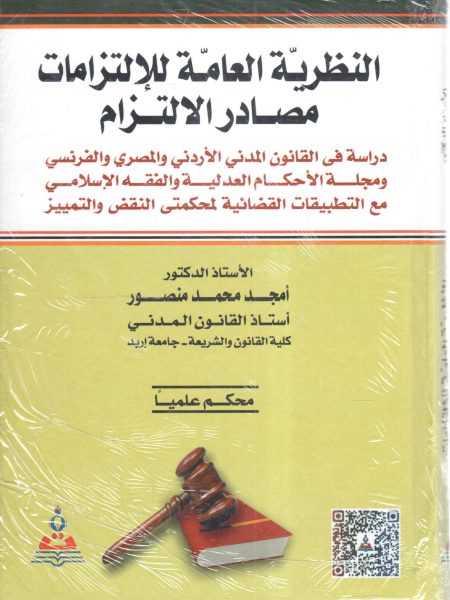
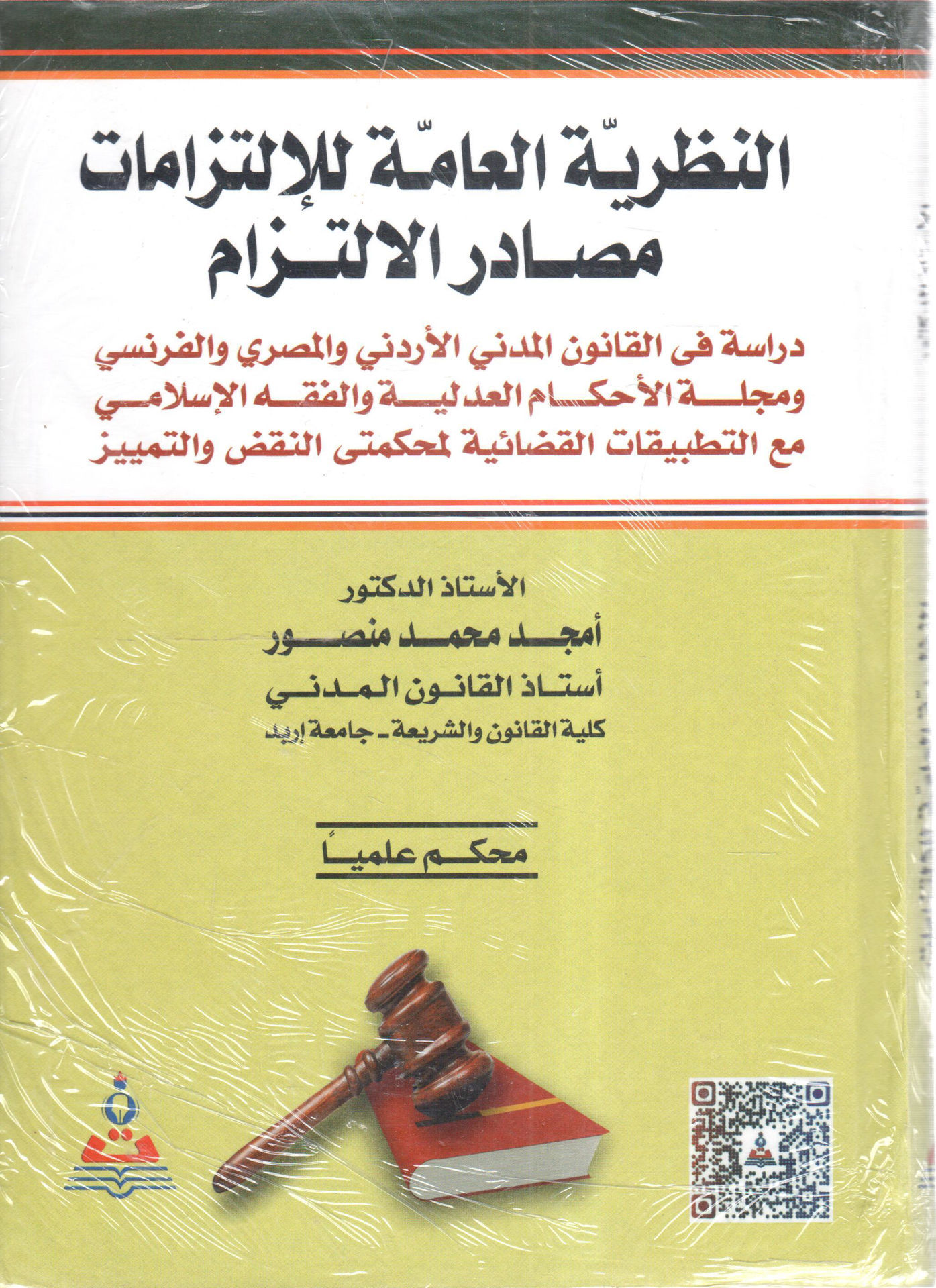
The author says in his book: “There is no doubt that the subject of the theory of obligation is one of the topics of great importance, not only in the field of civil law, but in all branches of law, because the theory of obligation contains rules that are more or less fixed and abstract, and therefore it is a general reference for all branches of law, to which every person who wishes to find a text governing the subject before him, whether it is in the framework of private law or even public law.”.
Book description:
-
Author: Prof. Dr. Amjad Mohamed Mansour
-
Number of pages: 392 pages
-
Number of doors: 5 doors
-
The subject of the book: A study in the Jordanian, Egyptian, French and Egyptian Civil Code, the Journal of Judicial Rulings and Islamic jurisprudence with judicial applications of the Courts of Cassation and Cassation
The contents of the book:
Introductory section: Commitment in general
-
The Importance of Commitment Theory
-
The Historical Development of Commitment Theory
-
The Personal and Materialist Doctrines of Commitment
-
The meaning and elements of commitment
-
Types and Sources of Obligations
-
How Islamic jurisprudence views the division of obligation
-
Dividing our study into sources of commitment
Part I: Contract
-
Introductory chapter: Contract Definition and Divisions
-
Section I: Definition and Scope of the Contract
-
Research II: The Power of the Will in Contracts
-
Third article: Contract sections
-
First requirement: Named and Unnamed Contracts
-
Second requirement: Consensual, Formal and In-Kind Contracts
-
Section I: Consensual contracts
-
Section II: Formal contracts
-
Section III: Contracts in kind
-
Third requirement: Two-sided and one-sided contracts
-
Fourth requirement: Contracts of Netting and Contracts of Donation
-
Fifth requirement: Fixed-value and contingent contracts
-
Sixth requirement: Immediate and Temporal Contracts
-
Seventh requirement: Bargaining contracts and contracts of adhesion
-
The eighth requirement: Division of Contracts in the Jordanian Civil Code
-
Ninth requirement: Division of Contracts in Islamic Jurisprudence
-
Chapter I: Establishment of the contract
-
Exhibit I: Consent
-
First Requirement: Presence of Consent
-
Section I: Expressing the Will
-
Section II: Compatibility of wills
-
Section III: Promising to contract and contracting with money
-
Second requirement: Validity of consent
-
Section I: Eligibility
-
Second branch: Disadvantages of satisfaction
-
Second article: Shop
-
The third: Reason
-
First requirement: Cause conditions
-
Second requirement: Proof of cause
-
Third requirement: The Idea of Reason in Islamic Jurisprudence
-
Fourth article: Contract Ranks in the Jordanian Civil Code
-
First requirement: Valid and invalid contracts
-
Section I: Termination of a void contract
-
Section II: Who has the right to invoke invalidity
-
Section III: When this right is forfeited
-
Second requirement: Bad contract
-
Third requirement: Suspended contract
-
Section I: The nature of the suspended contract
-
Section II: The theory of contract interruption favors the theory of relative invalidity
-
Section III: Authorization of the suspended contract
-
Fourth requirement: Unnecessary contract
-
Section I: Condition option
-
Second branch: Vision option
-
Section III: Appointment option
-
Chapter II: Effects of the contract
-
Topic I: The effect of the contract on the subject matter “Determining the content of the contract”
-
First requirement: Determining the content of the contract
-
Section I: Interpretation of the contract
-
Section II: Determining the scope of the contract
-
Section III: Pacta sunt servanda
-
Second requirement: Contractual liability
-
Section I: Nodal error
-
Second branch: Damage
-
Section III: Causal relationship
-
Research II: The Relativity of the Effect of the Contract in Terms of Persons“
-
First requirement: The effect of the contract on contractors, successors and creditors
-
Second requirement: The effect of the contract on third parties
-
Section I: Undertaking on behalf of others
-
Second branch: Stipulation for the benefit of others
-
Chapter Three: Discontinuity of the contract
-
Exhibit I: Termination of the contract
-
First requirement: Terms of annulment
-
Second requirement: How annulment occurs
-
Section I: Judicial annulment
-
Section II: Consensual annulment
-
Third requirement: Effects of annulment
-
Second article: Termination of the contract by force of law
-
Exhibit III: Defense of Non-Execution
-
First requirement: Conditions for invoking the defense of non-execution
-
Second requirement: How a contractor can assert the defense of non-performance
-
Third requirement: Effect of the defense of non-execution
Part II: Unilateral Conduct “Unilateral Will”
-
Chapter I: The Unique Will as a Source of Voluntary Obligation
-
Exhibit I: The position of jurisprudence on the unilateral will
-
Research II: The position of Islamic jurisprudence on the unilateral will
-
Research III: The Jordanian legislature's approach to the unilateral will
-
Chapter II: Unilateral Disposition Provisions in the Jordanian Civil Code
-
Section I: Convening
-
Research II: In terms of enforceability and binding
-
Chapter Three: Applications of unilateral behavior
-
Exhibit I: Promise
-
Research II: The promise of a prize
-
First requirement: What is meant by promising a prize
-
Second requirement: Conditions for Promising a Prize
-
Third requirement: Prize Promise Provisions
-
Fourth requirement: No Prize Claim Hearing
Section III: Tortious Act “Tort Liability”
-
Introductory chapter: The General Concept of Responsibility
-
Chapter I: Liability for the personal act
-
Research I: Harm “Harmful Act”
-
First requirement: Meaning and definition of torts
-
Section I: What is meant by direct
-
Section II: What is meant by causation
-
Section III: Conditions for Direct Liability
-
Fourth branch: If the direct and the caused are combined, the judgment is added to the direct
-
Section V: Command and control
-
Section VI: Coercion and directness
-
Second requirement: Non-liability torts (grounds for authorization)
-
Section I: Legal defense
-
Section II: A public servant's execution of a superior's order
-
Third requirement: Applications of the harmful act
-
Section I: Arbitrary Use of Right Theory
-
Section II: The theory of arbitrariness in Jordanian civil law
-
Section III: Proof of arbitrariness
-
Section IV: Penalty for arbitrariness
-
Research II: Damage
-
First requirement: Conditions for Damage Causing a Guarantee
-
Second requirement: Potential damage
-
Third Requirement: Is it permissible to compensate for missed opportunities?
-
Fourth requirement: Types of damage
-
Section I: Material damage
-
Section II: Moral damage
-
Third article: Causality
-
First requirement: Defining the idea of causality
-
Section I: Equivalent Cause Theory and Productive Cause Theory
-
Section II: The Jordanian legislature's position on the two theories
-
Second requirement: Lack of causation (foreign cause)
-
Section I: Celestial pest
-
Section II: Unforeseen event or force majeure
-
Section III: The act of the injured person
-
Fourth branch: Third-party action
-
Chapter II: Liability for the act of others
-
Section I: Responsibility of the supervisor for those under his supervision
-
First requirement: Conditions for Liability
-
Second requirement: The Legal Basis for the Responsibility of the Oversight Officer
-
Third requirement: How to Pay Liability
-
Fourth Requirement: Can the taxpayer return to the regulated party?
-
Research II: The responsibility of the follower for the act of the follower
-
First requirement: Conditions for Follower Liability
-
Second requirement: Legal Basis for Follower Liability
-
Third requirement: How to Pay Liability
-
Fourth requirement: The follower's recourse against the follower for what he paid
-
Chapter Three: Responsibility for doing things
-
Exhibit I: Liability of the animal guardian
-
First requirement: Conditions for Animal Guardian Liability
-
Second requirement: Legal Basis for Animal Warden Liability
-
Exhibit II: Liability of the construction guard
-
First requirement: Conditions to fulfill the liability of a construction guard
-
Second requirement: Legal Basis for Construction Guard Liability
-
Research III: Responsibility of the Keeper of Things
-
First requirement: Conditions to fulfill the liability of the custodian of things
-
Second requirement: Legal Basis for the Liability of the Custodian of Things
-
Chapter IV: Effect of Tort Liability “Guarantee”
-
Exhibit I: Liability claim
-
First requirement: Parties to the lawsuit
-
Section I: Plaintiff
-
Second branch: The defendant
-
Second requirement: Who has the burden of proof?
-
Third requirement: The Court of Cassation's review of the elements of liability
-
Fourth requirement: Liability claim cannot be heard
-
Exhibit II: Warranty
-
First requirement: “Indemnification”
-
Section I: Warranty or compensation in kind
-
Second branch: Warranty with consideration
-
Second requirement: Assessment of the “indemnity” guarantee”
-
Third requirement: Cannot combine two compensations for the same damage
-
Section III: Agreements Modifying Liability Provisions
Section IV: The Beneficial Action “Enrichment Without Cause”
-
Chapter I: The general rule of unjust enrichment
-
Exhibit I: Conditions for unexplained enrichment
-
First requirement: Enrichment on the debtor's side
-
Second requirement: Lack on the creditor's side
-
Third requirement: Lack of legal cause for enrichment
-
Research II: Provisions related to unjust enrichment
-
First requirement: Enrichment claim
-
Second requirement: Extent of the enricher's obligation to respond
-
Third requirement: The time at which enrichment and deprivation are estimated
-
Chapter II: Applications of causeless enrichment
-
Exhibit I: Paying the Undeserving
-
First requirement: Conditions for paying the undeserving
-
Second requirement: Provisions related to the payment of the undeserving
-
Exhibit II: virtue
-
First requirement: Conditions for virtue
-
Second requirement: Rulings related to virtue
-
Section I: Obligations of the curious
-
Section II: Employer Obligations
-
Third article: Paying the debts of others
Section V: Law
Read also
Daily lessons from the Nuclear Forty Commentary
Symbols of Treasures in the Interpretation of the Dear Book ”The Lost Part“