Description
Book description:
-
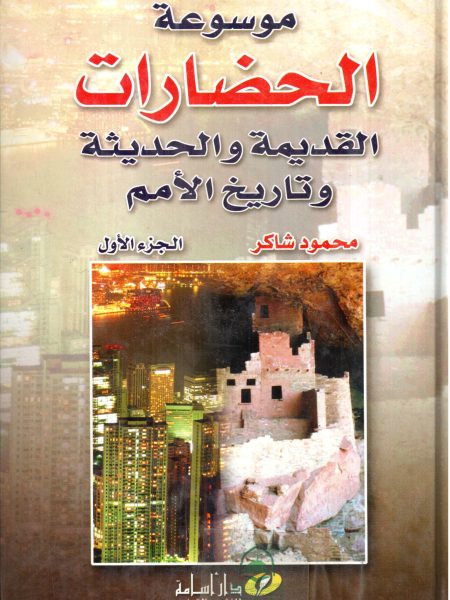
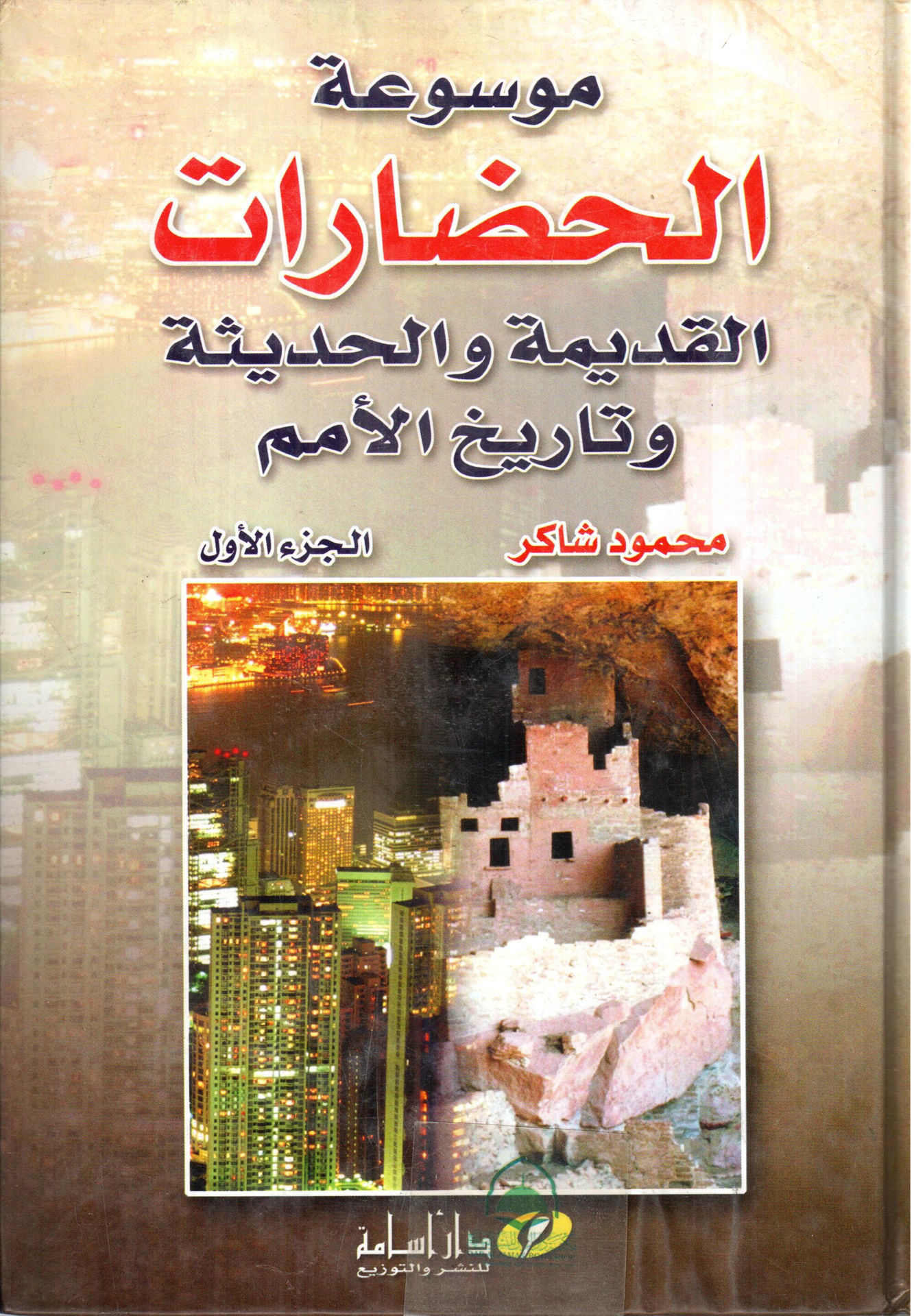
Author's name: Mahmoud Shaker
-
Number of pages: 944 pages
-
The subject of the book: Encyclopedia of Civilizations
The contents of the book:
The book first deals with the original civilizations, which are those civilizations that arose from a simple primitive life without friction or contact with other more civilized peoples or nations, such as the civilization of the Mesopotamian Valley and the Nile Valley, where man established small settlements on the banks of the Tigris, Euphrates and Nile and discovered agriculture, which was truly the birthplace of all human civilization.
It was in Syria that the first method of alphabetic writing emerged, and it was through Syria that most of the components of ancient Arab civilization were transmitted to the West through the Greek and Roman countries. He focused his research on this period on the most important political developments and civilizational achievements.
In order to complete the sequence of historical periods, he dealt with the history of the Arab-Islamic civilization. During the era of the Prophet (peace be upon him), the Arab-Islamic state was established and its pillars were established in the Arabian Peninsula, and in the Rashidi era, Arab forces were able to conquer multiple territories in the east and west and spread Islam throughout them.
This was accompanied by the construction of the edifice of a flourishing Arab-Islamic civilization that played an important role in human civilization. As soon as the Umayyad era came, the Arab-Islamic state developed to the level of a stable nation-state, and the transformation and development of urban life took place, and opportunities were created to extend the borders of the Arab state and flourish Arab culture. This was accompanied by comprehensive Arabization in government departments, offices, and monetary institutions. The Abbasid era witnessed the development and maturity of Arab-Islamic civilization.
The research dealt with the history of modern European civilization because it is the source of influence that changed the course of historical events. The transition to the Middle Ages took place in the second half of the fifth century AD, and this transition came as a result of several interrelated factors that began before this time, namely the division of the Roman Empire and the influx of Germanic tribes and their overthrow of the Roman Empire in the West and the imposition of a new character on the European continent.
The last period of the Middle Ages witnessed major political, social, economic, and cultural transformations that led to Europe's transition to the modern era. All these events signaled the dawn of a new era that was shaped by the European and global renaissance, geographical explorations, and the religious reform movement: the modern era, which began at the beginning of the sixteenth century. As for the end of the modern era and the beginning of the contemporary era, historians agree that the end of World War I in 1918 is considered the dividing line between them.