Description
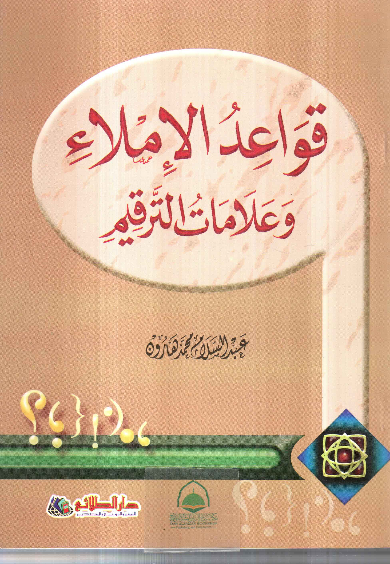
Abdul Salam Harun said: “Drawing, or what is today called dictation, is an art that has fundamentals and principles, in which the ancients took into account various considerations, some of which are due to ease in drawing common words that are frequently used, some of which are intended to remove the ambiguity and confusion that occurs between similar words, and some of which are intended to indicate the morphological origins of many words, and this is closely related to the previous purpose, and it is clear that the art of dictation has moved to various stages, and has undergone reform and technicality until it ended up in the last situation, which is represented by what we have now. It is a situation that some people and some organizations have tried to undermine it, but nothing has harmed it, because it was built on solid and consistent foundations, so I was determined to write in this art, because I found that writers and professors need a reference that combines comprehension and brevity with the closeness of the approach and clarity of the method, as well as clarifying the rule and indicating the pitfalls and doubts, so that the writer can avoid them and his writing is safe for him.”.
Book description:
-
Author's name: Abdulsalam Haroun
-
Number of pages: 84 pages
-
The subject of the book: Spelling and punctuation rules
The contents of the book:
-
In the name of God, the Merciful, the Compassionate
-
Part I:
-
Hamza
-
The first letter of the word
-
End-of-word accent
-
The center of the word
-
Section II:
-
Soft alpha
-
The soft center alef
-
The soft A terminal
-
Recognizing the Wawi and Yawi
-
Aleph substituted for J
-
Thousand substituted for a light accent nun
-
Thousand substituted for noon then
-
Section III:
-
Letters that are increased
-
Increase the thousand
-
Increase F
-
Section IV:
-
Letters that decrease
-
Minus the first A
-
The lack of a middle alef
-
Minus another thousand
-
Lack of Al
-
Lack of F
-
Lack of y
-
Lack of NON
-
Imperfection of the code
-
Section V:
-
Disconnecting and connecting
-
Connection
-
Connecting (who) to what comes before it
-
Connecting (what) to what comes before it
-
Connecting (no) to its antecedent
-
Separate
-
In E Feminine
-
Examples and Explanations of Humza and Alef
-
I: Hamza
-
The first letter of a word: fact or judgment
-
The center of the word
-
End-of-word accent
-
II: Soft Alpha
-
Medium thousand
-
Thousand Extreme
Also available
Morphological application
Clarification of grammar, Ibn Aqeel's commentary and link to modern methods 2/1