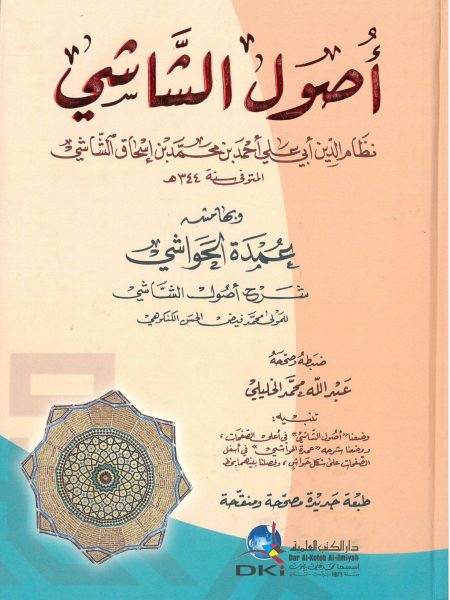
Description
Book description:
-
Name of the author: Nizamuddin Abu Ali Ahmad bin Muhammad bin Ishaq al-Shashi
-
Adjusted and corrected: Abdullah Muhammad al-Khalili
-
Number of pages: 394 pages
-
The subject of the book: Origins of Alshashi
The contents of the book:
-
Chapter One
-
The Four Fundamentals of Jurisprudence
-
The first research in the Book of Allah
-
A chapter on the private and public
-
Public and private search
-
Consider dividing the year into two parts
-
Examining the generality of the word "what
-
Examining the general population from which some are singled out
-
Chapter II: Chapter on the Absolute and the Repeater
-
The Absolute: If it can be followed, it cannot be exceeded
-
Discussing the permissibility of ablution with saffron water and its ilk
-
Searching for common and specialized
-
Chapter three: Chapter on Common and Differentiated
-
Searching for truth and metaphor
-
Chapter four: A chapter on truth and metaphor
-
Truth and metaphor
-
A discussion of the division of truth into three parts
-
Abu Hanifa's discussion of metaphor as a successor to truth
-
Chapter 5: A chapter on defining a metaphor
-
Chapter six: Chapter on Explicit and Implicit
-
Chapter VII: A chapter on opposites, meaning the obvious, the text, the interpreted, the interpreted, and the definite, with their corresponding hidden, ambiguous, ambiguous, dubious, and similar
-
Research on the obligation to follow the text
-
Discussing the weighting of the interpreter over the text
-
The Hidden, the Mysterious, the Mukamal, and the Similar
-
Chapter VIII: A chapter on what leaves out the truth of words and what leaves out the truth of words of five types
-
The study of leaving the truth by implication in the same speech The study of leaving the truth by implication by the speaker
-
Chapter IX: Chapter on Textual Objects
-
Examining the general rule of the text's indication of the general rule of the stipulated judgment
-
Examining whether the requirement is in addition to the text
-
Discussing the importance of acceptance in sales
-
Chapter ten: Chapter on Command
-
Investigating the Realization of Absolute Command Separate
-
Chapter Commanding an action does not require repetition
-
The Repetition of Worship by Repeating the Causes of Worship
-
Researching the two types of commands: absolute and restricted
-
Examining the two types of commands, absolute and restricted, and their rules
-
Examining one of the two types of commands, i.e., restricted
-
Investigating the two types of commands for Hassan
-
Chapter Commanding something implies the goodness of what is commanded
-
Chapter The duty of command is of two types
-
Underperformance Research and Judgment
-
Judicial research and the quality of full and minor
-
Discuss the division of the prohibition into two parts
-
Chapter Eleven: A chapter on prohibition
-
The prohibition of sensual and legal actions
-
Chapter Twelve: A chapter on defining the way texts are meant
-
Researching the way to know what texts mean
-
Examining weak and corrupted pleas
-
Chapter Thirteen: Determination of letters of meaning
-
Examining whether W is plural and F is transitive
-
Separating the F's with the hyphen
-
Explain that F can be used to show attribution
-
Separating then from later
-
Searching the Placement of Pl for Error Correction
-
Separate but to correct the mistake by substituting the second for the first
-
Exploring the use of but as an interpolation after negation
-
Separating the but from the negation
-
Investigating whether or includes one of the following
-
Searching for coming or eating one of the following
-
Searching for the meaning of the end
-
Extremely Separate
-
Searching for an endpoint
-
Disconnecting to an end
-
Discuss whether the word "on" is mandatory and "in" is an adverb
-
Separating the word on
-
A statement on the meaning of adverbiality
-
Separating a word on
-
Searching for a word with an adverbial meaning
-
Examine the placement of the P for Paste
-
The letter "B" is for stickiness in the language, which is why it accompanies eighths
-
Chapter Fourteen: Reporting Statement and Interpretation Statement
-
Chapter on the Faces of the Statement
-
Chapter and Statement of Interpretation
-
Change statement research Chapter and change statement
-
Examining whether an exception is a form of change statement
-
and the judgment of the change statement
-
Examining the statement of necessity and the statement of case
-
Chapter As for the statement of necessity
-
Separation and Status
-
Searching for an ampersand
-
Chapter: Explanation of the conjunction
-
Researching the Sunnah of the Messenger of Allah, may Allah bless him and grant him peace
-
Chapter on switching statement
-
Second search
-
Chapter on News Categories
-
Investigating Whether the Frequent Occurrences are Possessive
-
Discuss the division of the narrator into two parts
-
Discussing the requirement to act on the news of a single person
-
Discussing the abandonment of a single report if it contradicts the phenomenon
-
Discussing the authority of single news in four places
-
Separating one person's news in four places
-
Third research on consensus
-
Separate
-
Consensus is divided into four sections
-
Discussing a type of consensus that is not segregationist
-
Separate
-
Discussing the duty of a mujtahid
-
Chapter The duty of the mujtahid
-
Research If two pieces of evidence conflict, what does the mujtahid do?
-
Investigating the authority of analogy and the obligation to follow it
-
Fourth Research Chapter on Measurement
-
Discussing the news that makes the analogy authoritative
-
The five conditions for the validity of an analogy
-
Chapter Five conditions for the validity of an analogy
-
Searching for examples of analogy conditions
-
Research on the definition of legal analogy
-
Forensic analogy class
-
Researching the book's known bugs
-
Searching for the Sunnah-recognized cause
-
Examining the consensus-derived cause
-
Examining the cause known by opinion and ijtihad
-
Searching for questions on measurement
-
Separating the questions from the analogies are eight
-
Examining the argument by reasoning
-
Discuss the division of the heart into two parts
-
Reversal and reversal research
-
Separation of judgment
-
Discuss the difference between cause and effect
-
Discussing the meaning of cause and effect
-
Research on the attachment of legal rulings to their causes
-
Separating legal rulings from their causes
-
Examining the four contraindications
-
Separate
-
Researching the meaning of imposition in language and law
-
Separate
-
Determination, what it is in language and law
-
Determination class
-
Researching the definition of license in language and law
-
Arguing without evidence is of two types
-
Separating Invoking Without Evidence
-
Amber does not have one-fifth according to Abu Hanifa
Also browse:
-
A special collection of books Jurisprudence and its principles