

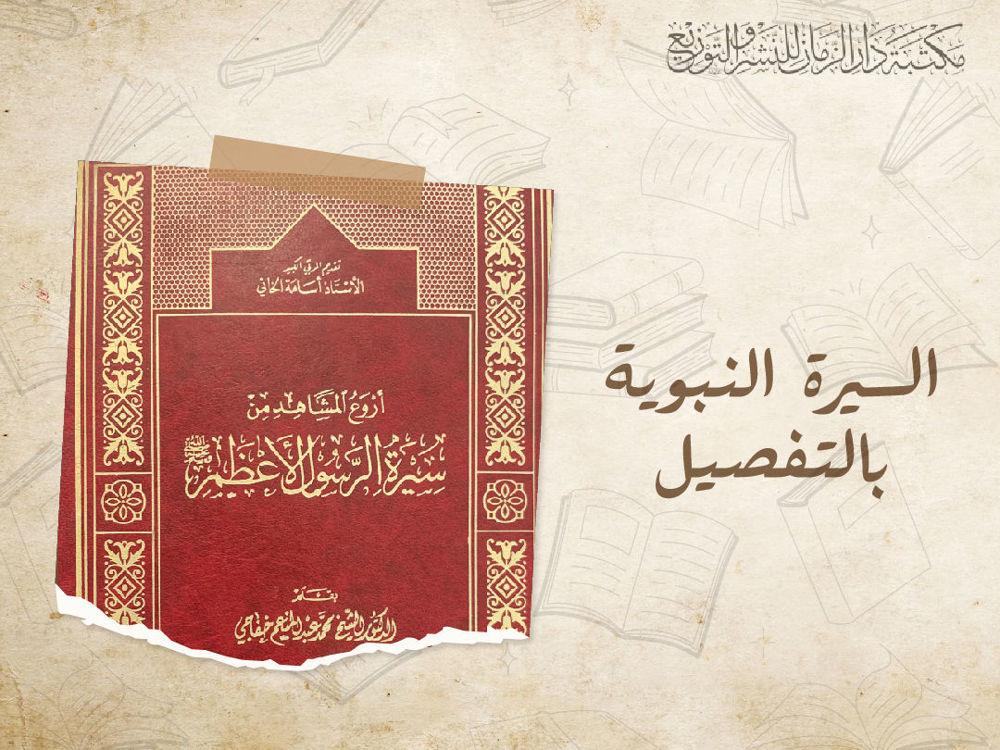
The biography of the Prophet Muhammad is a unique life story that has been a source of inspiration for Muslims of all ages. Born in Mecca in 570 AD, he played a pivotal role in guiding the Islamic message. His prophetic mission began in 610 AD, when the divine message was conveyed to him through the angel Gabriel. For more, read on to learn about the Prophet's biography in detail.
Learn about the Prophet's biography in detail
The beginning of the biography of the Prophet Muhammad in detail. The Prophet Muhammad lived a life full of challenges and tests, yet he built his call with strength and patience. His biography shows mercy and justice, and he was an example of morality and tolerance. His history is an essential part of the history of Islam, as he established an Islamic state in Medina and conveyed the message of monotheism and piety.
This biography of the Prophet inspires and guides people in their daily lives, and is a source of inspiration for the search for knowledge and the realization of compassion and justice in society.
The Prophet's birth and upbringing
The Prophet Muhammad was born on Monday of the month of Rabi al-Awwal, in the year of the elephant. At his birth, his mother saw
A light shines from it, illuminating the palaces of the Levant. The Prophet grew up as an orphan and stayed with his mother until she sought a nurse. He was breastfed by Thuwaybah, then Halima al-Saadia took him to Bani Saad, where the incident of chest incision took place, where Gabriel came to him and opened his chest, then washed his heart with Zamzam water and put the heart back in place. This is the beginning of the Prophet's life.
The Prophet Muhammad grew up in his people as his mother and nursing mothers were able to do their part in his upbringing. The Prophet's mercy was embodied even in his youth, as he lived as an orphan without a father, but God was his protector and guardian.
The incident of the chest incision showed the divine care and grace that inspired people that he was a prophet of mercy. His life continued to spread goodness and peace, build morality and human connection. As he grew older, he received the prophetic message and began the process of spreading Islam and guiding people to the right path.
This was the beginning of the life of the Prophet of the Ummah, Muhammad (PBUH), the Messenger of God who changed the course of history with his divine message and prophetic example.
The Prophet Muhammad stayed with his mother until her death, which occurred while they were visiting relatives in Medina. After his mother's death, he was fostered by his grandfather Abdul Muttalib, who died when the Prophet was eight years old. He was cared for by his uncle Abu Talib, and despite his uncle's poverty, the Prophet decided to help him with household expenses.
The Prophet grew up in his uncle's house, and when he saw their poverty, he decided to contribute to the household expenses. He tended sheep for a while, then traded with his uncle to the Levant. On one of their journeys, a monk noticed signs of prophethood on the Prophet Muhammad and went out to tell the people that a prophet had arrived in that caravan. These moments were a prelude to a new stage in the Prophet's life and a confirmation of his divine mission.
The Prophet's Youth
In the Prophet's youth, his honest and truthful qualities stood out, which affected his reputation among his peers. His fame spread until Mrs. Khadija trusted him to manage her business. Thanks to his wisdom and skill, the Prophet made a large profit, prompting Khadija to invite him to marry her. They married and the Prophet remained committed and faithful to her for 25 years until her death. In an instance of the Prophet's wisdom, he resolved the dispute over the placement of the Black Stone with a clever suggestion that led to agreement between the tribes. The Prophet's life in his youth reflects the values of honesty and integrity, which influenced his good reputation. Thanks to his successful experiences and wisdom, he demonstrated his ability to manage difficulties, as in the case of the Black Stone, where he led the people to consensus by offering an enlightened solution.
In his dealings with Khadija, he did not limit himself to the financial aspect, but showed deep respect and appreciation for her character and wisdom. Their marriage was not limited to the personal aspect, but was a union of honesty and understanding.
These traits and actions make the Prophet (peace and blessings be upon him) a role model for people in how to deal with others and manage things wisely and gracefully.
The Prophet's Worship in the Cave of Hira
The Prophet (peace be upon him) loved to indulge in solitude with his Lord, as he used to devote himself to worship in the nights of the Cave of Hira, and in those sacred moments, he realized true visions that were his first revelations. The beginning was with the revelation of Gabriel - peace be upon him - who descended on him in the cave, when he was forty years old.
While the Prophet was spending time in the Cave of Hira, Gabriel descended from heaven and ordered him to read. The Prophet, who was not a reader, apologized at first, but Gabriel repeated the command twice, until the first verse of the revelation was revealed by Gabriel, which carries an invitation to read in the name of God, the Creator and Teacher of the pen.
The verse that was revealed to the Prophet (peace be upon him) in the cave of Hira comes in Surah Al-Alaq, where Allah Almighty said:
(Recite in the name of your Lord, who created * He created man from a stick * Recite in the name of your most honorable Lord * Who taught with the pen) Surah Al-Alaq, verses 1-4
After receiving the revelation, the Prophet returned to Mrs. Khadija with fear and awe, and found in her the comfort and support that softened his life. Khadija reassured him and removed his worries, reminding him of his high morals and good dealings with people.
Reminding her that he honors the guest, connects the womb, and helps the needy proved to her that God would not waste his efforts and that this noble prophet is suitable to be the bearer of a divine message. She accompanied him to her cousin, Waraqa ibn Nawfal, who was a Christian scholar, and discovered from his knowledge that this revelation was similar to the Law that had been revealed to Moses, peace be upon him. This support strengthened the Prophet's steadfastness in his mission.
Revelations to the Prophet
Revelation was first revealed to Prophet Muhammad as a preparation and education for him. After six months, Gabriel - peace be upon him - returned with the revelation, signaling the beginning of the period of call and message. This is evidenced by the saying of God Almighty:
“O Al-Mudathir, arise and warn, your Lord is great, and your garments are clean.”
Therefore, fulfilling his mission requires preparation and readiness, with a focus on sincerity and righteousness in obeying God, which highlights the importance of understanding all aspects that support the performance of this mission with all seriousness and dedication.
Secret Advocacy
After the revelation of the revelation and the command to call in the words of Almighty God:
“O Al-Mudathir, arise and warn.”
The Prophet began the duties and responsibilities of dawah with the task of warning people. He began calling his family and companions in secret, in order to protect their lives from the threat posed by the idolatrous Quraysh. This secret call lasted for three years, with the Prophet taking cautious measures to avoid being exposed to dangers and persecution.
The Prophet's public proclamation
When the verse was revealed in which Allah Almighty said: “And warn your immediate family,” the Prophet (peace and blessings be upon him) began to proclaim the call to Islam. The Prophet stood on Mount Safa, inviting his people to gather around him. In his sermon, the Prophet tested his standing among them and his credibility by asking if they would believe him even if he warned them of an approaching danger. The people responded that they would believe him, and the Prophet explained that he was warning them of God's punishment if they continued on their bad path.
In this ordeal, the Prophet (peace and blessings be upon him) expressed his pure and sincere invitation to them, telling them that he was God's messenger to them, and warning them of the dire consequences of persisting in polytheism and immorality. This was an important moment in the march of the call, as the Prophet (peace and blessings be upon him) set out with sincerity and courage to deliver the message of Islam to his people, and this was the beginning of a new phase in his divine mission.
Harming Quraysh
As soon as the Prophet (peace be upon him) made his call public, the Quraysh began to harm the Muslims, and did not stop their fierce efforts for ten years, as torture and humiliation campaigns broke out against the believers. The Prophet was not deprived of injustice, but was subjected to false accusations and severe defamation. He was sometimes accused of insanity and at other times labeled as a sorcerer. His companions were also subjected to injustice, disparagement, and insults, but they did not break, and their will did not weaken.
Migration to Abyssinia and the boycott
As the suffering of the Muslims escalated due to the escalating torture by Quraysh, the Prophet (peace be upon him) authorized the Muslims to migrate to Abyssinia, so that they could rest and find shelter. The country of Abyssinia adopted Christianity and its king was just and kind to the people. The Muslims migrated to Abyssinia twice, the first time twelve men and four women, and the second time eighty-three men and eleven women.
Quraysh decided to boycott Banu Hashim in the streets of Mecca for three years for refusing to deal, marry, and pledge allegiance. The boycott was lifted thanks to the intervention of a wise man.
It is worth noting that the event of migration to Medina came after the death of the Prophet's uncle Abu Talib, and that year was filled with sadness due to the loss of support and protection.
During this period, while the intensity of the abuse was escalating on the Prophet and his companions, the Quraysh decided to boycott Banu Hashim in the streets of Mecca, a harsh measure that lasted for three years. This boycott was a great burden on the Banu Hashim, as the Quraysh refrained from doing business with them, marrying them, and pledging allegiance to them.
In this context, the Prophet's uncle, Abu Talib, passed away, which was a great tragedy for the Prophet, as he lost the protection and support provided by his uncle. The Prophet's grief that year was not only limited to the death of his uncle, but in the same context, Mrs. Khadija died, which added to the Prophet's grief, and made that year called the “Year of Sorrow”.
The Prophet's Exodus to Taif
As the pain and torment increased for the Prophet (peace and blessings be upon him), and the victory was minimized by the absence of his uncle Abu Talib, the Prophet decided to move to Taif in the hope of finding support, but there he faced harsh rejection and harassment. Throwing stones and inciting children against him was the most painful part of that experience.
After this failure, the Prophet returned to Mecca to continue his call to God. It was in this context that the miracle of Isra and Mi'raj took place, in which the Prophet's soul and body were transported on a night journey to Beit al-Maqdis, and then lifted into the sky. During this journey, the Prophet met the prophets and saw the wonders of his Lord, and during that great night, the most important pillar of Islam, prayer, was imposed on Muslims, and five daily and nightly prayers were made for the nation of Islam.
That period was full of challenges and trials, but the Prophet (peace and blessings be upon him) did not retreat from his mission. He was affected by the loss of his uncle and great supporter, but he continued his call to God with persistence and fortitude.
The miracle of Isra and Mi'raj was a confirmation of the Prophet's status and steadfastness in his mission. He was transported from Mecca to Beit al-Maqdis, and then his soul and body were lifted into the sky. On this great night, God made prayer a cornerstone of Islam, imposing it on Muslims five times a day and night.
Despite the difficulties he faced, the Prophet (peace be upon him) remained steadfast in his call, and the fruits of these efforts gradually began to appear in the Meccan society, as some hearts began to open to the Islamic message.
Migration to Medina
After returning from Taif, the Prophet continued his call to Islam, taking advantage of the pilgrimage season to meet people and present his religion to them. During this time, he met young men coming from Medina to perform the pilgrimage, to whom he introduced Islam and they responded positively. They returned to the city and began to invite their people to Islam, and the city resolved to receive the Prophet and pledged to protect him and adhere to his religion.
At first, the Prophet authorized his companions to emigrate, so they left Mecca secretly. Afterward, the Prophet and his companion Abu Bakr al-Siddiq decided to leave for Madinah. When the Quraysh learned of the Prophet's departure to Medina, they sent a group to capture and kill him, but God protected the Prophet on his journey, until he arrived safely in Medina via Ghor Thawr.
Construction of the mosque
God authorized the Prophet (peace be upon him) to migrate from Mecca to Medina, and one of the first things the Prophet did was to build a mosque. His camel blessed a land that belonged to two orphan boys, and he bought it from them to be the place where the mosque was built.
The brotherhood between the Muhajireen and the Ansar
The Prophet (peace and blessings of Allah be upon him) built the mosque and made an important development when he fraternized between the Muhajireen and the Ansar in the house of Anas bin Malik (may Allah bless him). Thanks to this influential brotherhood, Muslims in Madinah became brothers who shared their livelihood. This brotherhood was a solution to the financial hardship that the immigrants faced after leaving their money in Mecca.
The Prophet's Invasions
Allah, the Almighty, authorized the Prophet (peace be upon him) to fight the polytheists from the Arab tribes after he settled in Medina. These invasions began with a major battle in which the Muslims were victorious, the Battle of Badr, and these invasions continued until they amounted to approximately twenty-five, twenty-six, and twenty-seven invasions. The Prophet fought in nine of them, namely: Badr, Uhud, Khandaq, Bani Qurayzah, Bani al-Mustaslaq, Khaybar, the conquest of Mecca, the day of Hanin, and Taif.
The conquest of Mecca was the most important of these battles; it began on the tenth day of Ramadan in the eighth year of the Hijrah. The Quraysh broke their agreement with the Messenger of Allah to fight his allies from the Banu Khuza'ah, so the Prophet mobilized his companions to prepare an army of ten thousand fighters. They entered Mecca without fighting, and the Prophet (peace be upon him) entered the Sacred House and smashed the idols, then ordered Bilal to call for prayer, and stood as an orator to the people, sparing them, releasing them by saying: “Go, you are free.”.
After the conquest of Mecca, the Prophet (peace be upon him) continued to direct the Islamic call and achieve unity among Muslims. The Prophet led several invasions, including the Battle of Tabuk, which saw a display of Islamic power and the promotion of rights and duties among Muslims.
In this context, the Prophet's wisdom shone in managing international affairs and dealing with other societies. In the context of social life, the Prophet established just judgments and an economic system that respects the rights of the individual and society.
Despite the challenges and difficulties he faced, the Prophet (peace be upon him) achieved the establishment of an Islamic state in Medina, where Islamic civilization flourished and Muslim communities grew in faith and communication.
The Death of the Prophet
The Prophet (PBUH) arrived in Mecca in the month of Dhu al-Hijjah to perform the Hajj pilgrimage, the only pilgrimage he made after the Hijrah. During this journey, the Prophet delivered the Farewell Sermon, where he gave Muslims advice and commandments that reflect the values and ethics of Islam.
In the following month, the news of the Prophet's illness shocked the Muslims, and he made the decision to stay in the house of Umm al-Mu'minin Aisha (may Allah be pleased with her) to take care of his health. During this time, Abu Bakr al-Siddiq (may Allah bless him and grant him peace) performed the Prophet's prayer.
In the end, the Prophet (peace be upon him) died on Monday, the twelfth day of the month of Rabi' al-Awwal, in the eleventh year of the Hijrah. His death came after he spent his life guiding people towards obedience and goodness, and he left a great impact on Islamic history.
The Prophet's life was full of sacrifice and guidance, as he led the nation towards light and guidance. Despite the challenges and tribulations he faced, he remained a symbol of honesty, nobility, and tolerance. Despite the challenges and tribulations he faced, he remained a symbol of honesty, nobility, and tolerance.
On the anniversary of his passing, we are inspired by the lessons he left us, and we seek to apply his values and biography in our daily lives. May his story remain a source of inspiration and guidance, as we strive to achieve goodness and peace in our societies.
Let us draw our strength from the Prophet's teachings, and strive to build a world where justice and mercy prevail, realizing the Islamic vision of a life of peace and tolerance.
We conclude our article by saying, “Pray to him, peace be upon him, so that you may receive Paradise and Naima.”