

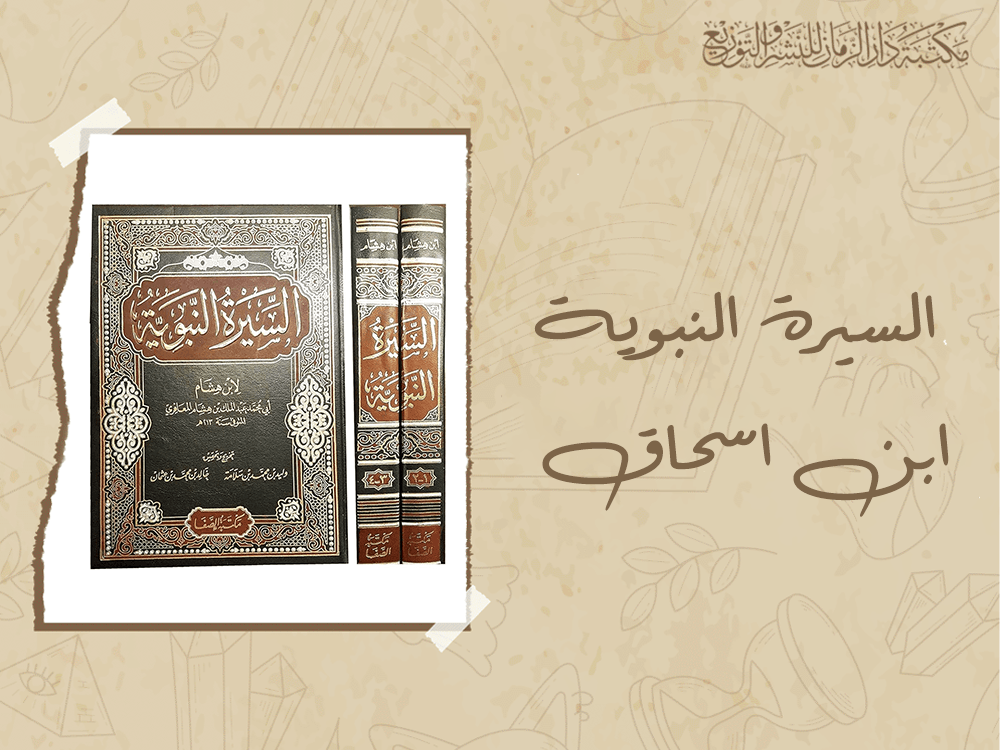
Ibn Ishaq's biography is one of the oldest and most important sources on the life of the Prophet Muhammad, as Ibn Ishaq made sure to collect different accounts and document them in his book. Many historians and modernizers have relied on Ibn Ishaq's biography as a basis for understanding the facts and events that took place during the early stages of the Islamic call. Although the original text has been lost, Ibn Hisham abridged it and presented it in a more organized form, which contributed to the popularity of Ibn Ishaq's biography among researchers and scholars. Ibn Ishaq's biography remains an important reference in Islamic studies and history, as it is the first comprehensive attempt to collect the events of the Prophet's life and accurately record their details. Therefore, the study of Ibn Ishaq's biography contributes to a deeper understanding of the historical context of the Islamic call and its development over time.
Original title of the book
Ibn Ishaq's biography was known as al-Mughazi wa al-Sir, as its main focus was on the invasions and military events in the Prophet's life, as well as details of his upbringing and calling. Over time, however, the book came to be generally referred to as “the biography of the Prophet,” especially after it was abridged by Ibn Hisham.
His approach to collecting narratives
Ibn Ishaq followed a special approach in writing the biography, relying on oral accounts he heard from the followers and senior muhaddiths, as well as written sources that were available in his time. His approach included:
1. Collecting multiple narratives: He did not stick to a single narration, but rather collected several narratives about the same event, making his book informative.
2. Mention of attribution: He sometimes mentioned the chain of narrators who relayed the story, but in some places he omitted some of the traditions, which exposed him to criticism by the Muhaddithis.
3. Use of Israeli narratives (news of the People of the Book): In some places, he relied on narratives taken from Jews and Christians, especially regarding the history of the Arabs before Islam, the previous prophets, and some rare events in the biography.
4. Storytelling: He adopted a clear literary style, which made his book easy to read, as he included poems, proverbs, and sermons.
His sources in the biography
Ibn Ishaq relied on a number of direct and indirect sources, including:
Hadiths of the companions and followers who lived in the early days of Islam.
The narrations of Madinah scholars such as Urwa ibn al-Zubayr, al-Zuhri, and Wahab ibn Munabbah.
Jewish and Christian narratives regarding older historical events, such as the biography of the Prophet Abraham and the birth of the Prophet Muhammad.
Jahiliyya and Islamic poetry, which he used to support certain narratives or illustrate events.
His writing style
Ibn Ishaq's style was characterized by several features, including:
Chronology: It begins with the genealogy of the Arabs, then deals with the birth and upbringing of the Prophet (peace be upon him), then his call, and finally the migration and conquests.
Detail in the Mughazi: He focused heavily on battles and invasions, providing accurate descriptions of events, names of commanders, and battle plans.
A lot of poetry: He used to mention many verses of poetry that were organized in those periods, both from the poetry of the companions and the polytheists.
Criticism of his book by scholars
Ibn Ishaq's book has sparked controversy among scholars, with differing opinions about its accuracy and methodology:
1. Supporters:
It is considered the first comprehensive book on the Prophet's biography, as it collected a huge number of narratives that no one else had collected.
Many historians, such as Ibn Hisham, Al-Tabari, and Ibn Saad, have cited it, demonstrating its historical reliability.
2. Opponents:
Some jurists, such as Imam Malik, accused him of being fraudulent in some narrations, which affected his credibility among modernists.
He has been criticized for quoting weak or unsupported narratives and sometimes relying on the news of the People of the Book without scrutiny.
Some have argued that his book focuses too much on the Mughazis and invasions, to the detriment of other aspects of the Prophet's biography.
The impact of his book on Islamic studies
Despite the criticism leveled at it, Ibn Ishaq's “Biography of the Prophet” remained the main reference for all historians who wrote about the biography after him. This book had a great impact on the development of Islamic studies, as it was used by:
Ibn Hisham: He abridged it, added amendments to it and deleted some unreliable narratives.
Tabari: The one who quoted many of Ibn Ishaq's accounts in his history.
Ibn Sa'd: In his book al-Tabqaqat al-Kubra, he relied on Ibn Ishaq to narrate the biography of the Prophet (PBUH) and the Companions.
Thus, Ibn Ishaq's book became the cornerstone of the Prophet's biography, despite the loss of its original copy, making it one of the greatest achievements of early Muslim historians.
Ibn Ishaq: His Life and Science
His name and pedigree
Muhammad ibn Ishaq ibn Yasar ibn Khayyar, nicknamed Abu Bakr, was born in Medina around 80 AH and grew up in a scientific environment interested in history and narration. His origins go back to Persia, where his grandfather was one of the captives of Ain al-Tamr, who were captured during the time of Caliph Umar ibn al-Khattab (may Allah be pleased with him), and then settled in Medina.
His upbringing and education
Ibn Ishaq lived in Medina during a time when the science of hadith and biography was flourishing, as the city was a scholarly center of great muhaddith and jurists. He grew up in an environment that enabled him to learn and communicate with the followers, so he started memorizing hadiths and collecting historical accounts from a young age. He was particularly interested in the narratives of the Mughazis and biographies, meeting with sheikhs and scholars to hear details of the Prophet's life and invasions.
His Scientific Travels and Influence of Modernists
Ibn Ishaq was not content to stay in Madinah, but traveled to various places to transfer knowledge and benefit from the sheikhs, traveling to Egypt, Iraq, Kufa, and Basra. In these journeys, he met a number of great modernists and historians, and was influenced by their methods of collecting narratives. Some of the most notable people he was influenced by include
Urwa ibn al-Zubayr (a student of Aisha (may Allah be pleased with her) and one of the great historians of Islam).
Wahab ibn Minbah (one of the Imams of the Ikhbariyya and author of the book “Prophetic Stories”).
Al-Zuhri (one of the first to write down hadith and biography).
Ibn Ishaq collected a lot of news and narrations from these and others, making him one of the first to systematically write down the biography of the Prophet Muhammad.
His Scientific Status and Relationship with Scholars
Ibn Ishaq was widely known in his time, but he was also the subject of controversy among the scholars of his time, with many praising him, while others criticized him.
Praise from scholars:
Al-Shafi'i said of him: “Whoever wants the Mughazis is dependent on Ibn Ishaq,” meaning that everyone who wrote about the biography quoted him.
Many historians, such as al-Tabari and Ibn Saad, praised him and relied on his narrations in their books.
Criticism:
Imam Malik ibn Anas was one of his harshest critics, accusing him of fraudulent and inaccurate reporting.
Some modernists saw that he quoted from the People of the Book (Jews and Christians) without scrutiny, which made some of his narrations subject to skepticism.
Imam Ahmad ibn Hanbal said, “Ibn Ishaq is a good narrator, but he has a tendency to mislead.”.
Despite these criticisms, Ibn Ishaq remained the primary source of the Prophet's biography, and most of those who came after him, such as Ibn Hisham, al-Tabari, and others, relied on him.
His death
Ibn Ishaq died in Baghdad in 151 AH, having left a great scholarly impact in the field of biography and maghazis. Since his death, his book on the biography of the Prophet remained the most important reference on which most subsequent writings on the life of the Prophet (PBUH) were based.
Ibn Ishaq's biography remains one of the most prominent sources documenting the life of the Prophet Muhammad, providing a comprehensive picture of the events that accompanied the Islamic call since its inception. Although the original version has been lost, Ibn Hisham's abridgment helped preserve and transmit the content of Ibn Ishaq's biography to subsequent generations. Historians and modernists have relied on Ibn Ishaq's biography to study the Prophet's history, emphasizing its scientific value and its great impact in shaping Muslims' understanding of the biography of their Prophet. Ibn Ishaq's biography remains an essential reference for historical studies, as researchers rely on it to analyze the narratives and events associated with the biography. In this way, Ibn Ishaq's biography remains a testament to early efforts to preserve and carefully document Islamic history.