

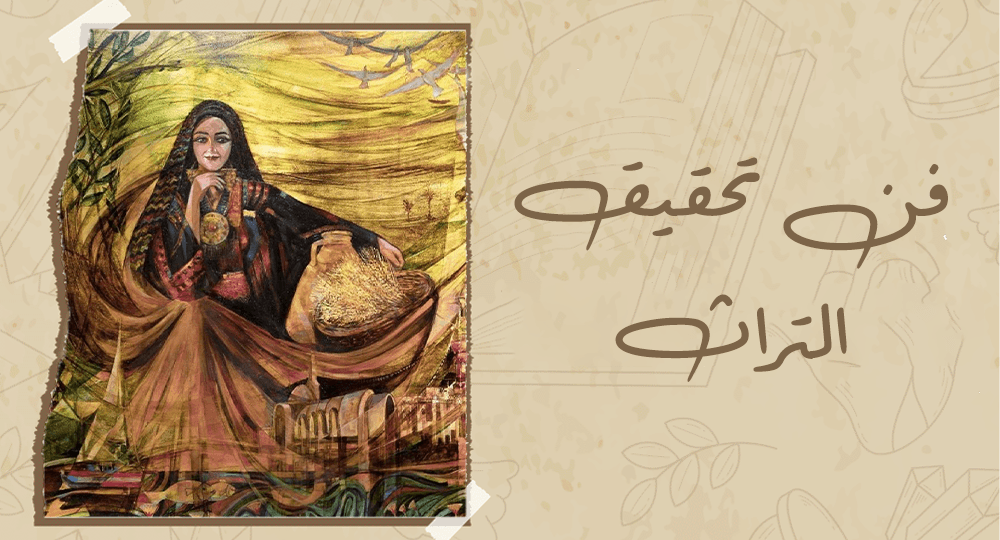
The fact that we Arabs carry an ancient heritage is beyond doubt, but the issue that prevents us from taking firm steps for progress is that we do not investigate this heritage and do not try to understand it, either we reject it completely or take it as it is without making it readable, so we find that ambiguity envelops it, and of course, misunderstanding prevails and we do not benefit from the lessons and sermons of the ancestral past, and here lies the importance of the art of heritage realization, and therefore we shed light on the concept of heritage realization and its importance in transferring ancient texts to contemporaries.
From the old copy to the edited text The art of heritage realization
The art of heritage investigation is a science that focuses on the study and investigation of any heritage text, such as ancient manuscripts, in order to show its true and accurate image, which its authors wished to communicate, in light of maintaining scientific integrity without any taint of distortion or distortion.
How manuscripts are brought back to life by investigators
Manuscripts are heritage treasures that contain knowledge, ideas, and a glimpse of the culture of the past, but there is a mass of challenges that pose an obstacle to the patrons of the art of heritage realization, as they are often worn out or distorted due to time or repeated transmission.
But the investigator has an important and vital role in this regard, as he works to revive these manuscripts and transform them into accurate scientific texts that make it easier for researchers and readers to benefit from them, and this is done through practical and methodical steps that ensure the preservation of the originality of the text, and the most prominent concepts and meanings to breathe life into the heritage and here are the stages and steps of scientific investigation:
1- Collecting written copies.
In the beginning, the investigator seeks to collect all available copies of the text he wishes to investigate, whether in research centers, private collections, or elsewhere. The need for diverse sources from different regions and different times lies in noting differences, additions, and deletions, and then noting all the data of each copy in terms of place, date, font, and size.
2- Comparing copies and selecting the master copy
The investigator compares disparate texts and identifies the differences between them so that he can identify the original and closest to the original, as it has the least number of errors and there are marks indicating the original author.
3- Reading, editing and proofreading the text
The editor is diligent in correcting errors and removing errors resulting from transportation and printing, adjusting the text by adding expressive movements and formation to facilitate reading and understanding, arranging the text in accordance with the rules of grammar, and recording everything that has been done with the source.
4- Writing footnotes and comments.
One of the most important steps taken by the editor is to explain difficult vocabulary and clarify words and phrases that may be incomprehensible to a modern reader, providing explanations and explanations for texts that need clarification.
5. Preparing the introduction and technical indexes
The introduction combines basic information about the author, the text, and the sources relied on by the investigator, as well as the index of topics, terms, verses, and hadiths, with full documentation of the work to be a reliable reference for researchers.
Indispensable Skills for the Heritage Investigator
Of course, the art of heritage investigation is based on a set of elements and skills that must be available in order to reach the ultimate goal, and below we present the most important conditions for a successful investigator:
- Experience and expertise in the fundamentals of investigation in order to understand all the terms used by the ancients, as well as recognizing the methods of writing and adjusting the form, which requires in-depth study and practical experience.
- Practical honesty in editing and correcting the text so that it is consistent with the original without additions or deletions in accordance with the approved investigation principles.
- Appreciating the value of heritage and its vital role in building civilization, attachment to the manuscript heritage and love to study its secrets and all its characteristics, as well as its types of fonts.
- Patience and honesty are among the most important qualities that must be present in the investigator, because the art of heritage investigation requires a huge set of practical skills that can only be acquired through continuous practice of this art.
- Familiarity with all aspects of the manuscript or text, which contributes to achieving a more accurate and perfect work.
Battles with ink and paper: Difficulties of realization
The art of heritage realization faces real challenges that hinder the work and negatively affect its quality and effectiveness, most notably:
1- Ambiguity in texts and similarity of copies
The original meaning may be distorted due to the appearance of errors in the copies or distortions that put the investigator in a challenge while correcting them with the presence of many copies that are very similar to each other, making it difficult to determine the original or close to the original, or whether it requires a careful study of minor differences.
In addition to the complexity of calligraphy due to the variety of fonts and writing styles in different times, reading and understanding requires specialized expertise, and some abandoned terms add shadows that confuse the investigator's vision and interpretation of the text.
2- Limited funding and institutional support
There are no financial resources to cover the costs of research, photocopying, and other investigative requirements such as buying copies. National policies often do not provide any clear strategy to facilitate the organization of the work, and on top of that we do not see the required academic support, as there are not enough specialized units or training programs to qualify and create competencies
3- Difficult access to manuscripts
The original copies of manuscripts are rarely accessible, and many of them are in private libraries or distant countries, which makes it difficult to access them, and they are often distributed in different places, forcing the investigator to travel or rely on poor quality photos of the copies, in addition to that, the manuscripts suffer from damage, falling pages, or bad handwriting that is difficult to read, and this increases the difficulty of the investigation.
This is thanks to the pioneers of the science of investigation who worked hard so that no one would ask Is heritage investigation still alive? Thanks to their emphasis on the importance of training new generations of investigators.
Read more:
- The story of the construction of the Prophet's Mosque: From migration to construction
- What is rhetoric: The beauty of speech and the statement of an idea? Definition and concept