

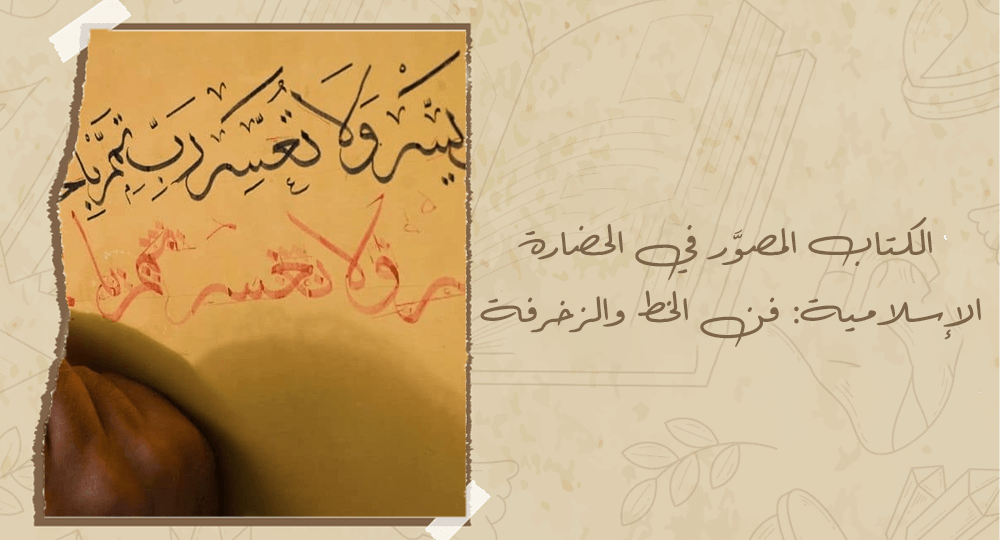
Have you ever imagined that a book could be more than a medium for knowledge, but a living, breathing work of art? This is what characterized the illustrated book in Islamic civilization: The art of calligraphy and ornamentation, combining artistic beauty and scientific heritage in a unique harmony. The Islamic manuscript was not just pages with words, but a field in which the idea was translated into an image, and the meaning into an ornament, in which scientific accuracy, visual creativity and exquisite calligraphy coexisted. Each of these manuscripts shines with the spirit of Islamic art, where letters and colors harmonize to tell the story of a civilization that believed that beauty is the companion of science.
In this article, we dive into the secrets and wonders of the illustrated book in Islamic civilization, exploring how it contributed to preserving the aesthetic legacy of the civilization.
What is a picture book in Islamic civilization? Calligraphy and Ornamentation?
When we talk about the illustrated book in Islamic civilization: The Art of Calligraphy and Decoration, we are talking about a world where thought and beauty intertwined in the same pages. The book was transformed from a mere written text into a vibrant work of art, combining scientific accuracy with the splendor of visual creativity. The illustrated manuscripts reflected the spirit of the prosperous Islamic era, showing great care for Arabic calligraphy and the delicate decorations that surrounded the texts as a frame of beauty and symbolism at the same time.
Through these books, Muslims were able to combine the transmission of knowledge with the preservation of artistic heritage. Each page was a painting in its own right, bearing evidence of the development of the art of illumination and illustrating the deep relationship between science and art in Islamic civilization. In this way, the illustrated book became a dual function: a vehicle for education and learning, and a masterpiece that preserved the spirit of Islamic creativity.
How did the comic book come about?
The development of the illustrated book began in Islamic civilization: The Art of Calligraphy and Decoration began with the introduction of the paper industry to the Islamic world via China and Samarkand, as paper provided an easy material for transportation, writing, and decoration. This transformation allowed the development of new techniques in the arts of parchment and illustration, transforming the manuscript from a simple textual container to an integrated artistic product that contains scientific and artistic drawings, exquisite decorations, and elaborate lines, giving the manuscript a unique artistic and scientific character.
How has the picture book contributed to the art of calligraphy and illumination?
The illustrated book contributed to Islamic civilization: The Art of Calligraphy and Ornamentation played a pivotal role in the development of the arts of calligraphy and ornamentation, as it was not only a means of transmitting knowledge, but also a living canvas that immortalizes the beauty of letters and the diversity of decorations. It combined technical precision and aesthetic imagination to become a rich reference for the arts of gilding, border embellishment, and margin decoration.
What are decoration techniques?
- Artists used gilding to highlight titles and important elements within the texts, giving the pages a majestic luster that harmonized with the sacredness of the text.
- Footnote embellishment is a separate art form, with illustrators adding botanical and geometric motifs to the page edges to complement the text and give it an elaborate visual framework.
- The decoration of the margins relied on geometric symmetry and precision in the distribution of colors, making each page a stand-alone work of art.
The Illustrated Book of Islamic Civilization: The Art of Calligraphy and Ornamentation documented floral and geometric motifs with astonishing precision, allowing scholars to trace their evolution through different Islamic eras. Over time, this type of book has become a living archive of Islamic art, passing on traditions of Arab and Islamic beauty from one generation to the next. Its influence also extended beyond geographical borders, as its examples reached Europe and inspired the illuminated styles of medieval books.
How did Arabic calligraphy develop?
The illustrated book preserved ancient Arabic scripts such as Kufi and Naskh, and meticulously documented their chronological and technical evolution. Kufi evolved from a strict geometric script to a more flexible and ornate style, while Naskh evolved into the most widespread script for writing Qurans and literary texts. Through these illustrated manuscripts, it is possible to trace how calligraphers combined aesthetics and function, and how artistic schools converged to give Arabic calligraphy its place in the history of Islamic art.
What are the aesthetic characteristics of calligraphy and illumination in illustrated books?
The art of calligraphy and illumination in illustrated books represents one of the most beautiful manifestations of beauty in Islamic civilization, where form and content coalesce into a vibrant canvas. Each letter and ornament carries the spirit of creativity and organization that characterizes this ancient artistic heritage.
What are the advantages of Arabic calligraphy?
Arabic calligraphy has a unique aesthetic that combines flexibility and balance, making it not just a means of writing, but an art form in its own right.
Among its most notable features:
- Aesthetic communication of letters It provides a unique visual cohesion, as the letters overlap seamlessly, making the word look like an ornament woven with geometric threads.
- Ability to transform into geometric configurations With the lines intertwined and rounded, sometimes the line takes the form of a circle, and sometimes it extends in crisscrossing lines that create a delicate mathematical equilibrium.
- Variety of Linear PatternsThe number of Arabic scripts reached more than eighty types by the end of the Abbasid era, such as Naskh, Thuluth, and Kufi, reflecting an artistic richness and development in aesthetic taste.
- Closely related to other Islamic artssuch as architecture, decoration, and inscription, making calligraphy part of the overall identity of Islamic art.
The calligraphers' mastery of this art was not just an exercise in writing, but a spiritual and aesthetic practice.
How did Islamic ornamentation stand out?
As for Islamic decoration in illustrated books, it occupied a wide artistic space in the world of beauty and detail, combining precision, symbolism and visual harmony.
Among its most notable features:
- Mixing botanical, geometric and geological motifs In one harmonious composition, flowers and geometric shapes combine to form a cohesive visual unity.
- Clever use of color Adding depth and vibrancy, color gradients are carefully used to emphasize the visual rhythm and strengthen the effect of the motifs.
- Meticulous attention to detail Every dot and every line was the result of conscious design and a delicate sense of balance.
- The integration of calligraphy and decorationThe letters were not separate from the decorative background, but rather harmonize with it in an artistic unity that combines beauty and knowledge, and embodies the spirit of the Islamic civilization that celebrated order and beauty at the same time.
With this harmony between calligraphy and decoration, the illustrated book becomes a masterpiece that can be read with the eye as well as with the mind.
How did the illustrated book evolve through Islamic times?
The path of the illustrated book began in Islamic civilization: The art of calligraphy and ornamentation began with a clear conservatism in its beginnings, then gradually transformed into an artistic arena full of creativity and precision, until it reached the peak of its art in the golden ages, especially during the Abbasid era. Its development was a direct reflection of the transformations of Islamic society, intellectually, culturally, and artistically.
What are the effects of religious context?
In the early centuries, people were wary of depicting living beings for fear of being suspected of idolatry or violating the sanctity of monotheism, so art was limited to geometric and botanical motifs that embodied a spirit of abstraction and symbolic beauty. However, as science flourished, the need for illustrations emerged, and books on medicine, astronomy, and engineering began to show accurate images with a purely scientific purpose.
These illustrations became a means of understanding scientific texts rather than an aesthetic end, combining scientific rigor with religious commitment, paving the way for a broader opening of the art of illustration within the book.
Why is the Abbasid period pivotal?
The Abbasid period marked a major turning point; it was here that the art of the illustrated book reached its highest level of maturity. The focus was no longer limited to the scientific aspect, but the decoration and calligraphy evolved to become part of the identity of the book itself.
Abbasid manuscripts were characterized by gilding, color harmony, and a variety of fonts, and artistic schools emerged in Baghdad and Samarra to bind books and design the title pages in a way that is rich in floral and geometric motifs.
During this era, attention shifted from scientific content to visual and aesthetic output, and the book became an integrated work of art that combines science and beauty.
How did books influence Europe?
Through Andalusia and Sicily, Islamic manuscripts crossed into Europe, directly influencing the development of Western manuscript art. Europe borrowed gilding, illumination, and elaborate decorative techniques, and learned from the Muslims the art of integrating text and image in a balanced visual harmony.
This is how the illustrated book was in Islamic civilization: The Art of Calligraphy and Illumination was a cultural bridge between East and West, preserving the memory of art and science and opening the doors of mutual influence over the centuries.
What are the best calligraphy and illumination books at Dar Alzaman Bookstore?
Characterized by Dar Al-Zaman Publishing and Distribution Library This book combines scientific depth and technical precision in the study of Islamic calligraphy and illumination, which is a fundamental reference for anyone seeking to understand the aesthetics of the illustrated book in Islamic civilization. These books are not limited to visual presentation, but give the reader tools for experimentation and application, making them an essential reference for anyone seeking to understand the aesthetics of the illustrated book in Islamic civilization: The Art of Calligraphy and Ornamentation.
The Art of Arabic Decoration and Calligraphy (C1)
First part The art of decoration and calligraphy From this unique series of Languages It explores the decorative motifs that influenced both Islamic and theatrical art. Analytical texts and diagrams illustrate the diversity of floral, geometric, and animal motifs, as well as mosaics and theatrical mask molds.
It also includes designs inspired by the Kashmiri shawl, giving it a diverse cultural dimension. This book not only documents but also provides artists and researchers with practical tools for experimentation and field study in the fields of calligraphy and Arabic calligraphy.
The Art of Arabic Decoration and Calligraphy (C2)
The second part The Art of Arabic Decoration and Calligraphy (C2) that comes from the Social Sciencesis the ultimate reference for students of calligraphy and ornamentation and lovers of Islamic art. This volume is characterized by its meticulous visual details that present authentic decorative examples along with modern applications of Arabic calligraphy designs.
The book is printed on premium paper, which gives the illustrations a remarkable visual depth, and is used in art workshops as a source of inspiration and hands-on training. It combines academic content with refined artistic design, making it an ideal choice for anyone wishing to study the development of Arabic-Islamic decoration in a modern way.
Frequently Asked Questions about the Illustrated Book in Islamic Civilization: Calligraphy and Ornamentation
What is the art of Arabic calligraphy and Islamic decoration?
The art of Arabic calligraphy and Islamic ornamentation is one of the finest creations of the Islamic civilization, as it is associated with the emergence of the Islamic religion and the Holy Quran in particular. This art was more than just writing, it became a visual expression of spiritual beauty. Muslims introduced ornamentation to letters and words, combining the sacredness of meaning with the splendor of form, so that the word itself becomes a vibrant painting.
What are the most important arts in Arab-Islamic civilization?
In the Arab-Islamic civilization, a number of arts emerged that shaped its cultural identity, foremost among them is the art of Arabic calligraphy, which was born out of the need to write down the verses of the Holy Quran. Along with it, literature developed as a mirror of thought and language, combining linguistic creativity and aesthetic spirit. Over time, Arabic calligraphy became an art in its own right, combining lettering and decoration to reflect the depth of Islamic identity.
What is Islamic calligraphy?
Islamic calligraphy is the art of handwriting using the Arabic alphabet or derived writing systems, characterized by its accuracy and elegance in forming its letters according to inherited technical rules. This art is used in writing religious texts, decorating mosques, and beautifying manuscripts and architectural facades. The Arabic, Persian, Ottoman, and Urdu scripts are of many types, showing the diversity of artistic schools within the Islamic world and the unity of its beauty at the same time.
The illustrated book in Islamic civilization: The Art of Calligraphy and Ornamentation is the culmination of the convergence of beauty and science, combining the mastery of the word and the splendor of the image in a unique harmony. It was a means of preserving Islamic visual identity and documenting artistic creativity through the ages, and continues to inspire lovers of art, calligraphy, and decoration with its historical depth and timeless aesthetic charm.
Read more: