

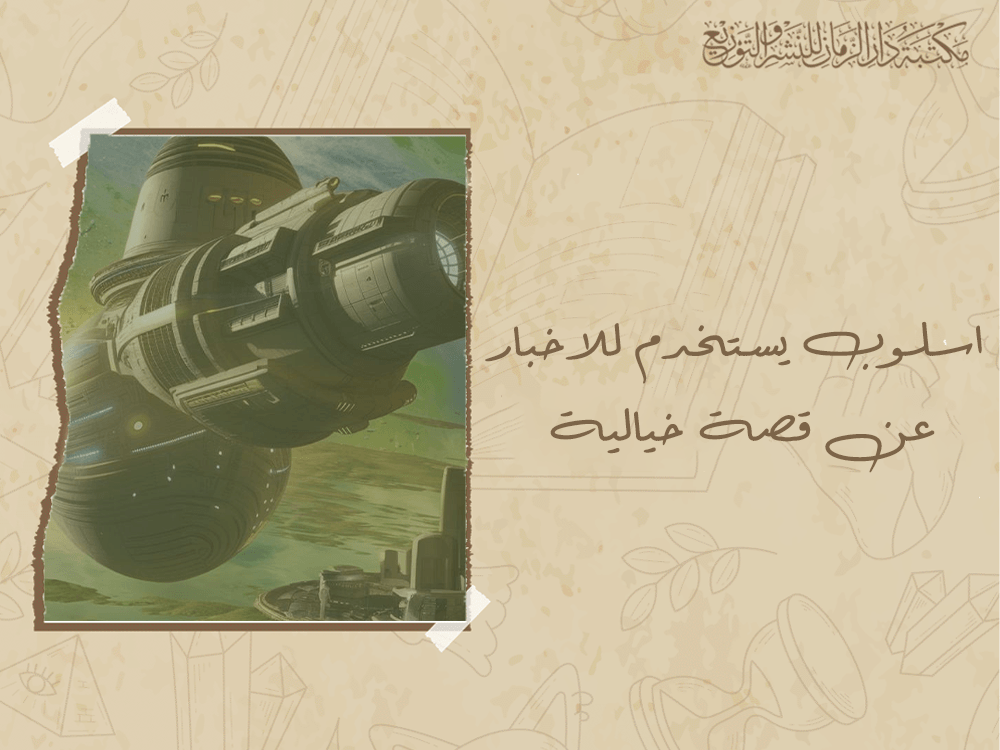
In the world of literature, one of the most creative and appealing tools used to tell a fictional story is the use of flash fiction. This technique is characterized by its ability to create completely new worlds, allowing the writer to transport the reader to places and times that exist only in the author's imagination. A technique used to tell a fictional story that relies on creating characters and events that transcend the boundaries of reality, giving the story a special charm and encouraging readers to interact with situations and ideas that are unimaginable in real life. Through this technique, the writer is able to use his language and style to paint amazing scenes that blend reality and fantasy, making the style used to tell a fairy tale more than just a recounting of events. It opens the horizon for the reader to explore new ideas and innovative visions of the world. In this context, we see that the use of fiction enhances literature's ability to address human issues through events that may be far from reality but close to the heart.
Narrative style (narrator)
In fiction, narration is one of the key factors that contribute to the presentation of events in an impactful and suspenseful way. The choice and type of narrator is a crucial element that influences how the reader is guided to understand the story and visualize its events. In this context, the narrator can be a first-person narrator who narrates events from a personal point of view, which enhances the reader's connection to the characters' inner feelings and thoughts. Or the narrator can be an outsider (third-person narrator), telling events from a neutral or omniscient perspective, revealing more details about the fictional world and characters.
When the narrator is reliable, it can give the reader a chance to understand the story more deeply. If the narrator is unreliable or confused in presenting facts, it creates dramatic tension and leaves room for imagination and interpretation. This type of narration allows the writer to build a sense of mystery or suspense, encouraging the reader to follow the events with more enthusiasm.
In addition, a writer can use limited or omniscient narration. In limited POV, the narrator is limited to presenting events from the perspective of one or a small group of characters, which enhances the reader's focus on those characters or the particular dimensions of the fictional world. In omniscient, the narrator is able to provide details about different characters and places at the same time, enhancing the complex construction of the fictional world.
Through these techniques, the narrative style is a powerful tool in the hands of the writer to create a fictional world full of intricate and exciting events.
Imagination in character building
In fiction, character building is one of the most important elements in creating a rich and exciting world. The writer uses the imagination to create characters that transcend reality, perhaps with supernatural qualities, fantastical creatures, or even characters from other worlds altogether. These characters can be pivotal in moving the story forward, reinforcing the importance of the fantasy genre in presenting challenges and adventures that cannot be imagined in realistic contexts.
Characters in fantasy stories may include heroes with special abilities, such as magic or super strength, which makes them more interesting and impactful to the reader. In addition to heroes, other characters such as villains, sidekicks, or secondary characters that represent different dimensions of the fictional world, which enriches the story and adds layers of complexity.
Besides supernatural or amazing characters, fantasy also allows the writer to build characters with unexpected characteristics, such as talking animals, aliens, or even people who deal with future technology in innovative ways. This expansion of character building helps create an exciting interplay between different forces and factors within the fictional world.
Moreover, fantasy character-building is characterized by the presentation of complex motivations and goals that may be impossible to achieve in reality, but through fiction, these characters can develop in a way that reflects maturity and personal challenge. Whether the goal is to save the world, or to search for a lost truth, building fictional characters contributes to a story that is rich in meaning.
So, it can be said that imagination in building characters contributes to making the story more exciting, and enhances the reader's ability to immerse himself in a fictional world full of challenges and surprises.
Preparing the place and time
In fiction, setting is an essential element that contributes to building the fictional world and contextualizing the events. Using imagination, a writer can create places and times that do not exist in reality, opening up a wide range of possibilities to develop environments that spark the imagination and add character to the story. This technique relies on presenting imagined worlds, which may be inspired by ancient legends, unfamiliar places in the distant future or even parallel universes.
One of the most prominent aspects of imagination in place-building is the ability to define characteristics that do not resemble reality; we may see floating cities, enchanted forests, distant planets, or even underground kingdoms, all of which require unlimited creativity on the part of the writer. This spatial diversity is not limited to visual description, but extends to the emotional atmosphere that these places create. It can be full of mystery, full of tension, or reflect a world of chaos or perfect order, all of which add depth to the story.
In terms of time, the ability to move between different time periods is one of the hallmarks of fantasy literature. Events may take place in the distant past, the distant future, or even across multiple eras, allowing the writer to create events that pose unprecedented challenges to their characters. Time can overlap in a way that enhances the complexity of the story, as we see in many science fiction and fantasy works where time is manipulated to create conflicts and tensions.
The goal of these time and place settings is to enrich the fictional style and enrich the world that is presented to the reader. The more precise and intricate the details of place and time, the more convincing and exciting the world of the story becomes, which contributes to fully immersing the reader in that fictional world.
The setting of space and time in fairy tales is a key factor in creating unconventional worlds and enhancing the fictional style of storytelling, allowing for a distinctive and exciting reading experience.
In conclusion, it can be said that the technique used to tell a fictional story is one of the most prominent literary narrative techniques that give stories a special character of excitement and suspense. Through this technique, the writer is able to build unfamiliar worlds and impossible events, giving the reader a chance to dive into an unlimited imagination. It has proven its effectiveness in conveying values and ideas in an unconventional way, as it can address social and humanitarian issues in an innovative way away from the constraints of reality. Its ability to create an atmosphere of tension and adventure makes it a powerful tool in the hands of writers. Therefore, it remains one of the most important tools that contribute to enriching world literature and achieving a deep artistic connection with the reader.