

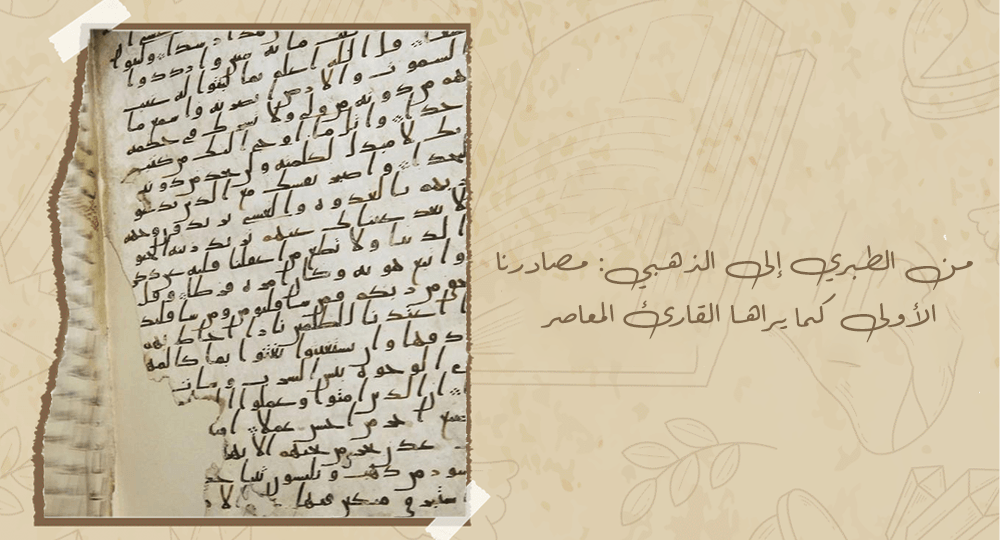
The greatness of a nation is not measured by the abundance of its books, but by its ability to understand those books and rediscover their meanings in the light of the current moment. Hence, returning to scholars such as Al-Tabari, Ibn Hazm, and Al-Dhahabi is not a retrogression, but a return to the roots to build branches and establish a cognitive identity at a time when superficial readings and hasty interpretations are in conflict, so reading their works today should be done with a critical sense and an eager mind that understands the difference between narrative and intention, between transmission and purpose, in the following lines we will address the glance from Al-Tabari to Al-Dhahabi: Our primary sources as seen by the contemporary reader.
A glimpse from al-Tabari to al-Dhahabi: Our first sources as seen by the modern reader
Referring to the great sources, from Imam Muhammad bin Jarir al-Tabari, to Imam Ibn Hazm al-Ishbili, to Hafiz Shams al-Din al-Dhahabi, is a journey of knowledge and culture.
In the folds of our cognitive foundation, historical, jurisprudential, and doctrinal truths are embodied, and images pulsating with the violence of reality and the originality of vision are realized before us.
Therefore, the contemporary reader must be aware of his pivotal role as a conscious critic; he picks up from the heritage what guides him to understand the contexts and enables him to draw lessons, interpret facts, and scrutinize contemporary realities:
First: Tabari
Imam al-Tabari represents an essential source for Muslims' understanding of their early events; he compiled the biographies of the prophets, read the political and social events in a clear language, and correctly presented the cases.
His Tafsir and History of Nations and Kings are an unmatched asset in analyzing political conflicts and the subtleties of defining moments, and he possessed a rare ability to extrapolate words and connect scenes.
The contemporary reader has an unparalleled interest in studying al-Tabari, and the contemporary reader has an unparalleled interest in studying al-Tabari.
It not only sets the stage for reading the past, but also shows symbols of power and contexts of ignorance and ignorance, and establishes a balanced view of the past that avoids falling into the trap of “beautification” or “uglification” while at the same time avoiding the temptation to imitate ready-made representations.
The Linguistic and Intellectual Dimension of Tabari
Al-Tabari's language, although it may seem dry at first glance, exudes a historian's keenness to document details and rely on the words of famous sources. For example, when he presents the saying: "Remember the grace of God upon you," he is not content with the repeated presentation, but rather draws on the collection of narratives and provides reasons.
This method gives the modern reader a window into the grammatical and rhetorical nature of the verses, and allows them to get a taste of the original language, away from mere intellectual translation.
Secondly: Ibn Hazm
Shafi'i in his approach, Hanbali in his firmness of speech, Ibn Hazm realizes that ijtihad is not a license for intellectual luxury, but a responsibility subject to reliability of narration and the use of reason within controls.
In al-Muhalla, al-Mustasafa, and all his jurisprudential books, he combines deconstruction and balancing, between scrutinizing the authority and refining the idea.
This method is still a guide for the contemporary researcher contemplating the nature of legal texts, as it provides him with an immune force against out-of-context influences and prepares him to distinguish between the documented and the popular, the valid and the acceptable, and what is added to the heritage.
The Linguistic and Intellectual Dimension of Ibn Hazm
Ibn Hazm's Muhalla, for example, is characterized by his elaboration of the deficiencies of narrators and the flaws of hadiths, and his identification of the reliable ones, especially when a jurisprudential issue is involved.
This method was not a theoretical slogan, but a practical act, used to mark the boundary between certain knowledge and speculative knowledge.
In this way, the contemporary reader acquires a significant critical capacity and a sense that deep research begins with confident questioning, not superficial indoctrination.
III: Golden
If previous sources specialized in history, jurisprudence, or transliteration, al-Dhahabi prepared institutionalized, codified approaches to science and literature.
In Tikrit al-Hafiz, Sir al-Alam al-Nubala“, and al-Tarikh al-Kabir, an integrated panel of writing biographies of scholars and their attitudes, personal assessments and opinions of their words, and sometimes measures of their conduct and behavior.
Dhahabi's linguistic impact
For today's reader, returning to al-Dhahabi provides a window into the biographies of the greats according to a critical evaluation methodology. When he reads Tikrit al-Hafiz, he understands the magnitude of the elements that make up the source of the science of hadith, and places each narrator within his map, whose contours change as he tests the characters with reliable elements such as justice and accuracy.
This builds a conscious view of the history of science, away from blind reverence, and pushes for consideration of the impact of scientists and their experiences.
The contemporary relationship with our primary sources
In a time of rapid communication and categorization, heritage becomes part of a window for dialogue, for reviewing our assumptions, so how do we interact with it consciously?
- Cognitive discrimination: The Journey Organizer urges a sense of distinction between the historical text and the mental text, between the narrative as it happened and the formulation as transmitted by the historian.
- Understanding in Context: Textual transmission is not acceptable on its own, but requires contextual clarification, knowing the environment, neighboring events, and overlapping interests.
- Constructive skepticism: Not everything that is narrated is taken without verification, as Al-Dhahabi himself did not hide his critical vision and his intention to review the narratives transmitted.
- Recruitment in the presentWhen we invoke the writings of these scholars, we seek to apply their principles to our reality: When we invoke the writings of these scholars, we seek to apply their principles to our reality in thought, interpretation, ijtihad, and understanding the details of social transformations.
Al-Tabari's treasures in your hands from Dar Al-Zaman Bookstore
Tabari was not only an exegete, but also a historian, thinker, and verifier of meaning in the form of words, but his scientific project in interpreting the Qur'an was a complex and solid one, brimming with authority, language, and disagreement.
Today, I've compiled a library of Dar al-Zaman The distillation of this venerable legacy in scientifically optimized abbreviations that approximate the meaning and preserve the effect, in three volumes of a comprehensive and exhaustive treatment of Al-Tabari, in a contemporary style that illuminates the way without breaking the reader's connection to the original.
These abbreviations are not an abridgement or a reduction, but rather a careful filtering of the text that keeps what illuminates and enriches the reader from what burdens, making al-Tabari close to the student of today and inspiring the researcher in a time when knowledge has accelerated and commentaries have multiplied.
End of the line. From al-Tabari to al-Dhahabi: Tabari, Dhahabi and Ibn Hazm are windows through which we look at our consciousness and ways to understand ourselves, and the contemporary reader is not asked to worship the text, but to understand it, deconstruct it, and interrogate it, in order to reshape a mature relationship with a heritage that still whispers in the details of the present.
Read more: