

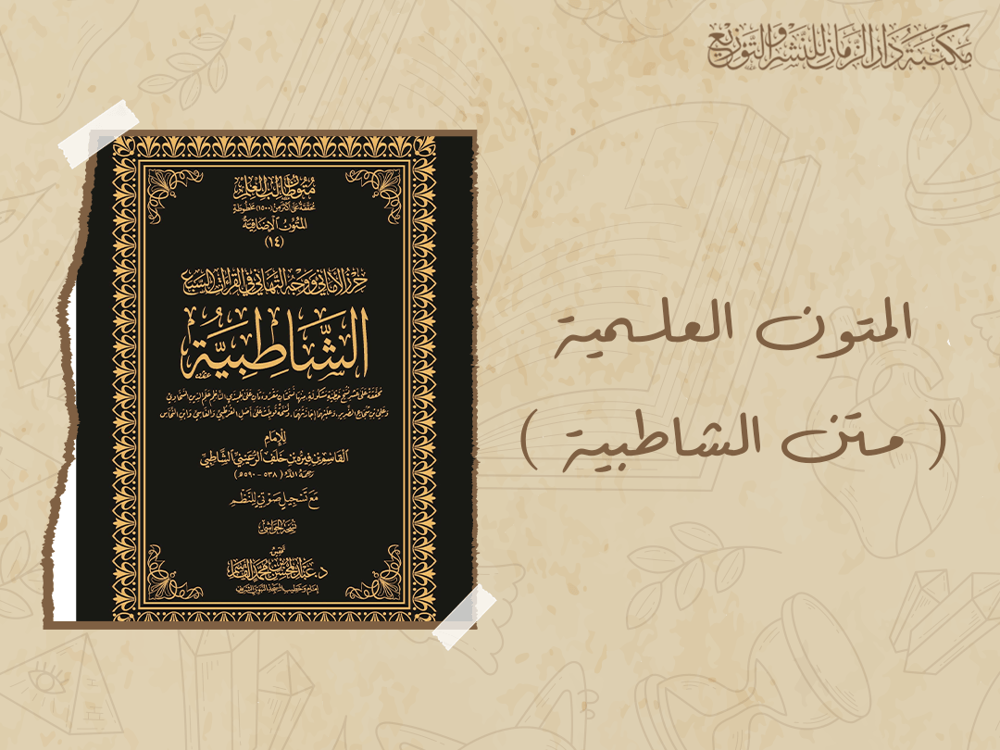
Matn al-Shatbiyya, also known as Harz al-Amani and Wajh al-Tahani, is one of the most prominent and important texts in the science of Qur'anic recitation. It was written by Imam al-Qasim ibn Firah ibn Khalaf ibn Ahmad al-Shatibi (538-590 AH / 1143-1194 AD), who is considered one of the greatest Qur'anic scholars in Islamic history. This work contains the most important rules and fundamentals of the seven recitations, and is considered a major reference for anyone interested in studying the science of Qur'anic recitation.
Scientific textbooks (Matn al-Shatbiyah)
Author: Imam Shatibi
Imam al-Qasim ibn Firah al-Shatibi was born in Shatiba, Andalusia (present-day Spain) and grew up in a rich scholarly environment. He began his studies in Qur'anic sciences from a young age, and specialized in the science of readings at the hands of a number of prominent sheikhs and scholars. He was known for his strong memory and perfect memorization, which qualified him to be a reference in the science of readings. In addition to Harz al-Amani and Wajh al-Tahani, he also has other works on Qur'anic and Shari'ah sciences.
Content of the board
Matn al-Shatbiyah is one of the most important texts in the science of reading, and it contains the following:
1. Introduction to the virtues and sciences of the Qur'an:
- Al-Shatibi discusses the importance of the Qur'an and the virtue of learning and teaching it. He mentions the virtue of the Qur'an and the importance of learning and practicing it, paving the way for students to understand the great importance of the science of Qur'anic recitation.
2. Fundamentals of the seven readings:
- Al-Shatibi presents the origins of the seven mutawatir readings, which include:
- Nafi: He is the reader of Medina.
- Ibn Kathir: He is the reader of Mecca.
- Abu Amr: He is the reader of Basra.
- Ibn Amer: He is the reader of the Levant.
- Asim: He is the reader of Kufa.
- Hamza: He is also from the readers of Kufa.
- Al-Kisa'i: He is the third reader from Kufa.
- Al-Shatibi discusses the origins and rules adopted by each reader, helping students understand the differences between the different readings.
3. Differences in the readings:
- Al-Shatibi explains the differences between these readings in terms of origins and brushes.
- Al-Shatibi explains the linguistic and verbal differences between the seven readings, which helps in understanding the diversity and linguistic richness of the Qur'an.
4. Poetic verses:
- The text includes poetic verses that address the rules, fundamentals, and differences between the readings, making it easier for students to memorize and recall.
- The verses are characterized by eloquence and clarity, and cover all aspects of the science of the seven readings, including origins and brushes.
Style and approach
Al-Shatibi uses the style of poetry, which makes it easier for students to memorize and recall. The verses are characterized by eloquence and clarity, and cover all aspects of the science of the seven readings, including origins and brushes. Al-Shatibi relies on a systematic and organized approach, which helps to present the information in a sequential and coordinated manner.
Importance and impact
Matn al-Shatbiyah is an indispensable reference for anyone interested in studying the science of Qur'anic recitation. It is highly regarded among recitation scholars and teachers, and is taught in many Islamic schools, institutes, and universities around the world. With its poetic style and systematic approach, it helps students understand and assimilate the rules and fundamentals of the seven recitations more effectively.
Annotations and footnotes
Due to the importance of scientific texts, many scholars have written commentaries and footnotes to clarify and explain the poetic verses. Some of the most famous commentaries include:
1. Shatbya Commentary by Sheikh Abdul Fattah Al-Qadi:
- It is a contemporary commentary characterized by clarity and accuracy, and helps students better understand the text.
- Sheikh Abdel Fattah Al-Qadi takes the verses and explains them in detail, relying on multiple sources to verify the authenticity of the information.
2. Sharh al-Shatbiyah by Imam Ibn al-Jazri:
- It is considered a classic commentary and contains detailed explanations and illustrations of the verses.
- Ibn al-Jazari provides a thorough explanation of the verses, drawing on his extensive experience in the science of Qur'anic recitation.
Challenges and criticism
Despite the great value of the course, there are some challenges that students face when studying it:
1. Poetic language:
- Poetry verses may be difficult for some students to understand, requiring explanation and interpretation by teachers.
- Poetic language requires students to be familiar with rhetoric, grammar, and syntax.
2. Memorizing verses:
- Due to its large size and large number of verses, some may find it difficult to memorize and recall.
- Memorizing the matn requires a lot of effort and perseverance from students, and they may need to break the verses into small chunks to gradually memorize them.
The Impact of “Scientific Texts” on Qur'anic Studies
Interpretation and analysis
The issue of interpretation and analysis is an aspect that has greatly influenced Qur'anic studies. Through the Scientific Mutun, researchers can learn about a variety of rules, origins, and differences between different readings. This is a valuable tool for exegesis and analysis research, providing a rich database of information that can be used in academic studies.
Research and scientific articles
The “scientific corpus” has received a great deal of attention from researchers and academics around the world. Many scholarly papers and articles are published that deal with different aspects of the Qur'anic metn, whether historical, analytical, or comparative. This research contributes to a deeper and more comprehensive understanding of the Qur'anic readings. Many of these researches rely on scholarly texts as the main source of information.
Scientific conferences and seminars
Many scientific conferences and symposiums are held to discuss Quranology and its work. These events bring together researchers and scholars from around the world to exchange ideas, research, and studies on the science of reading. These conferences contribute to enhancing academic understanding and providing new and innovative insights. These conferences present the results of research that relies on the Qur'an as a primary source.
Challenges and criticisms
Modern criticism
Despite the great importance of the work, it has not escaped criticism. Some critics argue that al-Shatibi was inaccurate in documenting some of the rules, especially those that rely on oral narration. However, this criticism is part of the process of scientific inquiry that aims to improve and better understand the science of Qur'anic recitation.
Modernization and realization
Due to its age and huge content, many institutions and researchers have re-investigated and updated the scientific texts (Matn al-Shatbiyya). These efforts aim to correct errors and present the texts more accurately and clearly. These investigations are based on reviewing the original texts and comparing them with old manuscripts.
Conclusion. The Matn al-Shatibiya is one of the precious treasures of the Islamic heritage and occupies a prominent position in the science of Qur'anic recitation. Thanks to his poetic style and organized approach, Al-Shatibi presents the rules and fundamentals of the seven readings in a way that is easy for students to memorize and assimilate. Whether you are an academic researcher or a student of science, Al-Mutun Al-Alamiyya provides you with the knowledge and tools you need for a deeper and more comprehensive understanding of the science of Qur'anic recitation.
By studying this work, scholars and readers can gain a comprehensive and deep insight into the seven Qur'anic readings and their origins. Thanks to its accuracy and comprehensiveness, al-Mutun al-'Ulama remains an indispensable reference for anyone interested in studying the science of Qur'anic readings. The influence of this great work extends to many academic fields, making it one of the precious treasures of the Islamic heritage.