

Writers and poets are the pillars of culture and art in societies, as they express human experiences and feelings in a variety of ways. They have a unique ability to craft novels, stories and poems that inspire and express the beauty and depth of life. They have a unique ability to craft novels, stories and poems that inspire and express the beauty and depth of life.
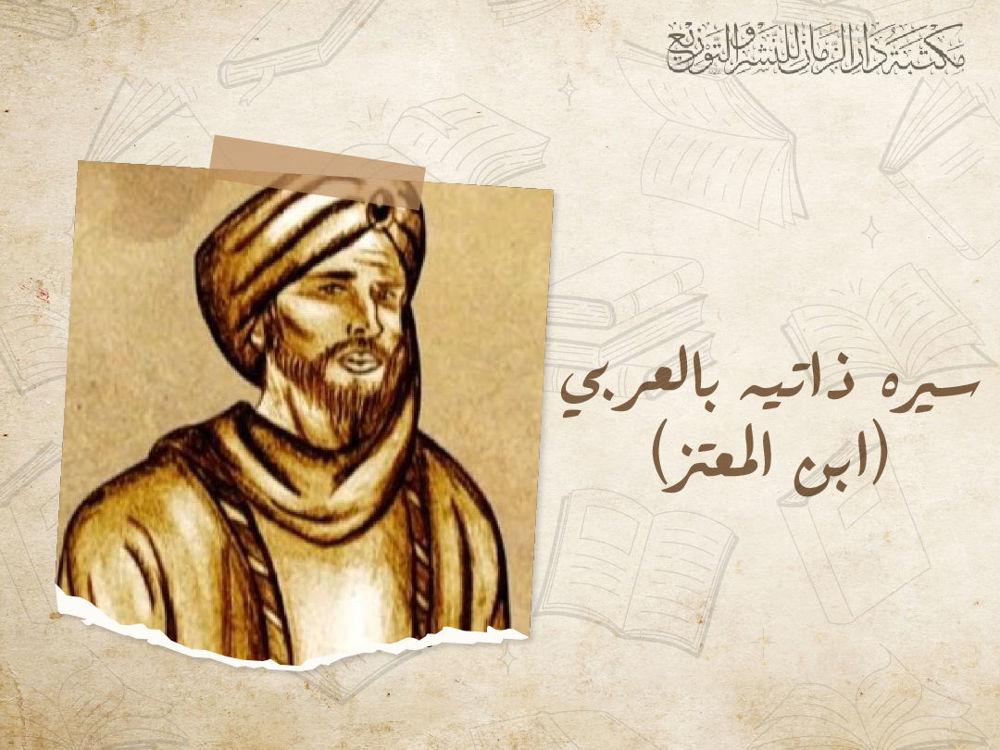
Biography in Arabic (Ibn al-Mu'taz)
In our introduction to the Arabic biography of Ibn al-Mu'taz, we say that he is Abdullah ibn al-Mu'taz al-Lah, the Abbasid caliph, nicknamed Abu al-Abbas, born without specifying the date of his birth. He was known as the “Caliph of a Day and a Night”, as he inherited the Abbasid caliphate, and was nicknamed Al-Murtada Billah. However, he did not last long in power, as his servants attacked him and took the caliphate from him.
His biography
A biography of Ibn al-Mu'taz in Arabic is not a short speech, this ancient writer has a lot to say about him, and in this article, which is the subject of the biography of Ibn al-Mu'taz in Arabic, we will provide most of that information about him.
Abdullah ibn al-Mu'taz ibn al-Mutawakkil ibn al-Mu'tasim ibn Harun al-Rashid, also known as Abu al-Abbas, was born in 247 AH. He assumed the caliphate after the death of his father al-Mu'taz, but his rule was short-lived, as he was killed by palace Turks and eunuchs. He was exiled to Sarra and then to Baghdad, and suffered from the persecution of the Abbasid state. He lived a turbulent life and resorted to entertainment. He had a prominent presence in Arabic poetry, but his reign did not last long, as he spent only one night in power. He was killed in the same year, and his death was part of a series of overthrows of the Bani al-Abbas caliphs.
Regardless of the divergent assessments of Ibn al-Mu'taz's life, his knowledge and culture compensated for his failure in the political sphere and gave him a prominent place in the history of Arab culture that emphasizes his genius. He was renowned for his vast knowledge of literature and poetry, and was known for his ability to negotiate with scholars in various fields such as grammar and history. He was known for his great scientific achievement in his time, as he was considered one of the most famous scholars of the era, along with Abu al-Abbas Tha'alb, two of the most prominent scholars of that time.
Biographies praise Ibn al-Mu'taz as a distinguished literary and scholarly figure, as he was prolific in literature and was a poet, critic, and rhetorician. His council was the center of attention of the intellectuals of his time, as he benefited from every art in the sciences. He met many great scholars and writers, such as Abu al-Abbas al-Mabrad and Tha'alb, and he had dealings with other great scholars such as Abu Ali al-Hasan bin 'Alil al-Anzi, and many literary figures, such as Abu Bakr al-Suli, narrated from them and recited his poetry. He was a printed poet who relied on poetry, was capable and skilled in composing poems, and was close to poetic styles, easy to pronounce, and good at reading, which made him the center of attention of scholars and writers of his time.
Ibn al-Mu'taz is a modernist poet
As a poet, Ibn al-Mu'taz was unique in his keen perception of linguistic details and complex poetic images, as his poems were characterized by delicacy and precision in similes and characterizations. His style is characterized by the use of descriptions and comparisons, reflecting his high skill in portraying scenes and ideas in a beautiful and innovative way.
As for literary critics, they praised Ibn al-Mu'taz for his ingenuity and his great use of the science of Badi'a and industry. Their appreciation was not limited to his skill in similes, but extended to his ability to use rhymes and weights in an elaborate and harmonious manner.
Despite his excellence in the art of poetry, Ibn al-Mu'taz was not satisfied with this, but worked to develop its styles and ornamentation, which some critics considered as evidence that the science of Badi'a and industry ended with him, and that it was sealed by him.
Ibn al-Mu'taz, Historian of Modernist Poetry
Ibn al-Mu'taz played a prominent role in promoting the study of modernist poetry through his works, such as “Layers of Poets” and ”Muhasasin Abu Tammam's Poetry and Muhasin.” By writing books such as Al-Badeea, he opened up new horizons for understanding and appreciating Muhaddithi poetry, allowing critics to engage with the genre in a deeper and more centered way.
Ibn al-Mu'taz is one of the few individuals who devoted his efforts to the dissemination and study of modernist poetry, as he collected information and samples of their poetry in his book “Layers of Poets”, which is considered one of the main works in this field. His goal was to shed light on the poets who wrote in praise of the caliphs, ministers and princes of Bani al-Abbas, so that their legacy would be preserved and known to the people.
Ibn al-Mu'taz dealt with more than one hundred and twenty poets, starting with Bashar ibn Burd and ending with al-Nashim al-Akbar, presenting their news and his opinion on some of them, and showing his interest in many of the obscure Abbasid poets.
His Tabaqat is a record of literary life shortly after the death of the Umayyad stalwarts, and in it we find strange trends and attempts to break the old and establish the new, along with sensible balances and careful explanations. Ibn al-Mu'taz also showed a tendency to take issues away from the intellectual polemics of a later period.
Ibn al-Mu'taz was one of the first scholars to publicize and promote the virtues of modernist poetry, praising this type of poetry and highlighting its advantages and virtues, without paying much attention to those who followed the doctrines of the ancients in their poetry.
Although the Muhaddithis imitated the ancients in the use of Badi'a, they had a problem with their excessive use of it, especially Abu Tamam, who was called the Imam of the Muhaddithis, as he was often impulsive and innovative in the use of Badi'a.
As mentioned in Muhammad ibn Ishaq al-Nadim's index, there were books that participated in the care of the poetry of the Muhaddithis, such as the book Al-Warqa' fi Akhbar al-Shu'ariyat by Muhammad ibn Daoud and the books of Ibn Tayfur, Ahmad ibn Taher, which were concerned with presenting the poetry of the Muhaddithi poets in a selected and selected form.
Several books have participated in the presentation and study of the poetry of the Muhaddithin, such as “Al-Bahir fi al-Ikhtiar al-Muhaddithin” by Jaafar ibn Muhammad ibn Hamdan al-Musli and “Mahasin al-Muhaddithin”, in addition to other books such as al-Rawdah by al-Mubarad and al-Bara'i by Harun ibn Ali al-Manjim.
Despite his appreciation for the poetry of the modernists, some critics, such as Dr. Ahmed Darwish, considered that Ibn al-Mu'taz could not excel in industrialization as Abu Tammam did, and that his industrialization was limited to sensual ornamentation and did not reach the depth of imagery. Darwish believes that Ibn al-Mu'taz's imagery does not require deep contemplation, and that he relied mainly on similes rather than deep imagery and imagination.
In today's article, we conclude our biography of Ibn al-Mu'taz, and with his death, another page in the history of Arabic literature closes. Although we don't have many details about his life and death, his poetic legacy is still present in the world of literature. He is considered one of the distinguished poets who enriched literature with his poetic art and linguistic innovations. Thanks to his poems and writings, he was able to leave his mark on the school of modernist poetry, and his poems remain historical testimonies that reflect the splendor of the Arabic language and the depth of poetic thought.
Read more: