

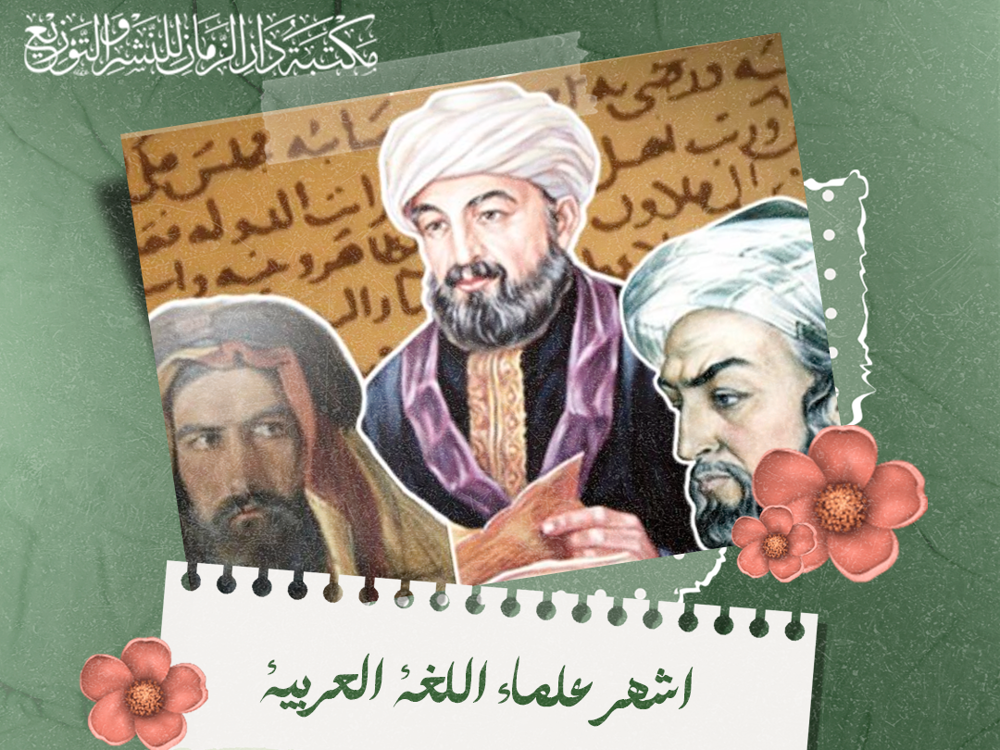
The Arabic language is characterized by its long history and rich cultural heritage, and it has produced many of the most prominent Arabic language scholars who have contributed to its understanding and development. In this article, we will review some of the most famous scholars of the Arabic language and their outstanding contributions.
Who are the most famous Arabic scholars?
Who are the most famous scholars of the Arabic language? We will answer this question in the following lines:
Abu al-Aswad al-Duwali
We will talk about Abu al-Aswad al-Duwali, the most famous scholar of the Arabic language, who is considered one of the prominent figures in the history of the Arabic language. Abu al-Aswad al-Duwali was born as Zalem ibn Amr al-Kanani, and he was one of the early followers. He lived in the city of Basra and died in 688 AD.
Abu al-Aswad al-Duwali is considered one of the pioneers of the science of Arabic language, as he was a lieutenant of Imam Ali ibn Abi Talib. He was chosen by Imam Ali to establish the rules of grammar, in order to prevent the introduction of melody into the Arabic language. Abu al-Aswad divided speech into verb, noun, and noun, and then followed and developed these rules as necessary.
Abu al-Aswad began collecting and analyzing information, presenting it to Imam Ali for review. Imam Ali then used it in the city of Basra, and it was also utilized by Umar ibn al-Khattab and Uthman ibn Affan. Abu al-Aswad al-Duwali also had a diwan of poetry attributed to him.
Abu al-Aswad al-Duwali's contributions to the establishment of grammar and the development of the Arabic language cannot be ignored. He played a major role in defining the rules of the Arabic language and making it easier to understand and learn. Abu al-Aswad al-Duwali is one of the scholars who contributed to building the foundations of the Arabic language as we know it today.
Al-Khalil ibn Ahmad al-Farahidi
We previously talked about Abu al-Aswad al-Duwali and his contributions to grammar and the development of the Arabic language. Now we will talk about al-Khalil ibn Ahmad al-Farahidi, one of the leading thinkers and scientists in language and literature.
Al-Khalil ibn Ahmad al-Farahidi, who was born in the second century and died in 170 AH, was an imam of language and literature. He founded the science of presentations and was the author of the first Arabic dictionary known as “Al-Ain”. He also had knowledge of the science of rhythm and melody, and it is said that he acquired this science from the makers of musical instruments. Al-Khalil studied Arabic poetry, rhythmic analysis and organization, then arranged the poems according to their melodies and grouped them into similar groups. As a result, he identified fifteen seas that could be used in poetry.
It is worth noting that Al-Khalil ibn Ahmad al-Farahidi changed the drawing of letters in the Arabic language. Previously, colored dots were used to distinguish different letters in the dotting system developed by Abu al-Aswad al-Duwali's student. However, Al-Khalil ibn Ahmad al-Farahidi changed the glyphs to distinguish between glyph dotting and exclamation dotting. He used a new drawing that included using a small diagonal alef above the letter for an opening, a small yaw below the letter for a fracture, and a small waw above the letter for a digit, reiterated the movement if the letter was mununun, added a non-dropped shin, and used an eye head to indicate the presence of a humza and other movements such as a consonant and a hyphen. Thus, al-Khalil ibn Ahmad al-Farahidi is considered the first to establish a system of movements and later a system of parsing.
As a result, Khalil's contributions to the development of the Arabic language and the definition of its rules are a valuable legacy in linguistics and literature.
Sibuyeh
Amr ibn ”Uthman ibn Qanbar al-Basri, also known as Sibweh, was one of the most famous Arabic language scholars in history. He was born in the second century and died in 180 AH. He was known for his deep knowledge of the Arabic language and his ability to analyze it and explain its rules.
He learned grammar and Arabic from the great scholar al-Khalil ibn Ahmad al-Farahidi, and benefited greatly from him in developing his knowledge and understanding of the Arabic language. Sibuwayh wrote a book in which he compiled the rules of grammar and morphology, which was carried and published by his student al-Akhfesh Saeed ibn Mas'ada. Although he died before the book was finalized, it is still considered one of the most important grammar and morphology books in history. The book is characterized by a large number of grammatical and morphological terms that have been used to this day.
Sibuya is considered a symbol of knowledge in the Arabic language and has been revered and glorified by many grammarians and scholars. Thanks to his contributions, the rules of morphology and grammar became clearer and more organized, and were documented in his book, which is an important reference in the study of the Arabic language.
Sibweh's legacy in Arabic linguistics is still present today, and is considered a starting point for anyone who wishes to study grammar and morphology and understand the foundations of the Arabic language.
Alexei
Al-Kisa'i, or Ali ibn Hamza al-Asadi al-Kufi, was a prominent linguist and grammarian, born in the second century of the Hijrah and died in 189 AH. He is considered the seventh of the seven Qur'anic reciters, and he founded the true Kufic school of grammar.
Al-Kisa'i made many important contributions to the linguistic sciences, as he wrote many notable works such as “The Meanings of the Qur'an,” a book on readings, “Al-Nawadir Al-Kabir” and a mukhtasir on grammar. Imam al-Shafi'i described him as a master of grammar, so whoever wants to delve deeper into this science must learn from scholars like al-Kisai.
Al-Kisa'i's writings left a significant impact on the field of Arabic grammar and language, and he is therefore considered one of the important figures in the history of this science.
Ibn Genie
Abu al-Fath 'Uthman ibn Jinni al-Muslimi, the most famous Arabic scholar, was a prominent scholar in the science of grammar and language. He was born in the fourth century and died in 392 AH. He received his education and training from prestigious scholars of the time, most notably Sheikh Abu Ali al-Farisi.
'Uthman ibn Jinni spent about forty years learning from al-Shaykh al-Farisi, until he became one of his heirs in the science of grammar. He accompanied him on his journeys and travels, whether in Aleppo, Damascus, and Baghdad, or in Kufa and Shiraz.
Afterward, 'Uthman ibn Jinni became a companion of the famous poet al-Mutanabbi. He worked at the court of the Buyhi ruler in Shiraz, and had a strong relationship with the court members.
He wrote several important books, including “Al-Khasisat” in philology and ”The Secret of the Industry” in Arabic. He is also considered the first to comment on the poems of al-Mutanabbi's Diwan, and al-Mutanabbi described him as knowing his poetry better than he did.
Uthman ibn Jinni, with his great contributions to grammar and his notebook of poetry, is considered an important figure in the history of linguistic sciences, and his legacy continues to influence the field until today.
Johari
Ismail ibn Hammad al-Jawhari, who died in 393 AH, is considered one of the most prominent thinkers and authors in the field of the Arabic language. He authored a huge dictionary titled “Taj al-Language and Sahih al-Arabiya”, which is considered one of the oldest dictionaries in the Arabic language. This dictionary is characterized by its precise and organized arrangement, as it includes different words, arranged and classified according to different sections and chapters.
Ismail ibn Hammad al-Jawhari made a major contribution to the development of the Arabic language, collecting and documenting words and explaining their meanings and uses. This dictionary is considered an important reference for researchers and students of the Arabic language, and has greatly influenced the development and improvement of the level of writing and expression in Arabic.
Using his unique and systematic approach, Ismail ibn Hammad al-Jawhari was able to provide a valuable tool for understanding and using the Arabic language in a correct and accurate manner. Over the centuries, Taj al-Language and Sahih al-Arabiya remains one of the most important references in the field of Arabic, and continues to enhance our understanding and use of this beautiful and rich language.
Thus, we have finished our article that talked about the most famous scholars of the Arabic language, we hope you liked the article.