

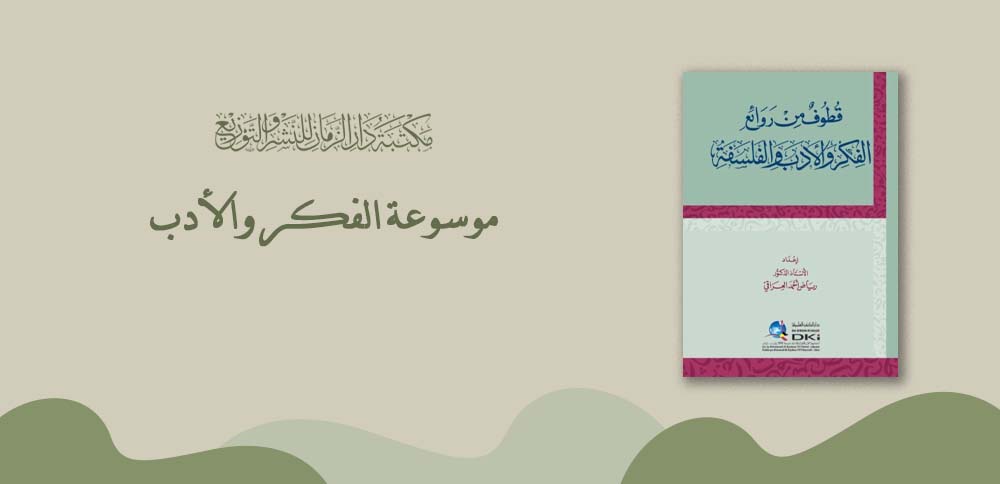
Arab readers today are increasingly eager for knowledge sources that combine comprehensiveness and accuracy, and give them a deeper understanding of the components of thought and literature in Islamic and Arab civilization. In this context, the Encyclopedia of Thought and Literature comes as a knowledge bridge linking the past to the present, offering researchers and interested parties a rich space to explore the paths of creativity and intellectual diversity that have shaped the features of our culture over time.
What is the Encyclopedia of Thought and Literature?
The Encyclopedia of Thought and Literature is a comprehensive encyclopedic work that focuses on tracing the development of thought and literature in the Arab and Islamic world, and presents with a broad horizon the symbols of the cultural renaissance and its major issues. The encyclopedia combines cognitive depth with a historical framework to provide an integrated picture of intellectual and literary creativity, and how cultural currents interacted with the transformations of society and identity through the ages.
What are the goals of the encyclopedia?
It aims to provide rich references that help researchers and those interested in studying the Arab and Islamic heritage to access accurate and organized information. It also seeks to highlight the intellectual and literary accumulations that formed the core of civilizational transformations, and to build a bridge between the past and the present by tracing the impact of thinkers and writers in shaping cultural consciousness.
How was it organized?
The Encyclopedia of Thought and Literature is organized in a way that allows for easy access to content and integration of vision. Its articles are categorized according to specific fields of knowledge, including philosophy, literature, poetry, social sciences, political thought, and other fields related to culture and human thought. This organization makes it a precise reference tool that allows readers to navigate between different branches without losing coherence or context.
What are the main themes?
- Biographies of influential people in thought and literature: The encyclopedia covers the lives of prominent thinkers and writers, focusing on the stages of their intellectual development and their contributions to the cultural movement.
- The evolution of schools of thought: It documents how intellectual currents arose and developed in the Arab and Islamic contexts, and how they influenced the course of the intellectual renaissance.
- Literary and critical doctrines: It presents the different literary approaches and methods of criticism that accompanied the development of Arabic literature, highlighting the creative debate between tradition and innovation.
- The cultural roots of ideas and terms: It examines the historical and linguistic backgrounds of intellectual concepts and compares Arab-Islamic thought with its Western counterpart in addressing cultural, linguistic and identity issues.
What are the main features of the Encyclopedia of Thought and Literature?
- The encyclopedia combines comprehensiveness and accuracy, as its topics span the fields of thought, criticism, literature, and cultural history.
- It provides in-depth analyses and a glossary of terms in three languages, allowing readers to make direct comparisons between Arab and Western schools of thought.
- It relies on documented scientific sources and presents accurate biographies of Islamic and Arabic scholars, highlighting their paths in the development of knowledge.
- It is an essential reference for researchers and students, as well as for readers interested in expanding their knowledge in the fields of literature and critical thought.
- It contains organized indexes and precise thematic paths that facilitate quick access to information and save time for research and review.
How comprehensive is the content?
The Encyclopedia of Thought and Literature is remarkably comprehensive, covering a wide range of issues from the classical roots of thought to modern trends in literature and criticism. This diversity makes it an integrated knowledge space that accommodates different schools and visions, giving the reader a balanced picture of the evolution of human thought through the ages.
How does it differ from traditional references?
This encyclopedia differs from traditional references by focusing on comparative cross-cultural analysis, combining the scientific method with multilingual study. It provides in-depth explanations of concepts and terms in three languages, becoming a tool for cognitive interaction between East and West and enhancing understanding of global intellectual exchanges.
Why is it important for scientific research?
The encyclopedia is of great importance to researchers, as it provides documented and organized material that facilitates academic reasoning and analysis. The precise indexes and categorized sections make it possible to quickly trace topics, making it an effective resource for preparing studies and research projects in the fields of literature, history, and critical thought.
How has Dar Alzaman Library contributed to the development of Arabic encyclopedias?
contributed Dar Al-Zaman Publishing and Distribution Library It has contributed significantly to the development of Arabic encyclopedias by producing accurate and systematic reference works such as the Encyclopedia of Thought and Literature, which combines scientific depth and easy access to knowledge. Dar Al-Zaman has adopted a methodology based on strict documentation of information, and organizing it according to scientific classifications that make it easy for readers and researchers to benefit from it. In this way, Dar Al-Zaman has become one of the most prominent institutions that have contributed to enhancing confidence in Arabic encyclopedic content.
It adopts a vision based on combining originality in knowledge and keeping abreast of modern developments in the fields of academic publishing. By providing specialized encyclopedias in literature, thought, humanities, and social studies, it continues to support the Arabic library as a source of accurate and renewable knowledge that serves students of science and researchers in various disciplines.
What are the best intellectual and literary encyclopedias available at Dar Alzaman Bookstore?
Dar Al-Zaman Publishing and Distribution Library is known for the comprehensiveness of its content and the diversity of its publications that serve researchers and those interested in the fields of thought and literature in the Arab world. Through its encyclopedias, it seeks to provide deep knowledge that enriches the reader and gives him a wide encyclopedic horizon, through accurate reference works that have a distinctive place in the cultural scene. Among the most prominent intellectual and literary publications offered by the library are the following:
Encyclopedia of Islamic Geniuses in Science, Thought, Literature, and Leadership (Volume 1)
is a Encyclopedia of Islamic Geniuses in Science, Thought, Literature, and Leadership (Volume 1) from a section Languages Written by Dr. Muhammad Amin Farshukh, this book is a cognitive reference that narrates the biographies of the most prominent figures of thought, science, and leadership in Islamic history within an analytical context that documents their achievements in the fields of jurisprudence, travels, science, and literature.
Ibn Battuta, Ibn Majid, Wassil ibn Atta, Imam Abu Hanifa, and others who contributed to Islamic civilization with their intellect and creativity. The encyclopedia comes in a traditional paperback edition with a blue cover with an elegant historical design, written in Arabic.
Encyclopedia of Social and Political Science Terms in Thought
Prepare Encyclopedia of Social and Political Science Terms in Thought from a section Book collections Dr. Samih Dghaim to be a comprehensive reference in defining and analyzing key concepts in the social and political sciences, with a special focus on the context of Arab and Islamic thought.
The encyclopedia contains glossaries in three languages (Arabic, French, and English), in addition to organized indexes that facilitate academic research. At 1346 pages, it is an important resource for students and researchers in the fields of humanities and social sciences.
How does the Encyclopedia of Thought and Literature reflect the diversity of Islamic civilization?
The Encyclopedia of Thought and Literature highlights various aspects of Islamic civilizational diversity by presenting biographies of prominent figures from different backgrounds and ethnicities. This diversity can be seen in a wide range of areas, including:
- Medicine and astronomywhich lists the work of Muslim scientists who contributed to the development of rigorous methodologies that have benefited all of humanity.
- Humanities and LiteratureIt documents the contributions of thinkers and writers who formulated intellectual and aesthetic concepts derived from multiple cultural environments.
- Leadership, Philosophy and LegislationThe biographies of leaders and scholars reveal the depth of interaction between religious texts and intellectual and social practices in building a cohesive civilizational system.
How does the Encyclopedia of Social and Political Science Terms in Thought contribute to the understanding of Arab and Islamic concepts?
The Encyclopedia of Social and Political Science Terms is an essential part of the project to develop intellectual awareness in the Arab and Islamic context, as it collects terms from heritage and modern sources and categorizes them in a systematic way that makes it easier for researchers to analyze and understand them. In addition to being a comprehensive linguistic and intellectual reference, the encyclopedia gives specialists a historical view of the development of social and political concepts, enhancing their ability to read the present through the accumulations of past thought.
This encyclopedia is characterized by its ability to link originality and contemporaneity. It does not merely collect and define words, but seeks to renew concepts and reconstruct Arabic and Islamic terminology within an integrated scientific format. This approach allows scholars and researchers to analyze concepts away from the literal transfer of imported theories, and opens the door to the development of social and political thought that draws its originality from the heritage while keeping pace with the requirements of the times.
How do intellectual and literary encyclopedias enhance the role of Arab scientific research?
The Encyclopedia of Thought and Literature is a model for resources that bring together specialized knowledge in the humanities and intellectual sciences, within an organized structure that makes it easy for researchers to access reliable information. Having a comprehensive encyclopedia means providing an accurate database covering cross-cutting topics such as philosophy, literature, and intellectual history, allowing complex issues to be analyzed from multiple angles.
These encyclopedias help academics compare intellectual trends and follow conceptual shifts in the Arab world, without having to search through disparate or unreliable sources.
What does it contribute to graduate studies?
Intellectual and literary encyclopedias provide vital tools for graduate students and university researchers, as they provide historical examples that illustrate the development of intellectual concepts and the mechanisms of cultural interaction between Arab and Islamic currents and their global counterparts.
These advanced resources enable researchers to trace the paths of intellectual influence and impact, and build their research projects on solid analytical foundations. They also provide them with a methodological framework that helps them read texts in their historical and intellectual contexts, making it easier to formulate accurate and evidence-based conclusions.
How do you support concept development?
Encyclopedias of thought and literature play a pivotal role in developing new concepts and theories within the Arab research environment. They give researchers the opportunity to start from the Arab and Islamic context to understand intellectual phenomena, away from complete dependence on Western models.
Through the comparisons and analyses provided by these encyclopedias, it is possible to develop hypotheses that stem from the local cultural reality and provide critical insights that contribute to the renewal of Arab thought and strengthen its presence in the global scientific arena.
FAQs about the Encyclopedia of Thought and Literature
Is the Encyclopedia of Thought and Literature suitable for beginner researchers?
Yes, the Encyclopedia of Thought and Literature is organized in a systematic way that makes it easy to use for both novice researchers and specialists. A clear and comprehensive style has been adopted that allows quick access to information, helping readers to understand concepts and analyze texts without complexity.
Does the encyclopedia cover world literature as well?
The encyclopedia focuses primarily on Arab and Islamic literature and thought, but includes comparative references to world literature when needed to analyze different schools of thought or cultural approaches. This enriches the content and provides a broader view of the topics.
Are intellectual encyclopedias limited to Islamic thought only?
Encyclopedias differ in their scope according to their classification and scientific approach; some focus on Islamic thought and its development, while others deal with general human thought in its various schools and trends. This diversity reflects the richness of the intellectual fields covered by these encyclopedias.
The Encyclopedia of Thought and Literature represents a bridge between the ancient Arab-Islamic heritage and the modernization of knowledge in the modern era, combining originality and contemporaneity to enrich the fields of research and education, and support the building of a renewed civilizational awareness that contributes to reviving the role of Arab culture in the global intellectual scene.
Read more: