

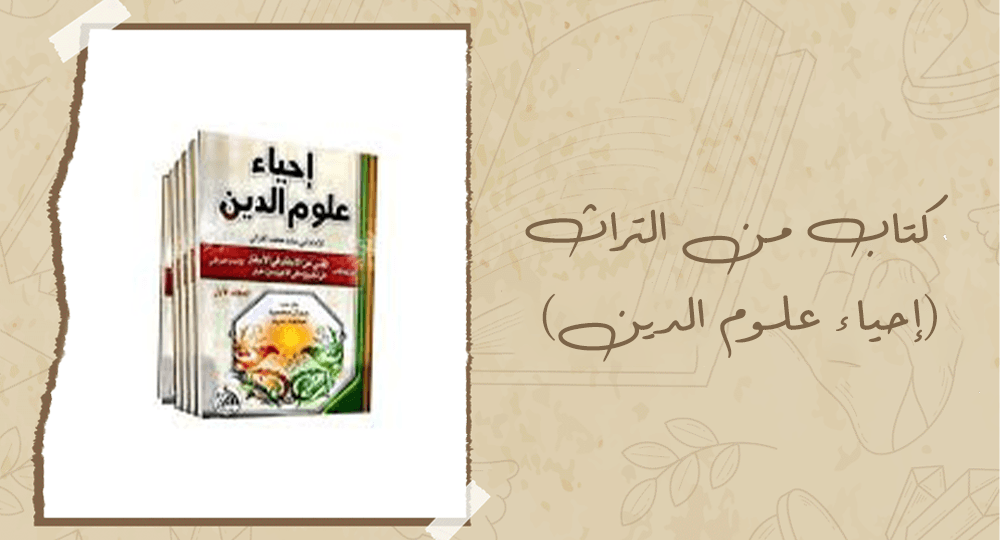
Have you ever wondered how a heritage book (Ihya al-'Ulum al-Din) was able to remain present in the minds of readers and scholars for more than nine centuries? It is not just an old work, but an intellectual and spiritual journey that Imam Abu Hamid al-Ghazali formulated in a way that blends mind and heart, science and behavior, making this book one of the most prominent titles of the Islamic heritage throughout the ages. It derives its value from its depth in analyzing the human psyche and its ability to blend jurisprudence and mysticism, providing an integrated model for revitalizing religion in people's lives rather than in texts alone.
In this article, we will take you on a fun tour inside a heritage book (Ihya al-Ulum al-Din), to get to know its intellectual and historical secrets, and reveal the circumstances of its writing that Al-Ghazali experienced in his journey between doubt and certainty.
What is a book from the heritage (Ihya' al-'Ulum al-Din)?
One of the greatest works in Islamic history is Ihya al-'Ulum al-Din (The Revival of the Sciences of Religion), written by Imam Abu Hamid al-Ghazali between 489 and 495 AH after a period of solitude and deep reflection following his spiritual and intellectual crisis. This work came to rehabilitate the spirit of the Shari'ah and self-purification, combining knowledge and action, thought and behavior, in an attempt to revive the deep human dimension of religion.
This book is not just a work of jurisprudence or mysticism, but a comprehensive encyclopedia that includes an integrated vision of Islamic life through four main sections: Worship, Habits, Habits, Destructions, and Manajiyat. Each section deals with practical and theoretical issues in education, behavior, and ethics, combining Sunni jurisprudence and Sufi analysis in beautiful harmony, making it a timeless reference for all those who seek to understand the essence of religion in a conscious and balanced spirit.
Who is the author of the book?
The author of this great book is Imam Abu Hamid al-Ghazali, one of the great Islamic scholars of the fifth century. Known for his sharp intellect and vast knowledge in jurisprudence, philosophy, and speech, he had a profound spiritual experience that made him turn from formal teaching to meditation on the essence of faith, emerging from his isolation with a book that changed the course of Islamic thought.
Why was the book written?
After experiencing an intellectual and spiritual crisis that shook his faith in the science of the external world and its social status, al-Ghazali chose to move away from positions to search for “the science that reforms the heart.” Through his book, he wanted to remind the Ummah that religion is not just an outward ritual, but a behavior of the heart and psychological purification that seeks to get closer to God through knowledge, work, and sincerity.
What is the historical context of a book from the tradition (Ihya al-'Ulum al-Din)?
The book was written in the fifth century AH (eleventh century AD), a time when spirituality was in clear decline, with jurisprudential and logical arguments overshadowing scientific life. Many scholars were preoccupied with the appearance of rulings and classification, and turned away from the essence of religion and the behavior of the heart.
This period witnessed widespread intellectual turmoil, severe political conflicts between the Abbasid state and the Seljuks, the pressure of the Crusades, and the deterioration of social conditions. Corruption was rampant among some scholars who were close to power, and people lost confidence in knowledge that was not reflected in behavior.
What are the causes of Ghazali's crisis?
In this climate, al-Ghazali experienced a deep intellectual and spiritual crisis. He had the knowledge and position that tempted him to settle down, but he lost his peace of mind. He was attacked by doubts about the purposes and usefulness of science, and his soul was divided between reason and faith, until he decided to isolate himself and search for the essence of religion away from appearances, and found in the path of mysticism the serenity he missed.
How did the environment affect the content of the book?
This environment, with its intellectual, political and spiritual crises, was reflected in the pages of Ihya al-Ulum al-Din, a vivid response to a turbulent reality. Al-Ghazali tried to restore the balance between knowledge and action, and to restore morality and tazkiyah to their place in the life of a Muslim. He went from criticizing the outward appearance of religiosity to reviving the inner, and from rigid theorizing to a practice that restores the spirit of both science and religion.
What is the approach and unique features of Ihya' al-Ulum al-Din?
Al-Ghazali's Ihya al-Ulum al-Din is a unique model for combining jurisprudence and mysticism, as he did not limit himself to stating the outward rulings of the Sharia, but linked them to their inner meanings and educational purposes. Al-Ghazali combined the sciences of origins and jurisprudence on the one hand, and the sciences of tazkiyah and behavior on the other, in an integrated format that makes legal action a means of purifying the heart, not just a formal adherence to the rules. Al-Ghazali used a storytelling and preaching style, speaking to the human psyche in moving language and deep psychological analysis, relying on religious and rational texts that emphasize the relationship between repentance and self-reform.
What are the pedagogical underpinnings of the book?
Al-Ghazali focused on practical education to acquire good morals and behavior, stressing that knowledge is worthless unless it is transformed into action and realistic reform of the soul. He called for repentance and sincerity, and believed that reforming the heart is the basis of all true worship. He also rejected the separation between knowledge and action, arguing that spiritual education begins with practicing worship with awareness and sincere intention, and ends with purity of heart and equanimity of behavior.
What is the thematic structure of the book?
- The first quarter is devoted to the topic of worship, dealing with the actions of the heart and wounds that strengthen man's relationship with his Lord.
- The second quarter dealt with the topic of habits, explaining how to transform daily behavior into worship with good intentions.
- The third quarter deals with the destructive ones, i.e., diseases of the heart such as envy, hypocrisy, and anger, analyzing their psychological roots.
- The book concludes with the fourth quadrant on manajiyat, focusing on the purification and purity of the soul through repentance, intention, and sincerity.
How did al-Ghazali deal with repentance in a book of heritage (Ihya' al-'Ulum al-Din)?
Al-Ghazali addressed the concept of repentance as the major turning point in the journey of self-cultivation and the struggle against sins. He saw that repentance is not just a word on the tongue, but a deep spiritual state that expresses the awakening of the heart after its obliviousness, and the awakening of the conscience before the greatness and justice of God. For him, repentance is a renewal of the covenant with God, and the beginning of the path of those who walk towards inner serenity and tranquility.
What are the stages and pillars of repentance?
Al-Ghazali divided repentance into three stages that reflect the degrees of those on the path of reform. There is public repentance from major sins, private repentance from minor sins, and private repentance from anything that distracts the heart from God. This categorization reflects his holistic view that extends from reforming the outward behavior to refining the inner intention.
As for the pillars of repentance, he defined them as three basic elements on which the validity and acceptance of repentance is based:
- Knowledge of guilt: It is a person's awareness of his sin and his realization of its ugliness and its effects on his worldly and eternal life.
- Regret it: It is the burning of the heart in sorrow for what has been lost, and a sincere feeling of need for God's mercy.
- Quitting the sin: That is, leaving the sin immediately and stopping the wounds from it.
Al-Ghazali added a fourth element: the determination not to return, as repentance is not complete without a sincere covenant that prevents a person from returning to the sin again.
What pedagogical methods are used?
Al-Ghazali used precise educational methods in Ihya' al-'Ulum al-Din to refine the soul and soften the heart towards repentance. He did not limit himself to theorizing, but adopted various methods that combine reason and conscience, reaching the reader in the depth of his feelings and behavior.
These methods include stories that illustrate the fate between the guilty and the repentant, and psychological analysis that reveals the roots of guilt and its entrances into the soul. He also employed carrots and sticks to balance fear and hope, and was keen on realistic application by providing examples of repentant behavior. He emphasized the educational progression in reforming oneself and linking knowledge to action so that the impact of repentance remains effective in daily life.
What are the behavioral effects of repentance?
Al-Ghazali highlighted the effects of repentance as an internal cleansing process that re-humanizes the heart and washes away the stains of guilt. It results in spiritual clarity that illuminates insight, forgiveness of sins that opens the door of divine mercy, and a sincere return to God that revives the relationship between the slave and his Lord. Through this state, repentance is transformed from a mere emotional act to a permanent behavior that controls the soul and refines morals, making the repentant's life more conscious and his behavior more pure and upright.
What are the best editions of Ihya' al-Ulum al-Din available?
Tully Dar Al-Zaman Publishing and Distribution Library Special attention to the heritage of Imam al-Ghazali by providing the best editions of the heritage book “Ihya” al-'Ulum al-Din" (Revival of the Sciences of Religion). These editions are characterized by careful scientific investigation and fine textual control, in addition to technical care in production and printing. The editions vary to meet the needs of students and researchers in the fields of jurisprudence, mysticism, and the fundamentals of spiritual education. Book collections:
Revival of the Science of Religion 1/5
This massive volume collects the first part of the Biology of Religious Sciences 1/5 In a copy edited by Sayed Omran. The edition was published by Dar Al-Hadith in Cairo with high-quality printing on durable paper suitable for intensive academic use.
The cover is eye-catching with its gold decoration and symbolic painting of the path of guidance, giving the book an artistic character that reflects the value of the scientific content within. This edition is an ideal destination for researchers in jurisprudence and spiritual education because of its carefully researched and revised text.
Repentance - Revival of the Sciences of Religion Series
Another version of Repentance - Revival of the Sciences of Religion Series It focuses on the chapter of repentance in a simple and clear manner. This volume comes in a hardcover, medium-sized paperback that is easy to carry for daily reading at home or while studying.
This edition deals with the meanings, conditions, and behavioral effects of repentance in language close to the reader, making it suitable for individual reflection as well as for use in educational institutions.
Frequently Asked Questions about a Heritage Book (Revival of the Sciences of Religion)
Is it permissible to read al-Ghazali's book?
It is permissible to read al-Ghazali's book for those who have a solid scientific background that enables them to distinguish between issues that are correct and those that need scrutiny. As for those whose knowledge has not reached this level, it is advisable not to read it alone, as some places may contain subtle issues or doubts that need clarification from scholars.
What is the best edition of the Revival of the Science of Religion?
The edition of Dar al-Fikr (Damascus) is considered one of the best editions available for a book from the heritage (Ihya al-Ulum al-Din), as it is characterized by accurate indexing that facilitates access to topics, and is distributed over five volumes with a clear methodological division, in addition to the quality of printing and clarity of writing, which makes reading it comfortable and useful for researchers and those interested in the sciences of religion.
What is the book Ihya al-Ulum al-Din about?
A book from the tradition (Ihya' al-'Ulum al-Din) deals with deep spiritual and ethical themes that aim to revive the sciences of the heart and tazkiyah, combining knowledge and behavior in one framework. The book emphasizes the ethical and social aspect of religion, and makes charity, piety, and tazkiyah the main axes for understanding religious life and human treatment.
Ihya al-Ulum al-Din remains a landmark in Islamic thought, as it combines deep legal knowledge with the spirit of faith-based education. It inspires its readers to refine the soul and improve behavior, so it is advisable to read the book to ensure an accurate understanding of Imam Ghazali's intentions that contribute to the purification of the heart and the revival of the conscience.
Read more: