

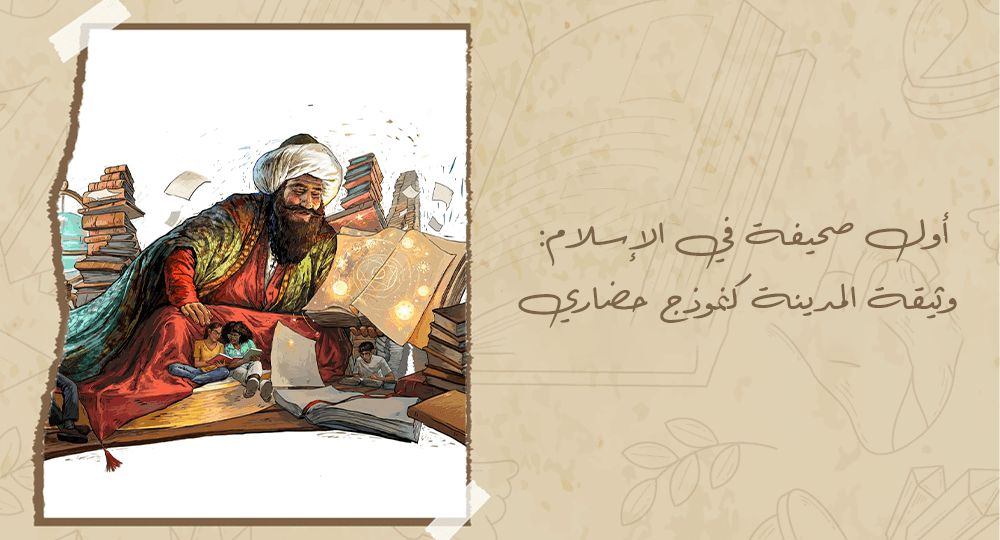
Imagine that you live in a troubled city, where tribal conflict is raging between yesterday and today, and religious difference is tearing apart the social fabric. In the midst of this chaos, a unique historical document emerges: The first newspaper in Islam: The Document of the City as a Civilizational Model, better known as the “Document of the City”. The newspaper was not just words on paper, but a decisive step and a civilizational model in shaping the coexistence between Muslims and People of the Book in Yathrib after the Prophet Muhammad's migration in 622 AD. If you are a researcher, student, or interested in the history of Islamic legislation and state-building, you will find that the Medina Document represents the first cornerstone of what later became known as the state of law, and clearly reveals how Islamic civil society began to take shape amidst complex political and religious circumstances.
What was the first newspaper in Islam: The Medina Document as a civilizational model?
The first newspaper in Islam: The Charter of the City as a Civilizational Model, also known as the Constitution of the City or the Madinah Newspaper. This document is considered a pioneering civilizational model because it laid a new foundation for organizing life in Yathrib after the arrival of the Prophet Muhammad, bringing together the Aws, Khazraj, Muhajireen, and Jews under one umbrella. The newspaper was a historic step to separate the parties and establish the rules of cooperation after tribal conflicts that lasted for many years.
The Document of Medina played a pivotal role in establishing the concept of the Ummah as a civil society of diverse ethnicities and religions, as it included clauses that regulated relations, put an end to conflicts, and established the principles of cooperation and collective security. As such, it represented the first experience of the social contract in Islam, as it included practical solutions to end disputes and formulate a new form of peaceful coexistence for all.
When was the City Charter written?
The City Charter was written almost immediately after the Prophet's migration, in 622 AD, following a long series of tribal conflicts between Yathrib's Aws and Khazraj residents as well as the presence of Jews.
Why is it called a newspaper?
It was called a newspaper because its provisions were written and documented in written form, and copies were distributed to representatives of all parties in the new society, ensuring that everyone was familiar with the rights and duties and that adherence to them was reinforced.
How did the City Charter establish a model of coexistence?
What is the concept of nation in the paper?
The City Charter began with the concept of “ummah,” but it went beyond the narrow tribal concept by making all residents of the city, Muslims, Jews, and their allies, a single civic unit based on social and political alliance. Thus, the ummah became a framework that accommodated religious and cultural diversity and placed loyalty to the community above tribal affiliations.
How are Jews and non-Muslims included?
The Medina Document considered Jews and non-Muslims as an integral part of the civic fabric, including them in its provisions, rights and obligations, and stipulating that they must fulfill their collective obligations to be considered part of the nation. The document thus placed them within the social and political covenant, granting them a status that guarantees common interests and peaceful coexistence.
What rights and duties are stipulated?
The document was keen to guarantee religious freedoms and civil rights for all parties, with a clear definition of collective and individual duties, with the aim of achieving justice and solidarity:
- It affirmed the freedom to practice all religious rites, stipulating that “Jews have their religion and Muslims have theirs.”.
- She stressed that the city must be jointly defended when exposed to any danger.
- It obligated everyone to bear the costs of defense and solidarity in time of war.
- It prohibited tribal revenge and laid the foundations for collective justice, so that each individual bears his or her legal responsibility.
- It prevented aggression and maintained social security, while guaranteeing freedom of association and religious activities for the entire community.
How did Al-Madinah establish the concept of an Islamic state?
From the time the Madinah Gazette was drawn up, the Prophet Muhammad's role in shaping the new Islamic state was clear. The Prophet assumed the position of supreme leadership, holding the reins of the highest arbitration authority. The newspaper made him the final authority in every major dispute or case, and combined the secular and religious authorities under his command in a way that was unfamiliar in the tribal Arab environment of the time. This role was not only administrative, but also foundational to the concept of political leadership in Islam, as governance became subject to a clear system of faith and morality.
When looking at how tribal law was incorporated into the new legislation, the paper balanced the prevailing tribal customs with some new foundations. Traditional separation mechanisms were used to resolve disputes between groups, while recognizing the authority of the new Islamic values. The document recognized the necessities and responsibilities of the group, but stipulated that no individual should be punished for the crime of another, thus introducing the principle of individual justice within a broader social framework.
The form of centralized authority crystallized in the Madinah newspaper was distinctive and unique. The newspaper formulated a unified leadership headed by the Prophet Muhammad, with the power of final judgment, especially on major issues. Its provisions included the organization of military and defense taxes so that everyone was held responsible without discrimination on the basis of religion. It was a legal and political document that established the nucleus of the Islamic state and ensured a delicate balance between the rights and duties of each component of the new society.
What is the civilizing role of the city newspaper?
In the heart of Islam's first newspaper, the City Charter stood out as a civilizational model by establishing the principles of religious pluralism. The document affirmed respect for the beliefs of the People of the Book, Jews and Christians. It also allowed non-Muslims within the city to practice their rituals freely, and provided them with a set of civil and legal rights that put everyone on an equal footing, without discrimination or exclusion.
The newspaper embodied the concept of justice in practice, providing freedom of belief to all residents of the city, guaranteeing equality before the law for all, and refusing to hold a group responsible for the fault of an individual. This legal framework helped solidify the meaning of justice in its broader societal context, not as an abstract value.
As for the civilizational impact of the Madinah on Islamic civilization, it constituted an earlier model for regulating civil relations and legislative regulation between the state and minorities. These principles were later reflected in the laws of Islamic civil regimes. The document also became the basis for contracts and treaties concluded with other societies in different eras of the Islamic state, especially with regard to the organization of coexistence and citizenship rights. For example, the impact of the newspaper was reflected in the covenants of the Rashidun caliphs with the Ahl al-Dhimmah, and its principles were evoked in the agreements that regulated the status of multi-religious societies during later Islamic periods, making it a reference even in today's contemporary issues dealing with the concepts of human rights and citizenship.
What are the cultural products around the city document?
Between the shelves Dar Al-Zaman Publishing and Distribution LibraryYou will find a wide range of cultural products that celebrate heritage and biography and highlight the status of the first newspaper in Islam: The City Document as a unique civilizational model. This library offers a variety of works that help deepen understanding of the history and values of the document, and provides educational and social resources for the whole family and lovers of Islamic culture. Islamic Books:
100 hadiths to memorize
Product “100 hadiths to memorize”It is an engaging educational tool that helps students and families memorize hadiths related to Islamic values and the spirit of coexistence, reflecting the principles established by the Madinah Document. This work brings together a carefully selected selection of hadiths as a practical reference in promoting ethics and daily behavior, making it an easy-to-use and motivating option for memorization and family engagement.
120 Keys to Paradise
As for the booklet “120 Keys to Paradise“It is a concise guide that collects verses and hadiths about the keys to goodness and paradise in an organized manner, facilitating a deeper understanding of the basic concepts that were established after the issuance of the City Charter. This product enriches the knowledge of those interested in Islamic culture and gives them a comprehensive overview of the means of goodness and reward, in a simplified manner that suits different levels of knowledge.
What distinguishes a city newspaper from other constitutions?
What makes the City Charter unique from other ancient and contemporary constitutions? When you look deeper into the document, it is clear that it not only organized the life of a newly formed society, but also created a new approach to the relationship between the state and society based on inclusiveness and civic openness.
- Al-Madinah newspaper went beyond the traditional tribal framework and established a civic concept that promotes the unity of society across different religions and ethnicities.
- It recognized equal rights for all city residents regardless of their religious or ethnic affiliations and clearly defined penalties and responsibilities, establishing an early principle of the rule of law.
- The leadership of the state in the newspaper did not rely on heredity or military power alone, but conditioned its legitimacy on the consent and agreement of the community.
- It was concerned with protecting the rights of non-Muslims within the Islamic entity, and emphasized the need to reject injustice and aggression, regardless of religion or origin.
In doing so, Al-Madinah became the first newspaper in Islam to represent an advanced civilizational model that transcends traditional boundaries towards a society that celebrates pluralism and ensures justice for all.
Frequently asked questions about the first newspaper in Islam
Did the City Charter include non-Muslims?
Yes, the City Charter included Jews and non-Muslim residents of the city, granting them rights and imposing duties on them within the civil society, which contributed to building a civilizational model based on coexistence.
Why is the Medina Document considered the first Islamic social contract?
The City Charter is considered the first Islamic social contract because it established a clear framework of rights and duties for all groups within the city, based on agreement and justice, away from the tribalism that had previously prevailed.
Do they apply in today's constitutions?
Although contexts have changed a lot, the principles of the City Charter such as equality and freedom of belief have become an integral part of many modern laws and constitutions around the world.
It is considered the first newspaper in Islam: The City Charter as a civilizational model, a timeless civilizational example in establishing a cohesive multi-religious society that upholds the value of justice and protects individual freedom. This document continues to inspire concepts of governance and co-existence even today, as its foundations of equality and mutual respect remain relevant in every age.