

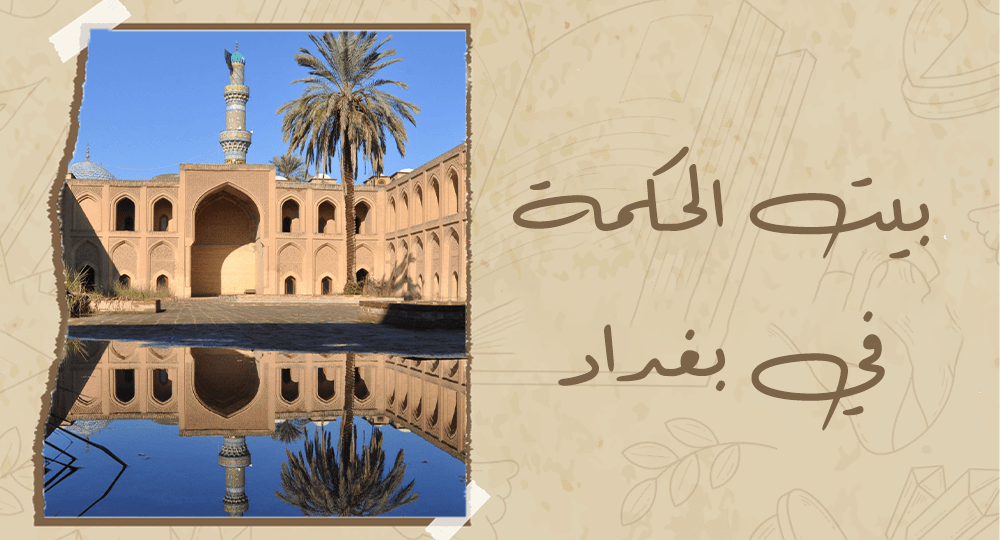
At a time when Baghdad was stepping confidently towards unparalleled scientific glory, between the corridors of the Caliphate Palace and the courtyards of the mosques, an entity unlike any other was born. The House of Wisdom, the name alone inspires prestige, was a pulsating spirit of science, a memory that gathers the civilizations of the earth, and a ship led by the mind towards the shores of progress, and the philosopher met with the mathematician, the doctor with the translator, the scientist with the astronomer, to cooperate and reshape the world again, and in the following lines we will explain to you what you need to know about the House of Wisdom in Baghdad.
The House of Wisdom in Baghdad What is it and why was it established?
The House of Wisdom in Baghdad was a huge scientific institution that was established in the Abbasid era, specifically in the second century AH, and reached its peak in the third century AH.
It included a huge library with thousands of books, study rooms, translation rooms, astronomical observatories, and councils for scientific and philosophical discussion.
It was founded by the Abbasid caliphs, especially Harun al-Rashid, and flourished during the reign of his son, Caliph al-Ma'mun. The aim of its establishment was to collect the sciences of previous nations, translate them into Arabic, develop them, provide a scientific environment that contributes to the renaissance of Islamic thought, and build a civilization based on science and knowledge.
The Abbasid caliphs realized that the Islamic state, whose authority extended from the borders of China in the east to Andalusia in the west, needed a collective mind to advance the nation scientifically and intellectually.
Ancient civilizations such as Greek and Persian had a huge scientific heritage, but it was written in different languages and scattered among countries, so a center was needed to collect this heritage and translate it into Arabic, then study, criticize, and develop it.
Hence the idea of Bayt al-Hikma, to be a civilizational bridge that transfers the world's sciences to the Arabic language and reproduces them within a rational Islamic context that values logic and experience.
Translation at the House of Wisdom
Translation was the most prominent activity at the House of Wisdom in Baghdad. The most famous translators were brought in from different countries, and they were Muslims, Christians and Sabians, fluent in languages such as Greek, Persian, Syriac and Hindi:
- Hanin ibn Ishaq: He translated dozens of medical and philosophical books from Greek and Syriac into Arabic, and was known for his accuracy and depth of understanding of the original texts.
- Thabit ibn Qurra: The famous mathematician who translated and explained the books of Euclid and Ptolemy.
- Al-Faraj bin Nasr: The one who transferred astronomy and astrology from the Persians and Indians.
But translation in the House of Wisdom was not a literal transfer, but a complex intellectual process that required understanding the text, then reconstructing it in Arabic with eloquence and precision, often with scholars adding their own comments and observations, and sometimes correcting errors in the original texts.
Science flourished at the House of Wisdom
The sciences that flourished within the House of Wisdom in Baghdad were diverse, and were not limited to philosophy and medicine, but included many fields, including:
- medical: The books of Hippocrates and Galen were studied, translated and explained by Muslim scholars, who then added their own experiences and discoveries, which led to the emergence of an advanced medical school in Baghdad, and one of the most prominent pioneers in this field was Dr. Al-Razi, who wrote Al-Hawi, one of the greatest medical books of the Middle Ages.
- mathematics: Al-Khwarizmi laid the foundations of algebra, invented algorithms (which are named after him), and wrote a book that later influenced Europe by being translated into Latin.
- Ark: Astronomical observatories were established near the House of Wisdom, the planets and stars were observed with a precision never before known to mankind, and the scholars of the House of Wisdom corrected Ptolemy's tables and created advanced astronomical instruments.
- Philosophy and logic: The works of Plato and Aristotle were translated into Arabic, and Muslim philosophers began to discuss concepts such as cause and effect, essence and presentation, and formal logic, setting the stage for later names such as al-Farabi and Ibn Sina.
- Geography: The Greek, Persian, and Indian books on geography were transmitted and developed through voyages and explorations, and Jacobi and Idrisi later wrote accurate maps, which were of great value in the ancient world.
The House of Wisdom and the European Renaissance
Some may think that the impact of the House of Wisdom stopped at the borders of the Islamic state, but the truth is that its influence extended to Europe itself. In later centuries, when Europeans translated the works of Muslim scholars into Latin, they drew on works that were born or developed in the House of Wisdom.
The House of Wisdom was the bridge through which the sciences of the Greeks and Indians were transmitted to the West, after being rebuilt and developed by Muslims.
In other words, the European scientific renaissance would not have happened without the great scientific efforts of the House of Wisdom and the long cycles of translation, commentary, and creation by Muslim scholars in Baghdad.
The fall of the House of Wisdom in Baghdad
Despite this great glory, the House of Wisdom did not last long. In 1258 AD, the Mongols invaded Baghdad under the leadership of Hulagu, killing scholars and burning books.
They threw thousands of manuscripts into the Tigris River until it was said that the color of the water was blackened by too much ink, thus ending the era of the House of Wisdom, not with a scientific failure, but with a human and civilizational tragedy.
However, despite this physical fall, the influence of the House of Wisdom remained in the books that spread to the horizon and the scientific approach it instilled in the minds of scholars east and west.
The House of Wisdom is living proof that nations that honor the mind, embrace science, and open their doors to dialogue succeed because it brought together minds, eliminated fanaticism, and raised the status of scientific research. In our contemporary world, drawing inspiration from the House of Wisdom model is not a cultural luxury, but a civilizational necessity to rehabilitate science and build new knowledge institutions in a spirit of openness, seriousness, and creativity.
Read more: