

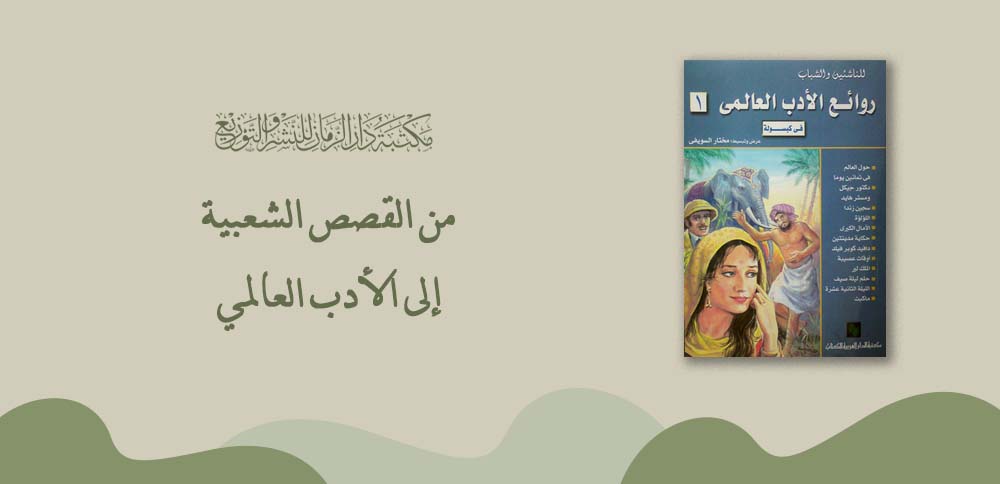
Folktales are one of the oldest forms of human expression, a mirror that has reflected the conscience, history and beliefs of peoples throughout the ages. Through these tales passed down orally, a literary identity crystallized that combined wisdom and simplicity, and laid the first foundations of what we know today as folk tales to world literature, as these tales moved from the boundaries of local communities to the common literature of humanity. Folktales have been the bridge over which cultures have crossed from the world of storytelling to the world of written literature, preserving their original spirit and adapting them to modern artistic frameworks.
Many are looking into the secrets of this transformation: How did these stories move from their narrow local environments to become an integral component of a global literature that is rich in forms and styles? In a time when cultural exchanges are accelerating and literatures are opening up to each other, this question is becoming increasingly important.
From folktales to world literature?
Folktales contributed to shaping the contours of world literature through their profound role in conveying human values and shared experiences between cultures. These tales were not just narratives for entertainment, but a means of instilling moral concepts and ideals that became part of human identity everywhere. They contributed to the emergence of a culture of literary interaction between peoples, paving the way for the emergence of what is known as civilizational cross-fertilization in world literature, where influences and contents converge across time and space.
What values do folktales convey?
Folktales conveyed a wide range of values that are still echoed in modern world literature, reflecting the long journey of transformation from folktales to world literature. They instilled the concepts of courage in the face of the unknown, wisdom in dealing with difficult situations, fairness as a basic human value, as well as altruism and sacrifice for the sake of others. These principles were transmitted from oral tales to novels, plays, and poems, becoming part of the moral and literary structure that expresses the common human experience and proves that the roots of world literature are deeply rooted in human folklore.
How did symbols and narrative concepts emerge?
Modern literature relied on the symbols and narrative structures established by folktales centuries ago. Repetition emerged as a tool to deepen the idea and anchor it in memory, verbal dialog emerged as a way to bring characters closer to the reader, and the transition between reality and imagination was used to weave worlds that transcend the boundaries of physical reality. These ancient narrative techniques were the basis from which modern narrative techniques, such as multiple narrators and overlapping times, evolved, giving world literature greater depth and comprehensiveness in expressing the human experience.
What are the most prominent examples of direct impact?
The influence of folklore on world literature is evident in many major works of literature. For example, Robinson Crusoe's adventures were inspired by the stories of legendary sailors such as Sinbad, while The Thousand and One Nights was a global literary model after it was translated and spread in Europe, where writers and thinkers were influenced by it in the construction of their own narrative works. Through these examples, it is clear that folk tales were not just a local heritage, but a cultural bridge through which humanity crossed from folk tales to world literature, opening up new horizons for literature to express and create shared human creativity.
How did folktales make their way into international literature?
The transmission of folktales from ancient civilizations to world literature began when Eastern tales crossed borders, reaching Europe from India, Persia, and the Arab world. This cultural interaction was more than just a transfer of texts, it was a gateway for the exchange of symbols and narrative styles that profoundly influenced Western literature. With the expansion of communication and technology, this exchange has continued in new forms, with ancient tales reworked to fit the zeitgeist and remain present in literary creations around the world.
How did cultures cross-pollinate?
Cultural cross-fertilization between East and West took place through translation, trade, and civilizational friction, which helped transfer values, symbols, and myths from folk tales to world literature. Indian, Persian, and Arabic influences were reflected in the creation of new fictional characters and diverse narrative styles that gave Western literature a humanistic depth and a world of rich Eastern symbols. This cultural interaction created a common space between the Eastern folk tale and the modern Western narrative, embodying an important stage in the evolution of human literature through the ages.
What is the role of translation and publishing?
Translation and publishing have played a pivotal role in the transition of literature from folktales to world literature, helping traditional tales reach different cultures and inspire writers in the East and West. The translation of “One Thousand and One Nights” was particularly important, as it opened Western readers to a world full of wonder, magic, and realism mixed with fantasy. The ease of printing and circulation of books contributed to the spread of these works and the adoption of their elements in European novels, making the influence between cultures reciprocal and continuous through the ages, and proving that human literature stems from common tributaries that have their roots in the first folk stories.
Have children's literature and narrative nonfiction been affected?
Children's literature and nonfiction have been heavily influenced by folktales, which have provided a fertile foundation for children's literature and modern adventures. Children's writers drew on folklore to inspire values of goodness and courage, while realist novelists utilized the structure of the folktale to construct a simple yet symbolism-rich narrative. With the development of modern media, these stories have continued to appear in multiple forms, maintaining their renewed impact on world literature.
What are the best books that combine folklore and world literature?
Advance Dar Al-Zaman Publishing and Distribution Library A selection of books that exemplify the intersection of folklore and world literature, giving readers a chance to discover the narrative diversity between human heritage and modern literary fiction.
Back to the nest and other stories
is a “Back to the nest and other stories”From the Arabic Language by Marwan Kadri Makansi is a work that honestly expresses the details of daily life and its human and social concerns. The stories combine the realism of the Arab scene with the depth of literary reflection, in a simple Arabic language that blends warm descriptions and symbolic imagination. In this work, the presence of authentic Arab values and behaviors is highlighted through scenes that pulsate with emotion and human experience.
The book features an artistic design that reflects the symbolism of the “nest” as a space of safety and nostalgia, with good paper and clear printing that makes reading comfortable and smooth. It is available through Dar Al-Zaman's bookstore for those interested in modern Arabic literature and social stories.
PYGMALION “YORK” CLASSICS
The play comes “Pygmalion”From the Literature and Biography George Bernard Shaw's “YORK CLASSICS” is one of the world's most important works of classic literature. It satirizes issues of identity and social transformation through a plot that combines the realism of British popular life with a philosophical reflection on human relationships.
The book is written in plain English for all levels and comes in a medium-sized paperback, making it suitable for lovers of theater and classical Western literature who seek to understand the intersection between universal folk narrative and notions of social justice and human dignity.
From Folktales to World Literature FAQs
Who are some of the most popular storybooks?
Kalila and Dimna is one of the most famous books of ancient stories that adults and children have enjoyed reading throughout the ages. The tales are told through the voices of animals, combining fun and deep thought, as they carry wisdom and moral lessons, which the author formulated in an interesting storytelling style that made it move from folklore to international literature.
What is a folk tale in literature and examples of them?
A folktale is an oral tradition that originated before the advent of writing and was passed down by word of mouth through generations, forming the basis of the collective imagination and cultural memory of nations. It includes genres such as fairy tales, fantasy, trickster tales, and ”why stories,” which symbolically explain natural phenomena or human situations. These genres were the first building blocks in the transition from folktales to world literature, from tales told by grandmothers in councils to written works that inspired writers around the world and shaped the contours of a common human literature.
What are the most popular folk tales?
Some of the most prominent Arab folk tales that are still present in the cultural memory: Abu Zayd al-Hilali, which epitomizes Arab heroism, I Ate the Day I Ate the White Ox, which instills the meaning of solidarity, Umm al-Sabiyan, which has a mythological character, and Ahl al-Khatta, which bears the features of the popular Sufi heritage.
From folk tales to world literature, the journey of human narrative unfolds in a path that combines the spirit of local communities with the depth of shared values among peoples, forming a vibrant cultural fabric, in which the simple tale with its traditional roots meets the vast horizon of human literature, in a constant continuation of creativity and renewal.
Read more: