

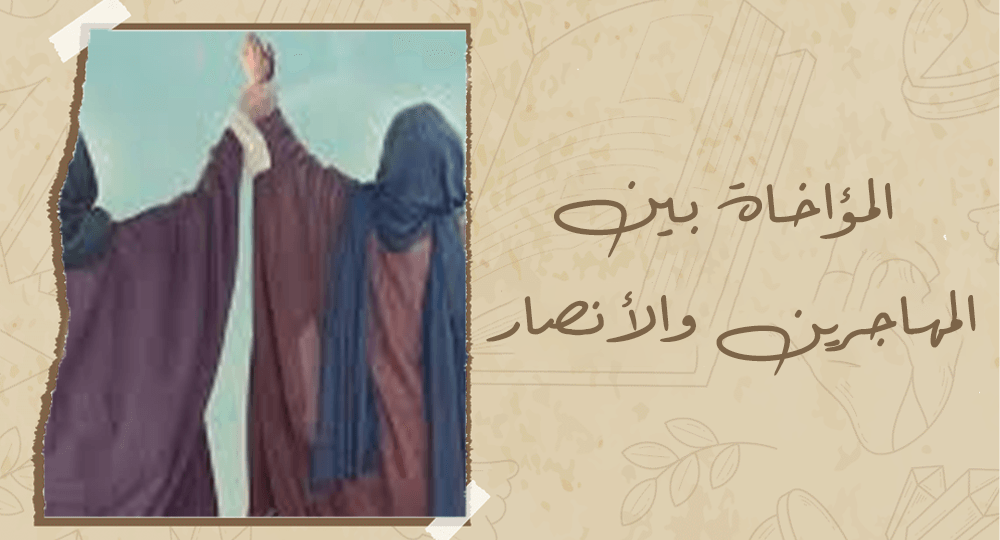
When we read about the brotherhood between the Muhajireen and the Ansar in Medina, we see how that historical moment turned into a milestone in the march of the Islamic nation. It was more than a mere social relationship; it was a practical embodiment of solidarity and altruism, as the Prophet (peace be upon him) planted the roots of a new society based on cooperation, justice and solidarity. Through the brotherhood between Muhajireen and Ansar, a formula of coexistence was born that transcended individual interests and made diversity a strength and difference a richness.
In this article, we will dive into the details of the brotherhood between the Muhajireen and the Ansar, to understand its meaning and its deep dimensions. We will examine the motives of this wise move, and the religious, social, and economic effects it had on the lives of the early Muslims.
What is the brotherhood between the Muhajireen and the Ansar?
The brotherhood between the Muhajireen and the Ansar was a unique prophetic measure aimed at building a strong bond of brotherhood between the Companions from Mecca and the Ansar from Medina. This step was not just an emotional directive, but a practical establishment of a new society based on cooperation and altruism, away from the tribalism that was entrenched in the Arabian Peninsula.
The narrations documented that this fraternization included a specific number of companions, up to forty-five immigrants and forty-five Ansar, and the Prophet renewed this fraternization whenever a new immigrant came to Madinah, making it an ongoing tool to promote cohesion and unity within the nascent Islamic community.
When did the fraternization begin?
The fraternization began in two stages; the first took place in Mecca when the Prophet (peace be upon him) fraternized among some of his companions before the migration, and then the larger and deeper stage came after his arrival in Medina, where the fraternization was made between the emigrants and the Ansar as a necessity to unite hearts and gather the word in a new society facing internal and external challenges.
How did the fraternization take place?
The fraternization took place in a direct and organized manner, as the Prophet (peace be upon him) would introduce a man from the Muhajireen and a man from the Ansar into a fraternal relationship that would bind them as brothers, in a public council in the presence of the Companions. Sources mention that this scene took place in the house of Anas ibn Malik, where this strong bond that broke social and tribal differences was established, making fraternity a firm basis for unity and solidarity.
What is the social and religious role of fraternization?
The brotherhood between the Muhajireen and the Ansar was not just a fleeting relationship, but a practical experience that melted the community into a solid unity and removed the barriers between the people of Mecca and Medina. Among its most prominent social benefits:
- It abolished the distinction between Muhajireen and Ansar; there was no longer a difference between Meccans and Ansaris, but everyone embodied the spirit of the one community.
- It bridged economic and social disparities, as supporters provided migrants with safety, shelter, and the money or resources they needed.
- The Ansar shared their homes and money with the Muhajireen, and shared agricultural crops and palm trees with the Muhajireen.
- It promoted the values of altruism, love, and mutual aid, as the Ansar sometimes put their own interests ahead of their own, and were a living example of solidarity.
What are the religious implications?
In religious terms, fraternity established the concept of faith-based brotherhood that transcends any bond based on blood or tribe. The texts of the Qur'an and Sunnah also indicate that true loyalty is to religion and to God and His Messenger. In the beginning, the law allowed a brother to inherit from his brother in the brotherhood, emphasizing its legal strength, but this was superseded by the provisions of inheritance when society stabilized and strengthened.
For example, the Muhajireen and Ansar began to put sacrifice for the sake of Allah above any tribal affiliation, so loyalty shifted from tribalism to faith, and fraternization was a solid step in building one cohesive nation.
What are the economic and political dimensions of fraternization?
Having left their money, trade, and homes in Mecca, the migrants to Medina were in a real economic crisis, finding themselves in an agricultural environment that differed from their previous experience in trade and markets. It was not easy for them to acclimatize to farming right away, which made their need for support urgent.
This is where the role of the Ansar emerged, who made financial contributions and offered to share their palm trees and crops with their immigrant brothers, and some of them suggested dividing the fruits of the palm trees between them. This complementarity united the migrants' commercial experience with the Ansar's agricultural experience, and there was a practical cooperation that created a kind of balance in the sources of income and production.
This fraternity was not just social solidarity, it was an equalization of living disparities and a system of economic solidarity that made the Muslim community more resilient and able to cope with poverty and deprivation.
What impact does it have on the power of the state?
The political dimension of fraternity was no less important than the economic aspect, as fraternal ties turned into a real force that strengthened the emerging state in Medina. The cohesive unity of the Muhajireen and Ansar made them more capable of facing external threats, whether from the Quraysh or from groups that were hostile to the state, such as some Jews.
The brotherhood turned the Islamic community into a single body, operating with a unified policy and a clear approach, which allowed the state strong social resilience in the face of challenges, and the ability to make political decisions without fear of division or gap between its various components. With this cohesion in place, the state was established on solid foundations that enabled it to deal with internal and external dangers simultaneously.
How is fraternization reflected in everyday life?
- The Ansar offered to share their money and palm trees with the migrants so that they would not feel deprived.
- Sharing houses and housing, so that those coming from Mecca can find a shelter to ease the feeling of estrangement.
- Cooperate in daily chores and share in their livelihood, including earning, earning, and serving.
- Sharing in joys and sorrows, so that both parties feel the spirit of one family.
How has it affected personal relationships?
The brotherhood created a unique state of spiritual and human proximity, not only in terms of material assistance, but also in terms of advice, consolation, and moral support. The immigrant came to feel that the Ansari was a true brother who shared the details of his day and supported him in times of need, creating a bond based not on interest but on love and common faith. These ties melted tribal differences and opened the way for a deeper relationship based on affection and loyalty.
What are the consequences of fraternization for community stability?
Fraternization was a key pillar in transforming the city from a place of residence to an inclusive homeland. The immigrants went from feeling nostalgic and alienated to a sense of belonging and security as the Ansar welcomed them like family. This transformation made the community more stable and cohesive, as old cliques receded and were replaced by the values of cooperation and unity. As a result, the new Islamic society became a unique model in which relationships were built on brotherhood and faith rather than narrow ties and social differentiation.
What are the best books about the brotherhood between Muhajireen and Ansar?
When you are looking for specialized and reliable books that deal with the brotherhood between the Muhajireen and the Ansar and the historical and social details associated with it, the Dar Al-Zaman Publishing and Distribution Library It is one of the most prominent destinations that offer this type of literature. It combines heritage books with modern studies, providing researchers and interested parties with a renewed wealth of knowledge.
Home and Home - A Gazetteer of the Construction of the Emigrants, Ansar and their descendants
Prepare The Book of Homes and Homes - Gazetteer of Muhajirin, Ansar and their descendants by Dr. Abdullah bin Nafi al-Saloumi from the Department of Languages An important reference that combines a linguistic and geographical character. It documents the locations where the Companions of the Emigrants and Ansar and their descendants lived between Mecca and Medina, and adds a distinctive visual dimension through sketches of the Haramain and caravan routes. You will find accurate data on the valleys and geographical areas that embraced that generation, making it a rich scholarly work that provides the reader with a clear picture of the environment in which the fraternization took place. The elegant paperback cover gives it a distinctive presence on library shelves.
The Prophet's Guide to Social Change
As for the book The Prophet's Guide to Social Change by Hanan Laham, which comes from the Book collections The book takes readers towards the intellectual and social dimension of the Prophet's biography. It analyzes how the biography brought about a radical change in the society of the Companions in a gradual and deliberate manner, and explains the mechanisms of reform that started from the values of fraternity and solidarity. The clear analytical method makes it suitable for researchers and those interested in studying societal change from a practical and applied perspective, as it opens the way for a deeper understanding of how to build a cohesive society on the foundations of mercy and fairness.
How did the brotherhood between the Muhajireen and the Ansar come about?
The documentation of the fraternization between the Muhajireen and the Ansar did not come from a single source, but from a wide network of books of biography, hadith, and maghazi. Among the most prominent of these sources are:
- Ibn Hisham's biography which has preserved for us minute details of migration and the beginning of the new civil society.
- Ibn Saad's layers who compiled the biographies of the Companions and reported the news of the fraternization by their names and roles.
- Sahih Bukhari And the authentic hadiths that emphasize the bonds of brotherhood between Muhajireen and Ansar.
- Al-Tirmidhi Mosque who relayed various accounts of this prophetic initiative.
- Imam Ahmed's Musnad It contains narratives that support the historical and practical context of fraternization.
- Opening the albari Ibn Hajar, who provided extensive commentaries on the hadiths and related them to the data of the biography.
- Narratives of Ibn Abdulbar and Ibn al-Jawzi which enriched the details and deepened the historical understanding.
- Maghazi books, in addition to his Yaqut al-Hamawi in Lexicon of Countries The geographical descriptions helped paint a clearer picture of migration routes and the landmarks associated with them.
This collection of sources contributed to memorizing names, identifying the first urbanization points in the city, and drawing the social and geographical picture that surrounded the fraternity.
What is the geographical context of fraternization?
The geographical context played a pivotal role in understanding the brotherhood, as it was directly linked to the events of the migration from Mecca to Medina. The road between them was marked by prominent stations such as Jahfah, which was an influential station in the course of events. The economic differences between the commercial Mecca and the agricultural Medina were also reflected in the nature of the integration between the Muhajireen and the Ansar. This geographical dimension was not just a road detail, but revealed how the Companions were distributed in the homes and farms of the Ansar, and contributed to clarifying the practical picture of brotherhood as an extension of the migration movement and the process of building the new society.
Frequently Asked Questions about the fraternization between Muhajireen and Ansar
What is the fraternity that the Prophet Muhammad (peace be upon him) made?
The brotherhood was a great legislation aimed at building a true bond of brotherhood between the immigrants who left their homes and wealth in Mecca and the Ansar who received them in Madinah. This fraternization took place in the house of Anas ibn Malik (may Allah be pleased with him), where the Prophet (peace be upon him) fraternized between forty-five immigrants and forty-five Ansar, bringing their number to ninety companions who were bound by a bond of brotherhood that transcended the boundaries of lineage and tribe.
Why did Islam abolish inheritance in fraternization?
However, after the revelation of the verses of inheritance, which determined the shares of eligible heirs, this provision was annulled, and brotherhood remained in its spiritual and moral sense only. Thus, the relationship turned into solidarity, support and affection, without any jurisprudential implications such as inheritance or marriage contract.
A picture of the brotherhood between the Muhajireen and the Ansar?
One of the most prominent forms of fraternity is giving sincere advice, consoling in times of adversity, and cooperating in daily life affairs. Salman al-Farisi used to recommend Abu al-Darda'a to be moderate in worship and good cohabitation, and the Ansar shared housing and money with the Muhajireen and opened their homes and hearts to the Muhajireen. These ties embodied the meaning of fraternity in its clearest practical form.
The brotherhood between the Muhajireen and the Ansar was not just a passing organizational move, but a social, religious and economic base that laid the foundations of the first cohesive Islamic society. This unique model embodied the values of coexistence, unity and solidarity, and remains a timeless example to be followed in building Islamic societies on the foundations of brotherhood and mutual support.
Read more: