

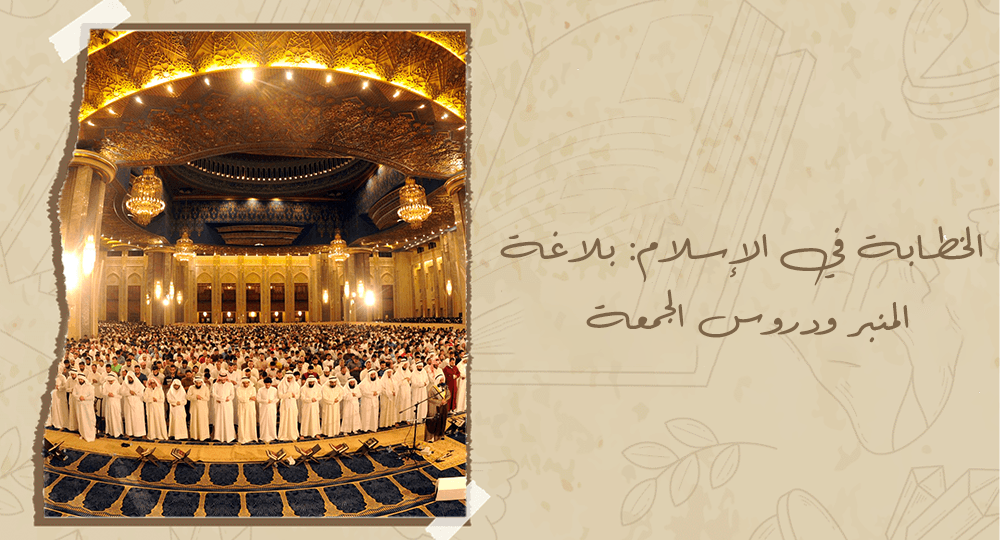
Have you ever felt the impact of a Friday preacher addressing hearts before ears? Oratory in Islam: The eloquence of the pulpit and Friday lessons is not just words, but an integrated art that combines an effective word, deep thought, and a noble goal. Since the dawn of Islam, the sermon has been a living means of spreading religious values and strengthening faith, carrying a message of reform and an invitation to reflection and action. It is the gateway that connects the Muslim to the essence of his message and unites ranks around the principles of truth and goodness.
Since the time of the Prophet Muhammad, oratory has occupied a pivotal place in the life of Islamic society; it has been a weapon for moral and social change, a platform for enlightening minds and revitalizing hearts. Today, Friday sermons remain an essential means of building religious awareness and fostering a sense of collective responsibility.
What is the role of public speaking in Islam? Rhetoric from the pulpit and Friday lessons?
Oratory in Islam: The eloquence of the pulpit and Friday lessons is not only a means of preaching, but it was one of the first tools of communication that influenced people since the dawn of the call. The Prophet relied on the truthful word and the purposeful pulpit to explain the fundamentals of the faith and refute the beliefs of the Jahiliyyah in a manner based on data, argument and good advice. The sermons would reshape the faith consciousness of the community and instill the values of monotheism, justice, courage, and altruism.
It is a bridge between religion and daily life, a means of social reform and moral building, and a platform that motivates action and jihad in the way of God. Through the eloquence of the pulpit, sermons became a school for educating people, disciplining souls, and igniting faith in hearts.
How did public speaking begin in the Prophetic era?
Oratory in Islam: The Eloquence of the Pulpit and Friday Lessons in the Prophetic Era with the revelation of the revelation and the beginning of the call, where the Prophet addressed the people in their own language, in a style that combines statement, persuasion, and mercy. The sermon was not just a flowery speech, but a concise and profound message that addressed issues of faith, behavior, and society. The Prophet's sermons were characterized by clarity, sincerity, and a balance between emotion and reason.
- The Prophet (peace be upon him) used oratory to stabilize the faith and purify the heart from the impurities of polytheism and ignorance.
- His sermons were a means of exposing the injustice of jahiliyyah and establishing the values of justice and equality.
- He motivated his companions to patience, jihad, and exertion in the way of Allah.
- He made it a platform for correcting behavior and guiding the nation towards virtuous morals.
How did public speaking after the Prophet's time?
Oratory continued after the time of the Prophet (peace be upon him) as a platform to express the conscience of the nation and evaluate its course in different eras. Caliphs and governors used it to clarify the rights and duties between the ruler and the ruled, and to instill a spirit of unity and obedience in the face of strife and crises. Speeches also became a means of disseminating Islamic rulings and legislation, and establishing principles that protect society from division and deviation.
Why is the Islamic pulpit so eloquent?
The rhetoric of the pulpit in Islam is based on an elaborate combination of power of statement, beauty of phrase, and clarity of thought, where brevity is combined with deep impact on the hearers. The orator does not just convey information, but seeks to touch the minds and hearts of the audience at the same time.
One of the main characteristics of this method:
- The orator uses proverbs to approximate meanings and facilitate understanding, as the proverb connects the sensible with the tangible.
- It employs mental arguments to persuade minds and establish facts in a logical manner without indoctrination.
- It relies on storytelling for its emotional impact that brings the lessons closer to the daily life of the listeners.
- He chooses effective rhetorical images that are thought-provoking and impactful, making the message more memorable.
- The speech is wise and balanced, respecting the listener's mind and conscience, without condescension or tedious repetition.
With this balance between linguistic beauty and pedagogical purpose, the pulpit becomes both a linguistic and spiritual school.
What is the role of emotional and logical influence?
Influence in public speaking in Islam: The eloquence of the pulpit and Friday lessons is based neither on emotion alone nor on abstract logic, but on a harmonious combination of the two. When the preacher addresses the conscience of the hearers with kind words and expressive images, he softens the hearts to accept the sermon, and then reinforces it with intellectual argument that solidifies intellectual conviction. This interaction between emotion and intellect makes the sermon more persuasive and makes a lasting impact on consciousness and behavior.
How does the pulpit serve community reform?
In Islam, the pulpit is not just a means of preaching, but a true social reform tool. Through his sermons, he reminds people of their real-life issues, confronts intellectual and behavioral deviations with a spirit of responsibility, and urges cooperation and collective virtues. He addresses reality in the language of positive change, awakening the collective conscience and instilling in people the spirit of reform, so that Friday sermons remain a vibrant pulpit that links religion to the daily life of Muslims.
What is the importance of the Friday sermon in society?
Friday sermons are the most important tool for teaching the pillars of religion and solidifying the meaning of faith in people's souls. From the pulpit, the preacher explains the purposes of the Sharia and presents them in a language that is close to hearts and minds, making the religious message alive and practiced in reality. When you listen to the sermon, you do not receive mere words, but lessons that link the sharia texts to everyday life. Through this pulpit eloquence, knowledge of religion is deepened and worship is rooted in correct understanding and a sincere spirit.
What is the impact of the Friday sermon on community behavior?
Oratory in Islam: The eloquence of the pulpit and Friday lessons play a direct role in educating behavior and correcting attitudes within society. It is a weekly collective reminder that calls for virtue and warns against moral and social deviations. Through the eloquence of the pulpit, the impact of the sincere word that touches hearts and awakens consciences is evident, making the Friday sermon an effective tool for reform and awareness. By repeating this regular meeting, the bonds of brotherhood among Muslims are renewed, and the common values that keep the fabric of society cohesive are reinforced. Through the sermon, each individual feels part of a single system that seeks goodness and reform, which is reflected in transactions and general morals in daily life.
How do Friday sermons contribute to meeting the challenges of the times?
When a preacher addresses the nation's current issues based on Sharia texts and practical examples, public speaking in Islam is transformed: The eloquence of the pulpit and Friday lessons becomes a platform for collective awareness and reform. It opens the discussion on the issues of the day and directs people towards the optimal Islamic position in dealing with them in a spirit of cooperation and responsibility. In this way, the sermon becomes a space for uniting ranks and building a conscious societal vision capable of facing challenges with a renewed spirit of faith.
How did Islamic rhetoric evolve?
Oratory in Islam: The Eloquence of the Pulpit and Friday Lessons has undergone a vast transformation thanks to modern technologies. Once delivered only from the pulpit of a mosque, speeches are now broadcast on radio, published on digital platforms, and viewed on video channels. This development has enabled preachers to reach diverse audiences around the world, while maintaining the spirit and authenticity of Islamic discourse. Technology has not changed the intentions, but it has given Islamic rhetoric a wider horizon for people to interact with its emotional and mental messages.
Has the function of the pulpit changed over time?
The function of the pulpit has evolved, but it has not lost its essence. From being a means of reminding principles and consolidating the unity of the Muslim community within the mosque, today it has become a comprehensive voice that extends to every home through digital platforms. The pulpit is no longer a limited space, but an intellectual platform that guides, unites, and mobilizes in the face of contemporary challenges.
For example, a preacher who used to address hundreds of worshippers in a single mosque can now reach thousands of listeners and followers on multiple continents with the same educational and religious message that reminds of principles and binds individuals and groups to the spirit of one nation.
What products specialize in public speaking books?
in Dar Al-Zaman Publishing and Distribution Library You can discover a wide range of books that serve the field of public speaking in Islam and enrich the experience of preachers and students alike. The platform is designed to be a comprehensive online space that allows for easy browsing of titles through precise categorizations and smart search options that save time and provide you with a seamless shopping experience. Some of the most noteworthy titles that are worth checking out from the Islamic Books:
Friday Sermons by Sheikh Mohammed Asfour
The book Friday Sermons by Sheikh Mohammed Asfour A practical reference for anyone interested in the art of rhetoric in Islam and the eloquence of the pulpit. It includes a collection of Friday sermons that address issues of faith, behavior, and society with a sober scientific spirit and a balanced religious approach.
The book is well organized and easy to refer to, making it suitable for use in mosques and regular classes. It also comes with a luxurious printing and an elegant classic cover that gives it a distinctive character befitting the high quality content it contains.
Hadiths of Imamate and Oratory in the Six Books
Hadiths of Imamate and Oratory in the Six Books This book provides a rich scientific material for anyone looking for a legal basis for the topics of imamate and oratory. It brings together the most important hadiths and narrations in this section from the six books, with an arrangement that makes it easy for the reader to access the information quickly and accurately.
This work is an authoritative source for preachers and researchers in Islamic affairs, allowing them to draw on well-established texts while preparing sermons and lessons.
Frequently asked questions about public speaking in Islam: The Rhetoric of the Pulpit and Friday Lessons
Who is the most famous orator in Islam?
One of the earliest and most famous examples of the art of oratory that influenced Muslims was the sermon of Qus ibn Sa'ada al-Iyadi in the Jahiliyah, which was famous for its eloquence and impact. Qus used a style that combined wisdom and sermon, and called on people to reflect on human destiny and contemplate the vicissitudes of life. His words paved the way for the birth of an influential Arabic speech that later flourished in Islam on the pulpit.
What did the Prophet say about public speaking?
The Prophet Muhammad said: “If one of you is betrothed to a woman, if he can look at what invites him to marry her, let him do so...” This prophetic saying highlights the depth of the concept of oratory in Islam: The eloquence of the pulpit and Friday lessons, as it shows the importance of clarity of intent and straightforwardness of speech. The Prophet's statement is a fine example of the use of words to communicate meaning in the shortest and clearest way.
What is the importance of the Friday sermon?
The Friday sermon is the centerpiece of the Islamic community's weekly guidance. It is a space in which faith and human values are conveyed to the community in a direct and realistic manner. Through it, the spirit of cooperation and virtue is promoted, people are reminded of their religious and social responsibilities, and the nation is alerted to the challenges it faces in its contemporary reality to remain vigilant and united in purpose.
Oratory in Islam: The eloquence of the pulpit and Friday lessons is a key pillar in building religious awareness and consolidating social values, as it is a tool that connects the mind and conscience and unites the ranks of the Muslim community around the principles of religion. Through effective eloquence and the arts of statement, the pulpit has remained an effective means of advocacy and reform, keeping pace with the developments of the times while preserving the authenticity of the message that aims to refine the soul and enrich society.
Read more:
- What is a book of heritage (al-Mawtooa)?
- What are margins and annotations? Scientists' secrets at the edges of the pages?