

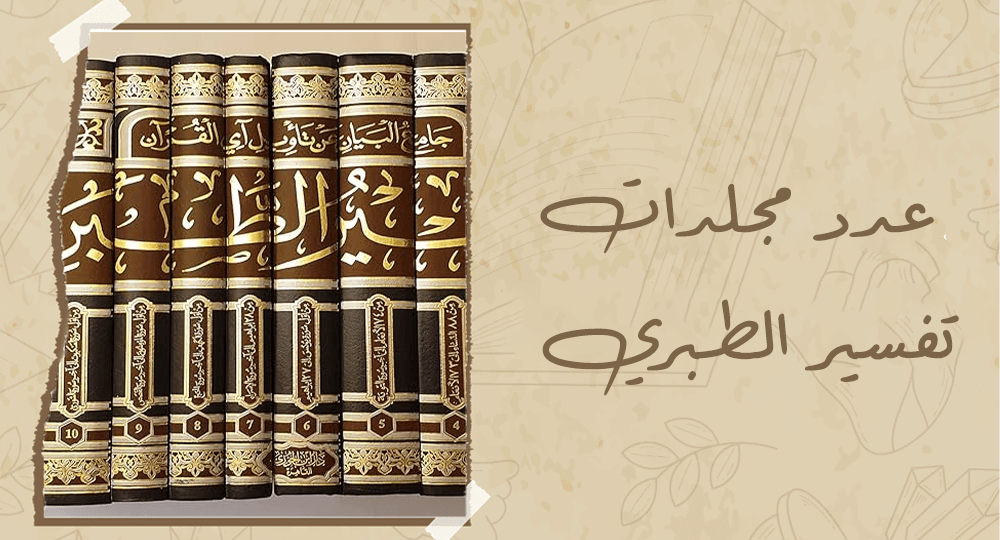
In the midst of the plethora of titles, there is one book that stands as an intellectual fortress, unshaken by the winds of time and changing tastes. “Despite the spread of rumors about Ibn Jarir al-Tabari, he surprised readers in the first pages of his interpretation; where one finds himself facing a scientist who knows how to listen to texts, catch the breath of language, and interrogate meanings as if he were writing them for the first time, but how many volumes of al-Tabari's interpretation? Is it an intellectual station that carries its reader from one era to another or are they just pages? This is what we delve into in detail in the following lines.
Number of volumes of Tafsir al-Tabari
Tafsir al-Tabari, also known as “Jama'at al-Bayan on the interpretation of the verses of the Quran,” has been printed in multiple editions, so the number of its volumes varied according to different publishing houses, font size, and numbering.
However, the edition of Dar Hajr “Cairo” is considered the most widely circulated edition because it is the most documented and investigated scientific edition, and the number of volumes of Tafsir al-Tabari is 26 volumes.
Some editions may be more voluminous, while others are abridged editions that may come in as few as 15 volumes, but lack the full text and detailed documentation.
All of these numbers are not just the number of notebooks or papers, but centuries of cumulative knowledge, and a critical and narrative approach that had few parallels in the author's time.
What distinguishes Tabari's tafsir from others?
When we talk about the greatest tafsirs in the Islamic heritage, Tafsir al-Tabari must be at the forefront of the scene, because it is the first and most comprehensive reference for the interpretation of the Holy Quran in the early centuries of Islam, not just a tafsir, and despite the large number of volumes of Tafsir al-Tabari, it is considered the best than others, for several reasons:
- The rigorous scientific method: Sheikh al-Tabari collected narrations and presentations, then weighted them in a scientific manner using language, grammar, jurisprudence, and Qur'anic sciences.
- Multiplicity of sources: Al-Tabari benefited from tafsir narratives, history books, and the opinions of grammarians and linguists, and he made his tafsir a comprehensive encyclopedia of all these sciences.
- Relying on anecdotal evidence: Al-Tabari did not interpret the Qur'an with his own opinion, but rather relied on the statements of the Salaf, the companions and followers, making his interpretation a pure mirror of the first Islamic understanding of the Qur'anic text.
- Interpretation by narration and study: Sheikh al-Tabari combined the interpretation of the verse in terms of language, context and connotation, with the narrations of the impact of the companions and followers.
- Balanced style: No doctrinal fanaticism, no deviation from the context, but all that the Shaykh was keen on was an attempt to understand the verses as they were first understood, away from late interpretations.
Dar al-Zaman Library A specific door for illumination
Tafsir al-Tabari represented a milestone in the history of Islamic exegesis, and the number of volumes of Tafsir al-Tabari al-Kabir demonstrates the depth of the scientific project that the Imam was keen to undertake in the third century AH.
At a time when there were no digital libraries and no ease of notation, he established an integrated school of tafsir that combines narration, reason, history, language, scientific humility, and a library Dar al-Zaman Here to deliver it.
In Dar Al-Zaman Library, we offer large copies of the Tafsir Al-Tabari Tafsir and volumes that will be a door to start anew, draw closer to God, and revive the light of hope, faith, and trust in God Almighty.
The end. Although the number of volumes of Tafsir al-Tabari may seem large, it is like a vast sea whose banks are unrecognizable and whose water is incalculable, like intellectual stations that take the reader on a journey from the time of the companions to the horizons of rhetoric, the depth of the Arabic language, and the paths of faith. The pages were written in ink, but they were watered with effort and vigilance to reach here.
Read more: