

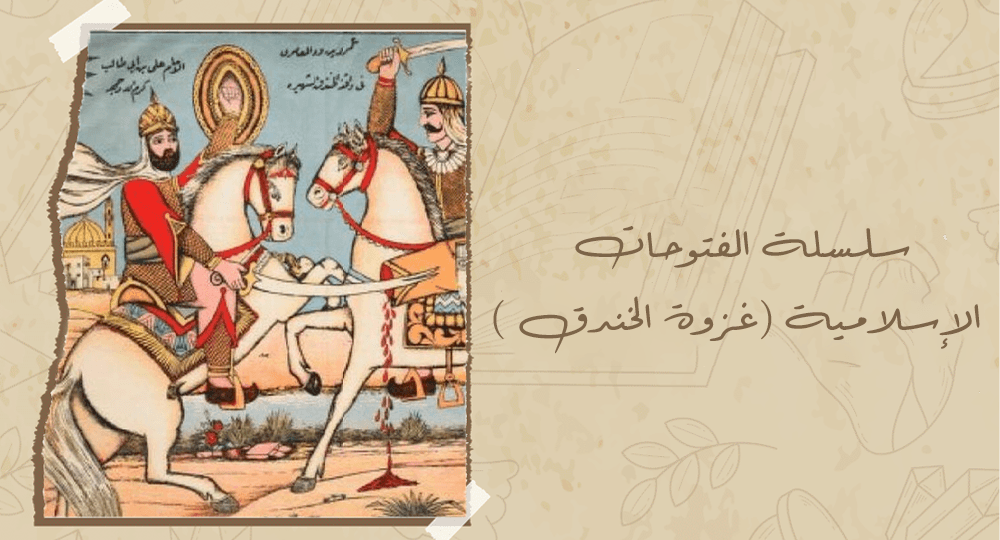
Have you ever wondered why the series of Islamic conquests (the Battle of the Trench) remains a milestone in Islamic history? This battle was not just a passing military confrontation, but a pivotal turning point in the course of the nascent Islamic state. It revealed the features of steadfastness, strategic planning, and the ability to face the siege in the harshest conditions, which made it entrenched in the memory of history as a symbol of defiance and fortitude.
If you are looking for a deeper understanding of the backgrounds of this invasion and its accelerated events, you will find in this article what will satisfy your curiosity; a knowledge journey that combines explaining the reasons that prompted it, reviewing its unprecedented events, and then highlighting the great lessons that settled in hearts and minds.
Islamic Conquests Series (The Battle of the Trench) What were the reasons for the Battle of the Trench?
The Battle of the Trench was not a passing event, but a pivotal part of the series of Islamic conquests that shaped the course of Islamic history in Arabia. It was a direct result of the accumulation of political and tribal tensions, as well as the hostility that the Muslims faced from multiple forces that came together to stop the expansion of the Islamic call. Several internal and external factors combined to lead to its outbreak, most notably:
- The Jews of Bani al-Nadir broke their covenants and attempted to assassinate the Prophet (peace be upon him), which led to their siege and subsequent expulsion from the city.
- Bani al-Nadir sought revenge after the expulsion from the city by inciting the major Arab tribes against the Muslims.
- The forces of Quraysh and the tribes of Ghutfan, Banu Asad and Sulaym joined forces to achieve a common goal of eliminating the nascent state in Madinah.
- The Quraysh felt a growing threat to their economic and religious status after the expansion of Muslim influence.
- The Jews of Bani Qurayzah joined the siege during the siege, further intensifying the threat and bringing the events to their most dangerous stage.
The invasion was inherently a defensive war, as the Muslims did not initiate combat, but rather responded to an all-out attack that targeted their very existence.
What is the role of the Jews of Bani al-Nadir?
The Jews of Banu al-Nadir played a pivotal role in the outbreak of the invasion. After their expulsion from the city as a result of their treachery and attempted assassination of the Prophet, they sought revenge in every way. They moved politically and made alliances with Quraysh, Ghutfan, and other powerful tribes, inciting them to confront the Muslims and presenting a picture that the destruction of the city would be easy if the major powers joined forces against it.
Why did the Arab tribes form an alliance?
The joining of the major Arab tribes such as Quraysh, Ghutfan, Banu Asad, and Sulaym was not a spur of the moment, but was linked to the historical context surrounding the series of Islamic conquests (the Battle of the Trench). These tribes were motivated by common interests; Quraysh saw the emergence of the Islamic state in Medina as a threat to its religious influence associated with the Kaaba and its commercial status in Mecca, as it feared that the trade routes would shift in favor of the Muslims. As for Ghutfan and the other tribes, they saw the Muslims as a rising power capable of overturning the balance of traditional alliances, and saw in their union with Quraysh an opportunity to try to stop this expansion early before it became more entrenched and widespread.
When did the Jews of Banu Qurayza join?
The Jews of Banu Qurayza joined the parties during the siege of the city, at a very sensitive moment when the Muslims were on the defensive. This sudden joining doubled the gravity of the situation, as the threat became both internal and external, bringing the invasion to its climax.
What was the trench plan like?
The idea of digging a trench came from Salman the Persian, who was inspired by his experience in Persian wars, where reliance on engineering barriers was an effective way to repel invasions. The Muslims in Medina were facing an unprecedented danger, as huge armies from the Quraysh and Al-Ahzab had gathered to storm the city. If they had resorted to direct combat, the situation would have been extremely difficult. Therefore, the first solution of its kind in Arabia was to dig a trench around the exposed parts of the city, making any attempt at a sudden break-in impossible.
What are the details of building the trench?
- The trench was about 5,000 cubits (about 2.5 kilometers) long, a massive stretch that protected the open side of the city.
- The width of the trench widened to almost 9 cubits, making it an impassable barrier even for trained horses.
- It was 7 to 10 cubits deep, too deep for infantry or cavalry to cross easily.
- All Muslims participated in the digging, in a form of collective solidarity, as they worked together, which boosted morale and united the ranks.
How did Muslims face hostile armies?
When the armies of the parties reached the city as part of the series of Islamic conquests (the Battle of the Trench), they were surprised by the trench the Muslims had dug around it, completely halting their advance. The Muslims skillfully positioned themselves behind it, relying on arrows and spears to repel any attempt to cross, which limited losses and greatly confused the enemy's ranks. Thanks to this innovative military plan, the numerical attack failed to achieve its goals and turned into a long siege that did not result in any achievement against the Muslims, but rather revealed the strength of planning and the unity of the Islamic ranks in the face of a wide coalition of tribes.
Who were the main heroes of the Battle of the Trench?
What is the role of Salman al-Farisi?
Salman al-Farisi (may Allah be pleased with him) was a milestone in the series of Islamic conquests (the Battle of the Trench), as he introduced an idea the Arabs had never known before: digging a trench as a line of defense around Medina. This unusual military plan completely turned the tide of the battle, transforming the city from an easy target for invasion to an impregnable fortress for the armies of the Partisans. Salman's advice was an example of how wisdom and experience from different civilizations can make the difference at a crucial moment, saving the Muslims from an imminent danger that threatened their existence and establishing the importance of consultation and diversity of experience in the march of the Islamic state.
How did Ali ibn Abi Talib confront Amr ibn Abdul Wad?
When Amr ibn Abdul Wad managed to cross the trench and cause anxiety in the ranks of the Muslims, Ali ibn Abi Talib rose to confront him. They fought a fierce duel that ended with Ali's victory, a victory that strengthened the resolve of the Muslims and proved their ability to stand up to their most formidable opponents despite the disparity in strength and experience.
Why is Naim bin Masoud's role important?
Naim ibn Mas'ud was a hidden card on the side of the Muslims after he secretly converted to Islam without the knowledge of his people. He used his intelligence and wisdom to create a deep division between Quraysh and Ghutfan on the one hand and Bani Qurayza on the other, which led to a breakdown of trust within the hostile alliance. This psychological and political role had a direct impact in facilitating the Muslims' victory.
What was the role of the Prophet Muhammad?
The Prophet Muhammad led the series of Islamic conquests (the Battle of the Trench) with the eyes of a wise and inspiring leader. He carefully organized the ranks of the Muslims, steadied their hearts in the face of fear, hunger, and siege, and personally supervised the digging of the trench and the details of the defense plan. He did not isolate himself from his soldiers, but was in the front rows sharing the effort and struggle with them. Alongside him stood the honorable companions with their sacrifices, such as Abu Bakr al-Siddiq, Abu Ayyub al-Ansari and others, forming an immortal school of patience and fortitude in times of adversity, proving that victory is made with faith and unity before swords and equipment.
What are the lessons of the Battle of the Trench?
One of the most prominent features of the Battle of the Trench was the Muslims' reliance on the principle of shura, which was evident in the adoption of Salman the Persian's idea of digging a trench around the city. This decision was not just a casual suggestion, but reflects the flexibility of the Islamic leadership in accepting opinions even if they come from outside the usual Arab framework.
The trench represented a qualitative shift in the style of warfare, as fighting moved from direct confrontation with swords and spears to an engineering defense method that had never been known in Arabia before, which confused the enemies and completely changed the course of the battle.
What is the impact of planning and intelligence?
The Muslim victory in the series of Islamic conquests (the Battle of the Trench) was not by chance, but rather the result of careful planning and skillful use of intelligence warfare methods. The role of the Companion Naim ibn Mas'ud (may Allah be pleased with him) emerged as one of the most important hinges of the battle, as he cunningly succeeded in sowing doubts among the ranks of the parties, sowing suspicion among the Quraysh, Bani Qurayza, and Ghatafan. This internal division dispersed their forces and weakened their cohesion, turning their great numerical superiority into a weakness that the Muslims exploited to their advantage. Thus, the value of strategic intelligence along with courage and faith was demonstrated in the trench, and history confirms that victory does not depend on numbers alone, but on unity and leadership.
How did leadership and teamwork materialize?
The Battle of the Trench highlighted a leadership capable of embracing everyone and mobilizing them in the face of the threat. The Prophet (peace and blessings of Allah be upon him) joined his companions in digging the trench, and this attitude strengthened the spirit of community and united the internal ranks. The cohesion between the leadership and the soldiers created a sense of equality and reinforced the value of collective sacrifice to protect the city.
What is the significance of faith and fortitude in battle?
The steadfastness of the Muslims in the series of Islamic conquests (the Battle of the Trench) in the face of a long siege and a huge numerical superiority was not just a passing event, but a clear manifestation of the depth of faith and the strength of fortitude. They relied on God Almighty with certainty and tawakkul, and drew from Him a multiplied psychological and spiritual energy that turned the scales of the battle. What appeared to be weakness in the face of huge allied armies turned into a source of strength that stunned the enemies and established a timeless model of will and patience in the face of the harshest conditions. Thus, the victory in the Battle of the Trench was not only a military victory, but a victory of spirit and faith over fear, hunger, and siege.
What are the best references and books about the Battle of the Trench?
When a reader or researcher wants to delve deeper into the series of Islamic conquests (The Battle of the Trench), the Dar Al-Zaman Publishing and Distribution Library It provides rich and varied references that combine historical accuracy with a visual and storytelling educational style, which makes the process of understanding and assimilation deeper and smoother. History and Geography:
Islamic battles and conquests - Miscellaneous
Islamic maps and volumes are not just aids, but visual resources that add a new dimension to understanding events and battles. Through the volume “Islamic battles and conquests” from Dar al-Zaman Library, students can trace the route of armies, places of siege, the routes taken by Muslims in the Battle of the Trench, and other events. The volume is printed on high-quality paper, making it suitable for students and researchers who need a clear geographical visualization of historical events.
Men Around the Prophet
Book “Men around the Prophet”Khalid Muhammad Khalid presents the Sahaba characters in a simple, vivid, and humanizing style that brings the reader close to their attitudes and sacrifices. It helps those interested in the early history of Islam to understand the role of the Companions in nation-building, including those who had a prominent presence during the Battle of the Trench.
Frequently Asked Questions about the Islamic Conquest Series (The Battle of the Trench)
Which tribe collaborated with the parties against the Muslims?
After the Battle of Uhud, Quraysh gathered with a number of other tribes, most notably the Jewish tribes of Banu Qurayzah, as well as tribes such as Ghutfan and Banu Asad, and formed a military alliance known as “Al-Ahzab.” Their main goal was to besiege Medina and eliminate the emerging Islamic state.
How many days did the parties' siege of the city last?
These days were filled with hardship, hunger, and fatigue for the Muslims, as they lived in harsh conditions, but their steadfastness and steadfastness were the reason for the failure of the coalition's plans.
Is Sahih Bukhari a hadith about the Battle of the Trench?
In Sahih al-Bukhari, there is a hadith that deals with the Battle of the Trench, in which there are references to the great effort that the Companions made alongside the Prophet during the digging of the trench and facing the hardships that accompanied that difficult phase.
The series of Islamic conquests shows how steadfastness and innovation can change the course of history. This battle was a model of planning genius, community spirit, and faith, and marked a pivotal stage in the consolidation of the Islamic state's strength and cohesion in the face of the most violent challenges.
Read more: